cost guides
Palm Tattoo Cost: What You'll Pay and Why It Fades Fast
Palm tattoo cost runs $150 to $500 for small pieces, but the real expense is retouching. Here's what you pay once, and what you pay again.
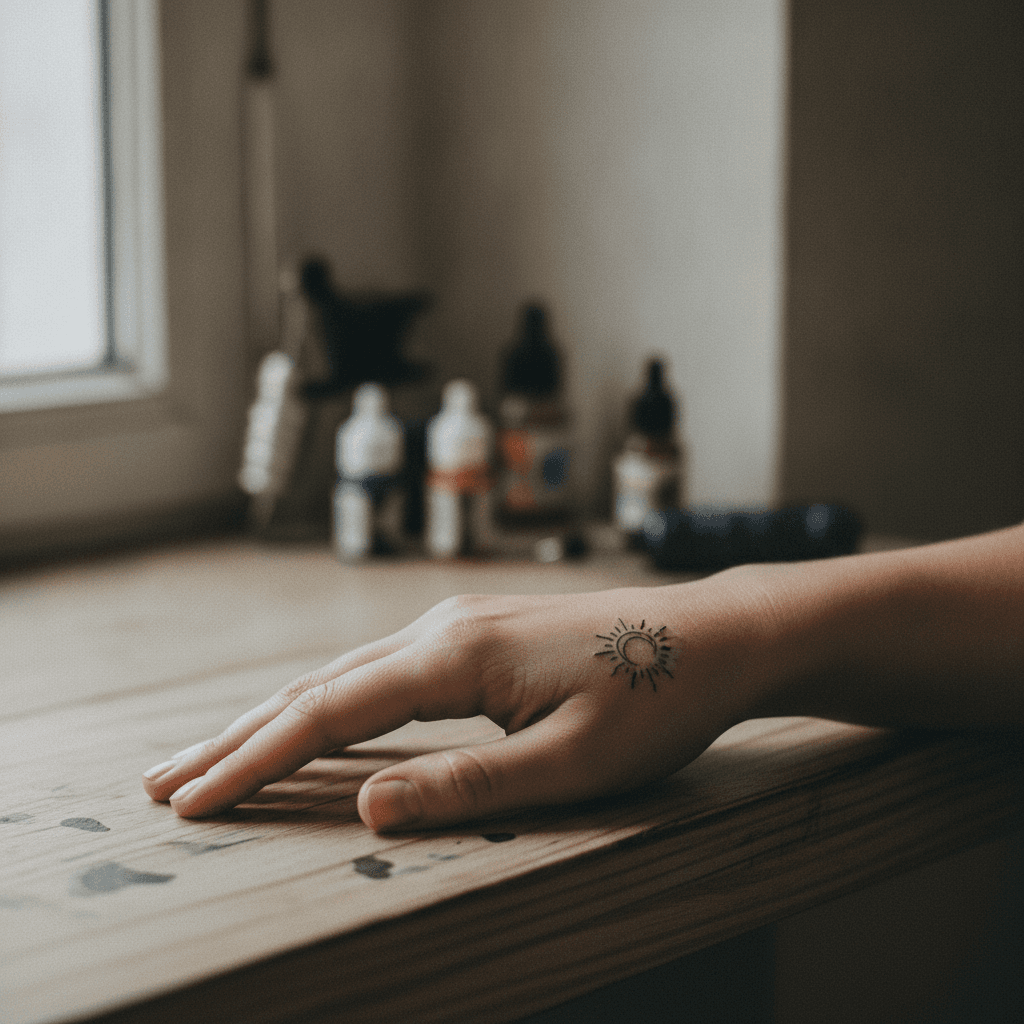
Palm tattoos look clean in the chair and chaotic six months later, which is why the real cost of one has very little to do with the first invoice. A small symbol on the inner palm starts around $150 to $300 at a reputable shop, and most sessions wrap in under an hour. The number you should actually plan around is the lifetime total, because palm skin sheds ink faster than almost any other placement on the body.
What a palm tattoo costs on the first visit
Most studios price palm tattoos the same way they price any small, detailed piece: either an hourly rate or a shop minimum, whichever is higher. Hourly rates sit between $150 and $300 at mid-tier studios in the US, and $250 to $450 at booked-out artists in cities like New York, Los Angeles, London, and Berlin. A simple palm design, think a short word, a planet, a small geometric shape, usually falls under the one-hour mark and lands in the $150 to $300 range. More intricate work, like a filled mandala or a dense sacred-heart motif, pushes the first session to $400 to $700.
Shop minimums matter here because palm pieces are small. A studio with a $200 minimum will charge $200 even if the tattoo takes twenty minutes, and that is standard. Setup time, needle changes, sterilization, and the artist's expertise are built into that floor. For a breakdown of why minimums exist and what they typically cover, our guide on tattoo minimum charges walks through the math. Expect to pay the minimum on almost any palm tattoo booked as a single-session piece.
Deposits run $50 to $150 and are applied to the final bill. Most artists require a deposit specifically for palm work because the drop-out rate on these bookings is higher than average. The deposit guide at tattoo deposit guide covers how deposits move through the booking process. If you cancel inside the shop's notice window, the deposit is forfeited.
Why palm skin burns through your budget
The inside of the hand is built to shed. Palmar skin lacks the follicles and sebaceous glands that help ink anchor in other placements, and the stratum corneum, the outer layer, turns over every two to three weeks instead of the four to six weeks typical for forearm or shoulder skin. Add the constant friction from gripping, washing, and typing, and you get an environment that pushes ink out of the dermis instead of locking it in.
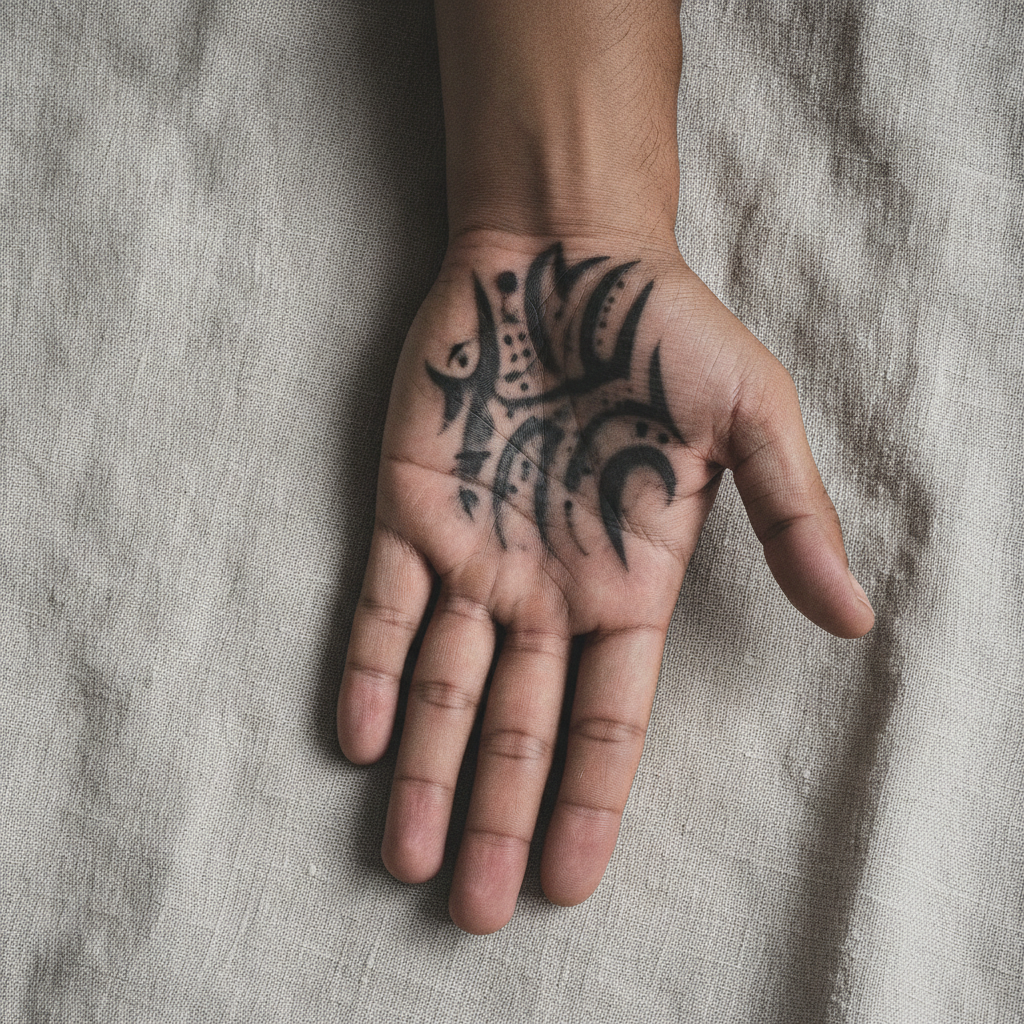
Pigment loss varies by artist technique and individual skin, but published artist estimates and healing documentation from established studios put six-month fade rates for palm tattoos between 30 and 60 percent. That means a $300 piece often looks like a ghost by the end of the first year. Compared to a forearm tattoo, which typically holds 90 percent of its density at the one-year mark, the palm is in a different category entirely. For context on how other placements age, our tattoo fading causes and prevention article maps fade rates across common spots.
Artists compensate by packing the ink denser on the initial pass, using slightly larger needle groupings, and advising a mandatory touch-up at the three to six month mark. Fine-line single-needle work on the palm is especially fragile. Thicker lines and bold black fills survive longer, which is why American-traditional and blackwork designs are the most common palm requests at experienced studios.
Touch-up pricing: the real line item
Here is where palm tattoos stop being a $300 tattoo and start being an $800 tattoo. Most artists include one free touch-up within 30 to 60 days of the original session, but that first touch-up addresses healing issues, not fade. The fade touch-up, the one you actually need, is a separate paid appointment at six months to one year.
Paid palm touch-ups run:
- $100 to $200 for simple linework redos at mid-tier shops
- $200 to $400 for detailed fills or color work
- Shop minimum, whichever is higher
Over three years, a palm tattoo owner should expect two to four paid touch-up sessions. The lifetime cost of a single $300 palm piece lands between $500 and $1,100, depending on how committed you are to keeping the image sharp. The guide on tattoo touch-up cost breaks down how shops price returning clients, and the one on when to get a tattoo touch-up covers the timing signals that tell you a session is due.
Some clients choose to let the palm tattoo fade naturally and view it as a semi-permanent piece. That is a legitimate approach and saves hundreds of dollars over the life of the tattoo, but go in with that expectation set.
What affects the quote you get
Palm pricing shifts based on five factors. Experienced artists charge more because they know how to pack palm ink for maximum retention, and that skill is worth paying for on this placement specifically. A $450 piece from a specialist often outlasts a $200 piece from a general tattooer by two years before the first paid touch-up is needed.
The five factors shops weigh:
- Design complexity: a single-line symbol vs. a filled design can swing the price by 2x
- Size: anything larger than a quarter crosses from minimum to hourly billing
- Color: color on the palm fades even faster than black and usually costs more because of ink layering
- Artist tier: resident artists at $150 per hour, mid-career at $200 to $300, booked specialists at $350 to $500
- Studio location: hourly rates in Manhattan, Brooklyn, LA, and major European capitals run 30 to 50 percent above regional averages
For a wider view of how experience level sets rates, see tattoo cost by artist experience level. It covers the apprentice-to-master range and what each tier typically delivers.
Tipping is standard. Twenty percent of the pre-tip total is the baseline at most US studios, with 15 percent acceptable for straightforward work and 25 percent appropriate for custom design time. The breakdown at how much to tip tattoo artist covers tipping conventions in different regions.
When a palm tattoo makes financial sense
Palm tattoos work best as small, graphic, meaningful pieces with simple geometry. A single word, a symbol, a short date, a planet, a minimal icon. Clients who go in understanding the fade cycle and budget for two touch-ups over the first two years tend to feel the money was well spent. Clients who want a crisp, forever-detailed piece on the palm almost always end up disappointed, because the physiology does not support that outcome regardless of artist skill.
For context on hand placement outside the palm, hand tattoo cost covers the back of the hand, knuckles, and fingers. Finger-specific pricing lives at finger tattoo cost. Both placements fade faster than forearm or shoulder work, but both hold ink significantly better than the palm itself.
The honest financial framing: a $300 palm tattoo is a $300 commitment to a one-year image, or an $800 commitment to a three-year image, or a $1,500 commitment to keeping it sharp for a decade. Pick which version you want before you book.
Frequently asked
How much does a small palm tattoo cost at a reputable shop? Expect $150 to $300 for a simple design under an hour. Shop minimums of $150 to $250 apply even if the piece takes twenty minutes. Studios in major cities and booked specialists charge $300 to $500 for the same first session.
Do palm tattoos need a touch-up and does the artist charge for it? Yes to both, usually. The first healing touch-up at 30 to 60 days is often included or free. The fade touch-up at six months to one year is a separate paid appointment, typically $100 to $400, depending on complexity and shop minimum.
Are palm tattoos more expensive than forearm tattoos of the same size? The first session is usually priced similarly or slightly higher because of the technical difficulty. The lifetime cost is significantly higher once touch-ups are factored in, often 1.5x to 3x the forearm equivalent over five years.
Does color cost more than black on palm tattoos? Yes. Color pigments fade even faster than black on the palm, so artists layer them more densely and often require two sessions instead of one. Add 30 to 50 percent to the black-ink quote for a color palm tattoo.
Is tipping expected on a palm tattoo? Yes. Twenty percent of the pre-tip total is standard in the US, 15 to 20 percent in most of Europe, and 10 to 15 percent in parts of Southeast Asia. Palm work is technically demanding and tipping reflects that.
Can I let a palm tattoo fade on purpose and save money? Yes, and some clients do exactly that. Skip the paid touch-ups and let the piece fade to a soft ghost over two to three years. That approach caps the total spend at the original session plus tip and avoids the recurring cost cycle entirely.