Tipping Tattoo Artists in Bali: Deposits & Cash Etiquette (2026)
How much to tip a tattoo artist in Bali, what deposits are normal, and why Canggu and Ubud studios still prefer cash in rupiah for the balance.
By Peachy Editorial · · 8 min read
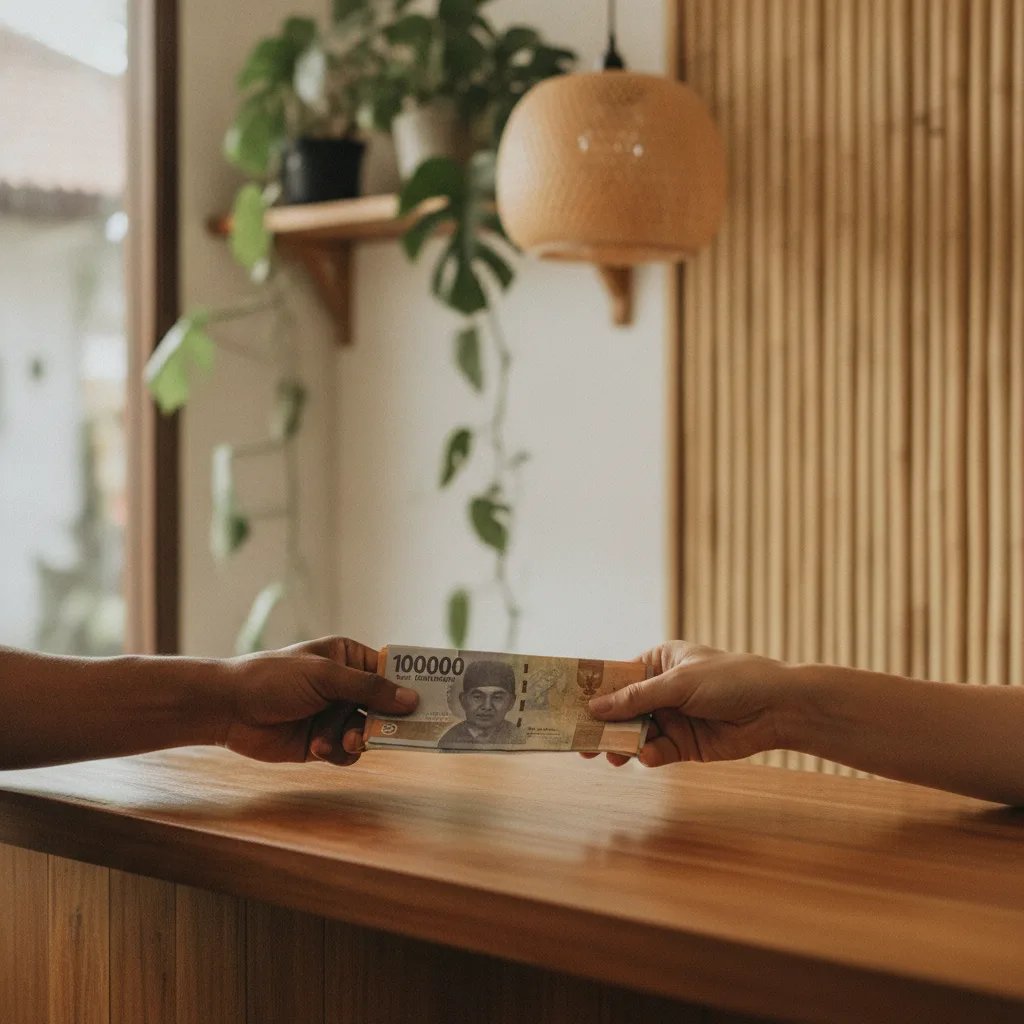
Tipping at a Bali tattoo studio is not like tipping at one in Sydney, London, or Berlin. Deposits are standard, cash in rupiah is still king, and the tip itself is appreciated but never assumed. If you are flying into Canggu, Ubud, Seminyak, Kuta, or Uluwatu for ink, this is what to expect for your wallet before, during, and after the session.
The short version: pay a 20 to 30 percent deposit to lock the booking, settle the balance in cash on the day, and add 10 to 15 percent as a tip if the work and the vibe were good. The long version has a few wrinkles worth knowing so you do not insult a good artist or get fleeced by a bad one.
Do you tip tattoo artists in Bali?
Yes, but tipping is a bonus in Bali rather than the expectation it is back home. Balinese and expat tattoo artists price their work knowing most customers will not tip, so a tip is read as genuine appreciation rather than a top-up to a deliberately low quote. That makes it more meaningful when you do leave one. It also means a no-tip is not the social crime it would be in Melbourne or New York.
Most AU, UK, and EU travellers we hear from land on roughly 10 to 15 percent of the final piece price as a tip, handed over in cash at the end of the session. Resident artists in the better Canggu and Seminyak studios have told us 20 percent is the upper end for standout work, and anything higher starts to feel awkward rather than generous. If the piece was small and the artist put real care into it, rounding up to the nearest IDR 100,000 note is also a clean, respectful move.
For broader pricing context before you tip, our Bali tattoo cost 2026 breakdown covers district-by-district rates so you know whether the base quote itself was fair.
How much to tip by piece size
Here is what tipping tends to look like in practice across Bali studios in 2026.
| Piece | Typical final price | Suggested tip (10-15%) | |---|---|---| | Small fine-line (<5cm) | IDR 800K-1.5M (~$55-100 USD) | IDR 100K-200K (~$7-14) | | Medium piece (10-15cm) | IDR 2M-4M (~$140-270) | IDR 200K-500K (~$14-34) | | Half sleeve or large back piece | IDR 8M-15M (~$540-1,000) | IDR 1M-2M (~$70-135) | | Full sleeve (multi-session) | IDR 15M-35M (~$1,000-2,300) | IDR 2M-4M (~$135-270) | | Per-hour (top Canggu/Seminyak artists) | IDR 1.2M-2M/hr (~$80-135) | Flat 10-15% at the end, not per hour |
For hourly work, tip once at the end of the final session, not after every chair-stint. For multi-day sleeves, a mid-project thank-you tip of IDR 300K-500K can be a nice touch on day two, with the main tip paid on completion.
Deposits: how much, when, and whether you get it back
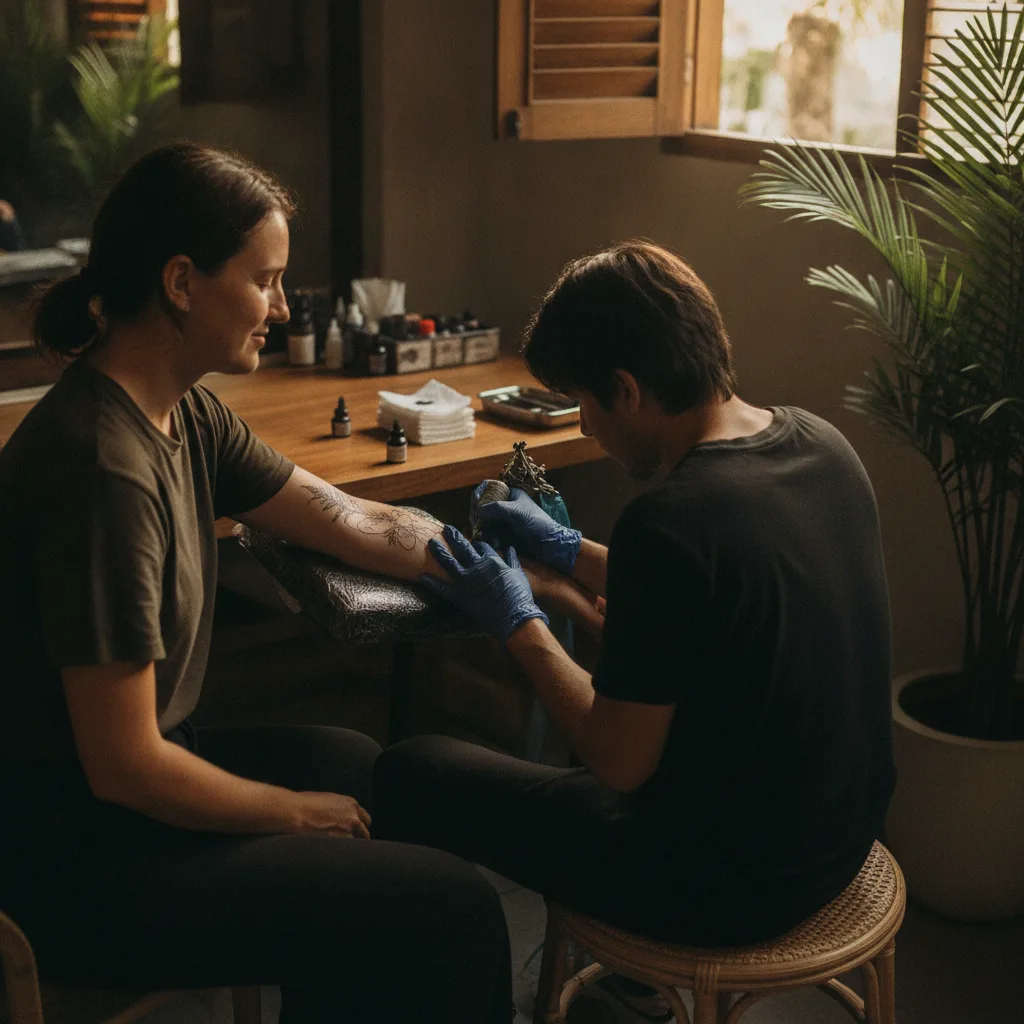
Almost every reputable Bali studio asks for a deposit to secure your booking. The standard range is 20 to 30 percent of the quoted piece price, usually paid at the time you confirm the date. Smaller studios in Kuta sometimes accept a flat IDR 500K deposit regardless of piece size, but anything that waives a deposit entirely is a yellow flag, not a perk. Artists who do not hold your time for money are often the ones with no demand for it.
Deposits are almost always non-refundable if you no-show, cancel inside 48 hours, or walk out during the consultation because you changed your mind about the design. They are refundable, or at least rolled into a reschedule, if you give 7 days notice. If an artist cancels on you, a full refund is the baseline you should expect. Get the deposit terms in writing over WhatsApp or Instagram DM before paying, because that message log is what you will fall back on if a dispute happens later.
A deposit applies to the final balance. If your sleeve is quoted at IDR 10M and you paid IDR 2M as a deposit, you owe IDR 8M on the day. Tips are calculated on the full piece price, not the remaining balance.
Cash vs card: why Bali studios prefer rupiah
Most Bali tattoo studios either do not take cards at all or add a 3 to 5 percent card surcharge on top of the final bill. The reason is simple: card processing fees in Indonesia eat into margins on what are already relatively low-ticket services by Western standards. Cash in rupiah is the default, and bringing exact or near-exact change in IDR 100,000 notes marks you as a traveller who did the homework.
Wise, Revolut, and Grab-linked Jenius accounts are the cleanest way to pull rupiah at ATMs in Bali, usually with a 1 to 2 percent total cost once you factor in the ATM operator fee. Pull enough for the balance plus tip plus a cushion before you walk into the studio, because asking to step out mid-session to find an ATM is a mild etiquette break. Larger studios in Seminyak and a growing number of Canggu spots now accept bank transfers via QRIS, which is often the smoothest option if your bank supports it.
Avoid paying the full balance in USD or AUD cash unless the studio quoted you in that currency upfront. The exchange rate you will be offered on the fly is usually worse than any ATM.
District differences: Canggu, Ubud, Seminyak, Kuta
Tipping and deposit culture shifts slightly by district, mostly because the customer base shifts. In Canggu, where digital nomads and surf-tourists dominate, tips of 10 to 15 percent in cash are common and artists tend to expect them from AU and EU clients specifically. Deposits are usually 25 percent, paid via QRIS or bank transfer. Our Bali vs Australia tattoo cost comparison has the full savings maths for Aussie readers deciding whether to book here or at home.
Ubud leans more wellness-traveller, with slightly older clients and more traditional-Balinese style work. Tips are appreciated but less reflexive, and many Ubud studios keep deposits modest at 20 percent because the walk-in business is steadier. Seminyak is the upscale end of the scale, with premium hourly rates, higher deposits (often 30 percent), and tips closer to 15 percent as the norm because the client base skews toward luxury-travel budgets.
Kuta and Legian are the budget belt. Deposits here are sometimes as low as IDR 200K-500K flat, cash is universal, and tipping is less culturally expected. The trade-off is quality variance. Our general rule: if a Kuta studio asks for no deposit, cannot show you a healed-work portfolio, or quotes a sleeve at under IDR 5M, treat the saving as a hygiene risk rather than a bargain.
Red flags: when not to tip (and when to walk away)
There are situations where a tip is simply not appropriate, and recognising them protects both your money and the health of your tattoo. Skip the tip, or in some cases skip the studio entirely, if any of these come up.
- The artist opens a used needle, reuses ink caps, or skips the single-use film wrap on arm rests. Walk out. The American Academy of Dermatology is clear that single-use equipment is non-negotiable.
- The quoted price balloons mid-session without you approving the extra work. Pay what was quoted, not the new number, and do not add a tip on the inflated total.
- The artist pressures you into a bigger or more expensive piece during the consult. A good Bali artist will often talk you down to something more appropriate, not up.
- The piece visibly deviates from the agreed stencil in ways you did not sign off on. Raise it calmly before paying, not after.
If the work was solid but the vibe was off (loud studio, rushed session, no aftercare briefing), it is fair to pay the balance and skip the tip without further explanation. You are not obligated to subsidise a bad experience, and in Bali specifically, no-tip is a signal the artist will usually read without resentment.
For what to do in the days after you pay and walk out, our guide to tropical-climate healing and sweating covers the Bali-specific aftercare rules, and the swelling and first-48-hours playbook handles the standard healing timeline.
Frequently asked
Is tipping expected at Bali tattoo studios?
Appreciated, not expected. Most artists price their work without factoring in a tip, so 10 to 15 percent in cash is a genuine bonus rather than a social obligation. A no-tip for a mediocre session is normal and not an insult.
How much deposit do Bali tattoo studios usually take?
Twenty to thirty percent of the quoted piece price, paid when you confirm the booking. Smaller Kuta studios may accept a flat IDR 200K-500K deposit. No-deposit studios are usually the ones to avoid.
Can I pay a Bali tattoo artist by card or Revolut?
Some upscale Seminyak studios accept cards, usually with a 3 to 5 percent surcharge. Most studios in Canggu, Ubud, and Kuta prefer cash in rupiah or a QRIS bank transfer. Bring cash as the safe default.
Should I tip in USD, AUD, or EUR instead of rupiah?
Rupiah is strongly preferred. Foreign cash forces the artist to exchange it at suboptimal rates, which reduces the real value of the tip. If you only have foreign notes left at the end of a trip, ask first rather than assume.
Do I tip for consultations or touch-ups?
Consultations are usually free and do not require a tip. Touch-ups within the artist's standard guarantee window (often 30 to 60 days) are also free and do not require a tip, though a small IDR 100K thank-you for their time is a kind gesture.
What is a fair tip on a full sleeve done over multiple sessions?
Ten to fifteen percent of the total piece price, paid as one lump on the final session, is the cleanest approach. Mid-project thank-you tips of IDR 300K-500K on longer sleeves are optional but appreciated.
Keep reading
- Cost Guides
Bali Tattoo Cost 2026: Canggu vs Ubud vs Seminyak Prices
A 2026 price guide to getting a tattoo in Bali, with real IDR and USD rates for Canggu, Ubud, Seminyak and Kuta, and how they compare to home.
- Cost Guides
Bali vs Australia Tattoo Cost 2026: What Aussies Actually Save
Honest 2026 Bali vs Australia tattoo cost breakdown with IDR and AUD prices across Canggu, Ubud, and Seminyak, plus when the savings actually disappear.
- Cost Guides

Rose Tattoo Cost: Pricing by Size, Style, and Placement
Rose tattoos run from $80 for a tiny flash piece to $2,500+ for a detailed color back piece. Here is what actually drives the price.