cost guides
Knee Tattoo Cost: Pricing, Pain, and What Artists Charge
Knee tattoos run $200 to $1,200 depending on size and style. Here is what artists actually charge, why kneecaps cost more, and what to expect during the session.

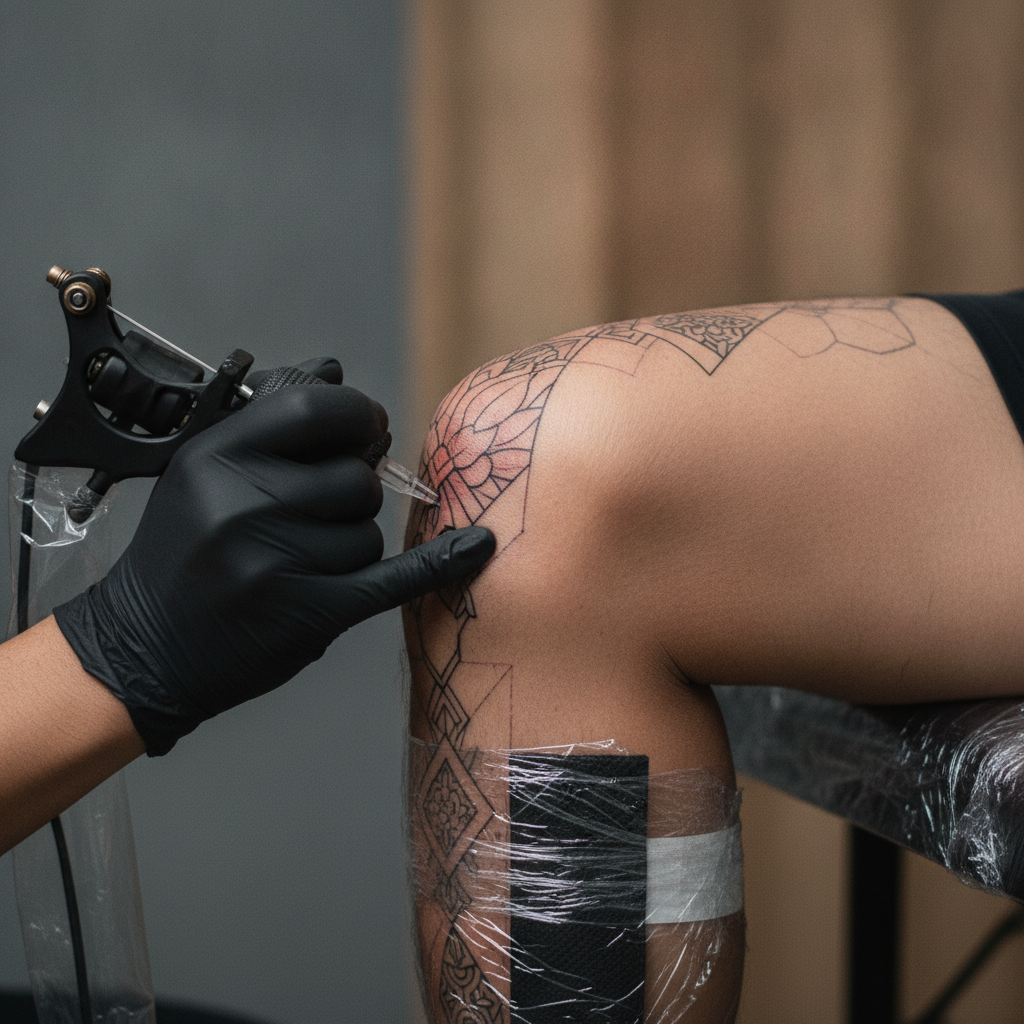
Knee tattoos sit in an odd pricing bracket. The skin is thin, the surface curves in two directions, and the joint bends every time you shift in the chair. That combination pushes most artists to charge a premium on top of their standard hourly rate, and it changes how you should budget for the piece.
What a knee tattoo actually costs in 2026
Expect a working range of $200 to $1,200 for a single knee, with most pieces landing between $400 and $800. A small ornamental cap piece the size of a golf ball runs $200 to $350 at a mid-tier shop. A full kneecap mandala or geometric spread that covers the patella and wraps slightly onto the upper shin sits in the $500 to $900 window. A dense blackwork or realism piece that extends above the knee and integrates into a leg sleeve pushes past $1,000 and often past $1,500 once the surrounding skin is considered.
Hourly rates for artists who take knee work run $150 to $300 per hour in most US cities, with named artists in New York, Los Angeles, and Austin charging $250 to $450. Flat-rate quotes on knees are common because artists know the session will run longer than a comparable piece on the forearm. A design that would take two hours on a bicep often takes three on the kneecap due to stretch, wipe frequency, and the need for repeated line passes on skin that will not hold ink evenly.
Why kneecaps carry a difficulty premium
The patella is one of the hardest surfaces on the body to tattoo well. The skin over the kneecap has almost no fat underneath, which means the needle hits bone-adjacent tissue almost immediately. Ink tends to blow out or drop out during healing because the skin heals unevenly across the curved surface. Most experienced artists add a 20 to 40 percent premium to knee work compared to a flat-skin piece of the same size, and some refuse to price knees hourly because they cannot predict how many touch-up sessions will be needed.
The bend also matters. Every knee tattoo lives on skin that folds and stretches thousands of times a day, which accelerates line softening and color fade compared to a shoulder or thigh piece. Artists who specialize in blackwork tattoos tend to price knees more aggressively because thick black linework holds better on this placement than fine detail. Compare that to a fine-line tattoo, where the artist may quote higher on a knee specifically because they know they are committing to a free touch-up within the first year.
Price by style
Style choice on the knee moves the number as much as size does. Here is what to expect at a mid-tier shop with a resident artist charging $200 per hour:
- Small ornamental or dotwork piece on the kneecap: $250 to $450
- Geometric or mandala kneecap centerpiece: $500 to $850
- Blackwork spider web or radial design: $400 to $750
- Fine-line floral or script wrapping the knee: $500 to $900, plus expected touch-up
- Neo-traditional or American traditional knee panel: $600 to $1,000
- Full color realism or biomechanical piece: $900 to $1,800
A neo-traditional knee panel usually costs more than a comparable blackwork piece because the color packing takes longer and often requires a second session for saturation. Realism and portrait work on knees is rare and expensive, mostly because few artists will guarantee the result on skin that heals this unpredictably.
Session length and what runs the clock
A small kneecap piece takes two to three hours. A full knee panel that wraps slightly onto the calf or thigh takes four to six hours and is usually split across two sessions to give the skin recovery time. Artists slow down on knee work because they wipe more often, reposition the client's leg to keep the skin taut, and take breaks that they would not take on a forearm session.
Booking a longer session does not always save money on knees. Many artists cap knee sessions at three or four hours because the client cannot hold the position comfortably beyond that, and cramped or shifted skin produces uneven line work that costs the artist reputation. If you want a large design, plan on two sessions of three hours each rather than one six-hour marathon.
Touch-ups, healing, and hidden cost
Budget for at least one touch-up. Roughly 60 to 80 percent of knee tattoos need a touch-up in the first year, and most reputable artists include one free session within six months of the original work. If you wait past that window, expect to pay $80 to $200 for the touch-up depending on the artist's rate and how much needs to be redone. Full color repacks on knee pieces can run $200 to $400.
Healing takes longer on knees than on flatter placements. Two to three weeks of visible peeling and scabbing is normal, and the deep healing continues for three to four months before the piece settles into its final look. During that window, you should avoid squatting, running, and long hikes, which is a real cost if the tattoo interrupts training or work. Read the tattoo healing timeline day-by-day if this is your first placement over a joint, and check the aftercare guide for tattoos over joints before you book.
Tipping and total budget
Tip 20 percent on the pre-tax total, same as any other tattoo. On a $700 knee piece that means adding $140, which pushes the real out-of-pocket to $840. If you are also covering deposit and design consultation fees, add another $50 to $150 up front. A realistic all-in budget for a mid-sized knee tattoo at a mid-tier shop is $900 to $1,100 including tip, deposit, and one paid touch-up if you miss the free window.
Frequently asked
Do knee tattoos hurt more than other placements?
Yes. The knee ranks in the top three most painful placements alongside the sternum and ribs, mostly because the skin is thin and sits directly over bone. Pain intensity peaks on the kneecap itself and drops off slightly on the surrounding soft tissue above and below the patella.
How long should I wait between knee sessions?
Wait at least four to six weeks between sessions on the same knee. The skin needs to fully close and the deep tissue needs to settle before another needle pass, and going back too early causes blowouts and patchy healing. See the guide on how long between tattoo sessions for a full breakdown.
Are knee tattoos more likely to blow out?
Yes, blowouts are more common on knees than on flat placements because the skin is thin and the artist is working over a curved bony surface. Choosing an artist with specific knee experience cuts the blowout risk significantly, and thicker line weights hold up better than fine detail.
Can I get a knee tattoo as my first tattoo?
It is possible but not recommended. The pain level, longer healing, and higher touch-up rate make knees a poor first placement. Most artists will steer a first-timer toward the thigh or calf and suggest returning for a knee piece after one or two easier sessions.
Does insurance or the shop cover a failed knee tattoo?
No, tattoos are not insurable and shops do not refund failed pieces. Reputable artists will offer a free first touch-up if the fault is on their end, but ongoing repair sessions on a knee that heals badly are on the client. This is the main reason to pay for an experienced artist rather than the cheapest quote.
How much does removal of a knee tattoo cost?
Laser removal on a knee costs $75 to $300 per session and typically takes 8 to 15 sessions for full clearance. Total removal budget lands between $800 and $3,500 depending on ink density and color. See the tattoo removal cost guide for a full comparison across placements.