style guides
Fine Line Tattoos: Style Guide, Real Costs, and How They Age
Fine line tattoos run $150 to $800+ for small pieces and age differently than bold work. Here is the needle setup, the real five-year fade, and what to ask before booking.

Fine line tattoos took over Instagram feeds around 2018 and never let go. They are small, deliberate, and almost always done with a single needle or a tight three-round liner. The look is delicate and graphic, and the price per square inch is usually higher than people expect. Here is what fine line actually is at the needle level, what it costs in 2026, and how the ink looks after five years on different placements and skin tones.
What counts as fine line
The defining characteristic is line weight. A fine line tattoo uses needles in the 0.20 to 0.30 mm range, most often a single 3RL (three-round liner) configured tight, or a true single-needle 1RL setup. Bold traditional work, by comparison, runs 5RL or larger and lays down lines closer to 0.7 to 1.0 mm. The ink saturation per pass is much lower with single needles, so artists work slowly and pass over each line two or three times to build it in evenly.
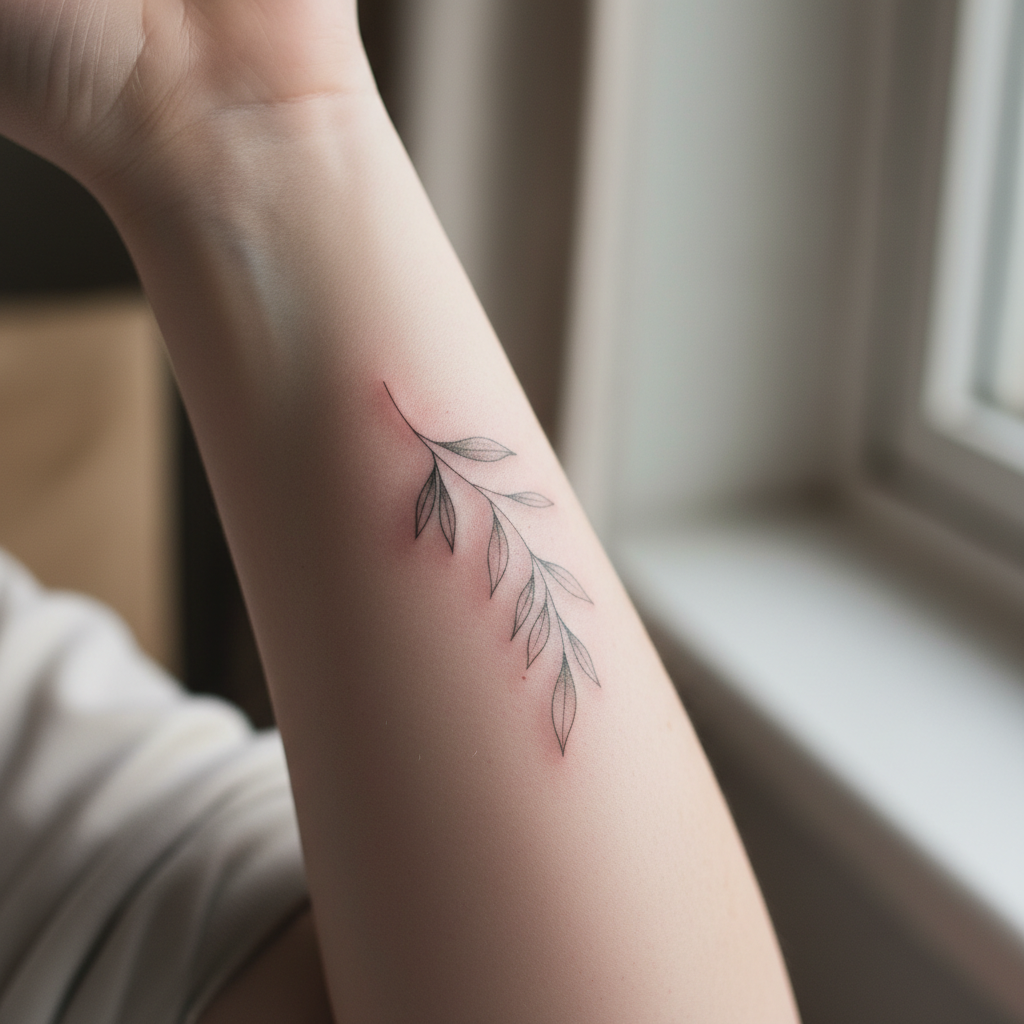
Style families that live under fine line include micro-script (tiny lettering and short quotes), botanical line work (flowers, branches, herbs drawn with no shading), single-line continuous drawings (one unbroken stroke), and minimalist symbolic work (geometric shapes, astrological glyphs, anatomical sketches). Some artists also do fine-line illustrative pieces with light dotwork shading layered in. The unifying thread is line weight, not subject matter.
How much they actually cost
Fine line work hits the shop minimum more often than most categories. Even a 1-inch fine line piece takes 30 to 60 minutes of stencil and tattoo time, so most studios charge their floor of $100 to $200 for anything under wrist size. Per-hour rates run $150 to $350 with a mid-tier artist and $400 to $700 with a fine-line specialist who has built a recognizable Instagram following. Read more in our breakdown of what drives tattoo pricing if you want the full math.
Typical 2026 price ranges by size:
- Micro script under 2 inches: $150 to $300
- Forearm botanical, 3 to 4 inches: $300 to $600
- Half-sleeve fine line composition: $1,200 to $3,500 across 2 to 4 sessions
- Back piece with fine line and light dotwork: $2,500 to $7,000+
Specialists in cities like Los Angeles, New York, Seoul, and Bangkok charge at the top end of the range. A booked-out single-needle artist in Manhattan will quote $500 to $800 per hour, with multi-month waitlists and a non-refundable deposit. For comparison on how artists structure these quotes, see our hourly vs flat-rate pricing guide.
How fine line ages in year three and year five
The honest tradeoff with fine line is longevity. A 0.20 mm line laid to a sensible dermal depth will spread (blowout or migration) by about 15 to 30 percent over five years on average. Bold lines spread the same percentage in absolute terms but look better doing it because there is more material to absorb the migration. A 1 mm line that grows to 1.2 mm still reads sharp. A 0.25 mm line that grows to 0.32 mm reads fuzzy.
Three variables drive the aging curve more than anything else. The first is placement. Fingers, hands, feet, and the inside of the wrist fade roughly twice as fast as the outer forearm or upper arm because of friction and constant flexing. Sun exposure is the second factor, and a daily mineral SPF makes a measurable difference, which we cover in our tattoo sunscreen guide. The third is skin tone. Warmer undertones with more melanin tend to lift fine grey and brown inks faster, so straight black ink generally holds best across all skin tones for fine line work.
Spotting a fine line specialist (versus a generalist)
Most generalist tattooers can do fine line, but few do it well. Three signals from a portfolio separate specialists from artists who happen to take fine line bookings.
Healed photos at 3+ months matter more than fresh photos. Fresh fine line work looks crisp on everyone because the ink is still settled in the upper dermis and the skin is still slightly swollen. Three months in, weak technique shows up as patchy fade, blowouts, and lines that have ballooned. Ask for healed shots and look for consistent line weight from start to finish of each stroke, with no fading at the line ends.
Volume of similar work also matters. An artist with 80 fine line pieces in their portfolio and 12 traditional pieces is a fine line artist. An artist with 12 fine line pieces buried among 200 mixed-style pieces is a generalist taking on whatever pays. Generalists are not bad, but they have not built the muscle memory for single-needle pacing, and it shows in the consistency of long sessions.
Booking lead time correlates with quality more than price does. A booked-out fine line artist with a 3 to 6 month waitlist is almost always the better choice over a similar-priced artist with same-week availability. Same-day fine line bookings are a yellow flag, not a green one.
Aftercare differences for fine line
Fresh fine line ink is more vulnerable than bold work in the first 10 days because there is less pigment buried in the dermis. Two adjustments matter. First, avoid sleeping on it for the first 5 nights instead of the usual 3, because pressure migration shows up much faster on thin lines. Second, keep moisturizer applications light. Heavy ointment over fine line can pull pigment up during the scabbing phase and leave gaps that need touch-up.
Most fine line work needs a small touch-up at the 6 to 8 week mark, and reputable artists include this in the original price. Confirm the touch-up policy at booking before you put the deposit down. Our touch-up cost guide covers when shops absorb the cost and when they bill you.
Frequently asked
Are fine line tattoos always single-needle? Most are done with a single 1RL or a tight 3RL liner, but not all. Some artists use a 1RL for outlines and a 3RL for soft shading within the same piece. The needle configuration matters less than the visible line weight at the surface, and a confident 3RL line can read finer than a wobbly 1RL.
Do fine line tattoos really fade faster? Yes, on average. The rule of thumb is that fine line work needs a touch-up every 5 to 8 years on high-friction or sun-exposed areas, while bold traditional work can go 15+ years without intervention. SPF, placement choice, and stencil-to-skin care during the session can stretch the timeline.
Can fine line tattoos be done on dark skin? Yes, but the contrast between line and skin tone is lower, so the aesthetic is different. Black ink reads cleanly. Light grey wash and white highlights are usually skipped on darker skin because they fade into the background within a year. Specialists experienced with deeper skin tones will steer you toward designs that work with the skin rather than fighting it.
Is fine line a good choice for a first tattoo? For a small, low-pain placement like the upper arm or shoulder, yes. The session is short, the healing is straightforward, and the visual is forgiving. Avoid fine line for first tattoos on fingers, ribs, or the sternum, where pain and movement work against clean lines and the failure rate is higher than the photos suggest.
How long does a typical fine line session take? Anywhere from 30 minutes for a 1-inch piece to 3 to 4 hours for a forearm composition. Fine line artists tend to schedule fewer back-to-back appointments because the precision work is more mentally taxing than larger pieces. Expect a slower studio pace.
Do I need a specialist or can my regular artist do it? If your regular artist has healed fine line work in their portfolio that you have seen at 3+ months, you are fine staying with them. If their portfolio is mostly bold traditional or color realism, book a specialist for the fine line piece. The skill transfer between styles is real but not automatic, and you do not want to be the test piece.