cost guides
Rose Tattoo Cost: Pricing by Size, Style, and Placement
Rose tattoos run from $80 for a tiny flash piece to $2,500+ for a detailed color back piece. Here is what actually drives the price.

Rose tattoos sit near the top of every artist's booking list, which means pricing varies more than almost any other design. A thumb-sized single rose can run $80 at a walk-in shop. A full-color realism piece covering a shoulder can push past $2,000. The gap comes down to size, style, color choice, and the artist you book. This guide breaks down what to expect to pay in 2026 and why the quote you get might be twice what your friend paid for something that looked similar.
What a rose tattoo actually costs in 2026
Most shops in the US charge $150 to $250 per hour, and a rose scales with how long it takes to draw. A small black-and-grey rose about the size of a credit card takes 1 to 2 hours, landing between $150 and $500. A palm-sized color rose with shading and background filler runs 3 to 5 hours, which puts it in the $450 to $1,250 range. Larger pieces that use the rose as a centerpiece, like a shoulder cap or a half-sleeve, usually quote at a flat rate rather than hourly. Those start around $800 and climb past $2,500 depending on complexity.
Flash sheets at walk-in shops are the cheapest entry point. A pre-drawn traditional rose from a flash sheet sits between $80 and $200, and most shops have a minimum of around $100 regardless of size. If you want a custom design, add $50 to $150 to that figure for the drawing time, even before the needle hits skin. Shops in major cities add 30 to 60 percent on top of these numbers because of rent and demand. The same rose that costs $300 in Columbus might cost $500 in Los Angeles.
How style changes the price
Rose designs cross almost every tattoo style, and the style you pick shifts the cost more than the flower itself. American traditional roses are the cheapest. They use thick lines, limited color palettes, and no realistic shading, which means a 3-inch traditional rose takes a competent artist about 90 minutes and costs $200 to $400. The aesthetic has been drawn tens of thousands of times, so most artists can execute it quickly.
Fine-line roses have exploded in popularity since 2021 and sit in a similar range for small sizes, though specialists in this style often charge $200 per hour or more because of the technical difficulty. A fine-line rose on the forearm with delicate linework and no fill runs $250 to $600. Realism roses are the expensive end. A single hyperrealistic rose with gradient shading, drop shadow, and skin-tone blending starts at $600 for something palm-sized and quickly becomes a multi-session piece. Expect $1,200 to $2,500 for a realism rose large enough to show the detail the style demands.
Watercolor, neo-traditional, and blackwork sit between those extremes. Watercolor adds color complexity but keeps linework minimal, so a watercolor rose on the shoulder usually prices at $500 to $1,000. Neo-traditional, with its bold outlines and painterly color, falls in the same bracket. Blackwork roses lean cheaper because the single-ink palette moves faster, usually $300 to $700 for a mid-size piece.
Color versus black-and-grey
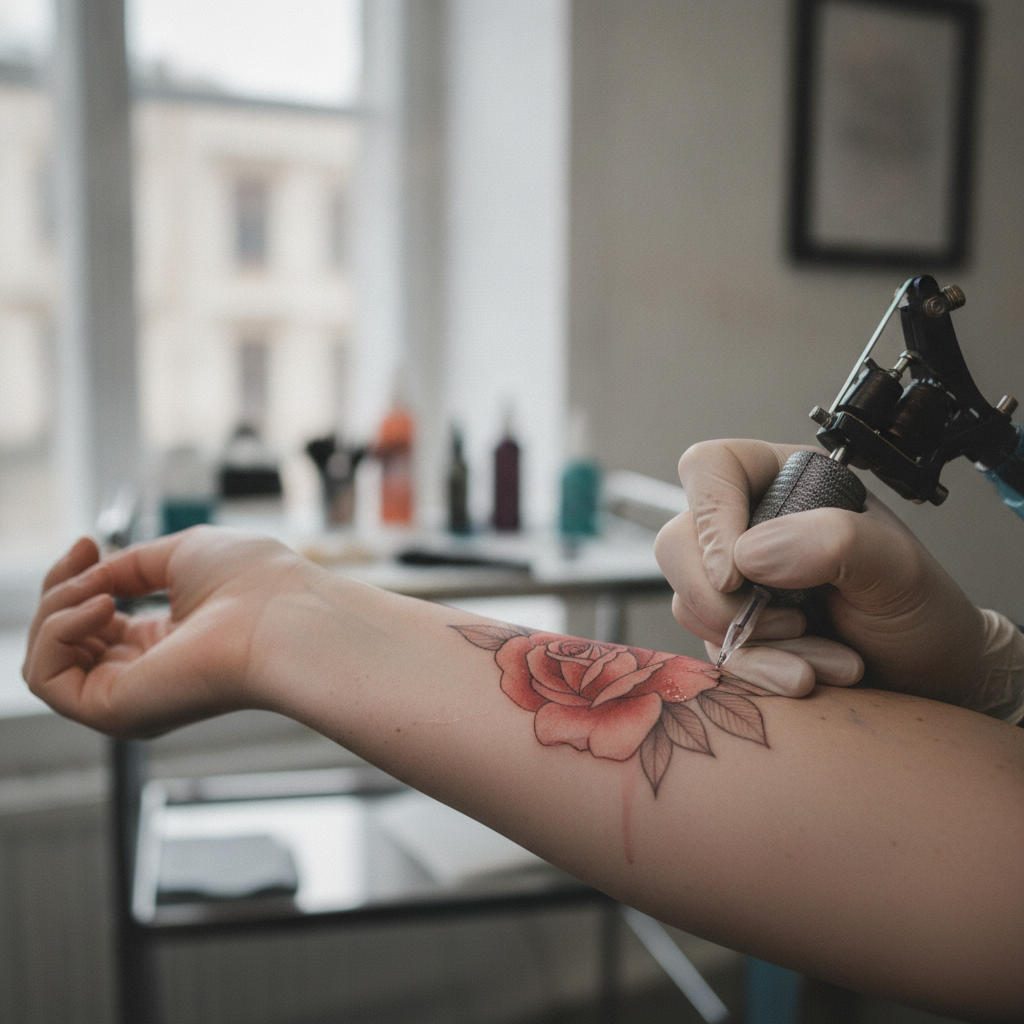
The color decision adds roughly 20 to 40 percent to the final price for any rose. Red and pink saturation needs multiple passes to reach the vibrancy the design calls for, and color ink costs more than straight black. A black-and-grey rose that would quote at $400 in solid black often comes back at $500 to $560 when done in full color. Beyond price, color roses also need a touch-up appointment 6 to 12 months after healing, which runs $50 to $150 or is included free depending on the artist's policy. Factor the touch-up into your real cost.
Black-and-grey roses hold up longer without maintenance. The lack of color pigments means less fading over a 10-year horizon, so you save on touch-ups even if the initial quote is similar. For warm skin tones, black-and-grey also reads more cleanly because the contrast relies on value rather than hue, which can get muddy with pinks and reds on deeper complexions.
Placement changes the number too
Where you put a rose shifts the quote because some skin surfaces are harder to tattoo than others. A rose on the outer bicep or forearm is the cheapest placement because the skin is flat, the artist has clear sightlines, and the client sits comfortably. A rose on the ribs, foot, or hand takes 25 to 50 percent longer because the artist stretches skin, repositions constantly, and works around nerve-dense areas where the client needs breaks.
- Outer arm or forearm: baseline price
- Thigh or calf: baseline price
- Chest, shoulder blade: +10 to 20 percent
- Rib, sternum, stomach: +25 to 40 percent
- Hand, foot, neck: +30 to 50 percent plus a potential finger surcharge
Finger roses look great in reference photos but blow out faster than almost any other placement. Most artists charge a flat $150 to $300 for a small finger rose and will tell you upfront that it needs retouching every 2 to 3 years to stay crisp. If you want longevity, pick a flatter placement and go slightly larger. A 2-inch rose on the forearm will outlast a 1-inch rose on the finger by a decade.
What drives the artist tier premium
The artist you book changes the price more than any other factor. A second-year apprentice charges $80 to $120 per hour and can produce a solid traditional rose with supervision. A mid-career artist with a strong Instagram portfolio charges $150 to $250 per hour. A guest artist on a two-week residency or a specialist with a 6-month waitlist charges $300 to $500 per hour, sometimes with a day-rate minimum of $1,500 to $2,500 regardless of how long your piece takes.
The premium buys experience, cleaner lines, and faster execution. A specialist might finish in 2 hours what an apprentice would take 4 hours to do, so the hourly difference closes partially on the final bill. For a simple traditional rose, the apprentice route is reasonable and often the better value. For a realism piece or a cover-up over existing ink, pay the specialist and do not negotiate the rate. The difference shows up every day you look at it.
Frequently asked
Can I get a quality rose tattoo for under $200? Yes, if you accept a flash design and a small size. Walk-in shops stock pre-drawn traditional roses that fit on a wrist or ankle and come in at $100 to $200 including the shop minimum. The design will not be custom to you, but a well-executed traditional flash piece ages beautifully and reads clean after 20 years. Custom designs almost always start above $250 because of the drawing fee.
Do I tip on top of the hourly rate? Yes. Tattoo tipping sits at 15 to 25 percent of the total price in the US, paid in cash at the end of the session. For a $400 rose, that is $60 to $100. On larger pieces billed at a flat rate, tip on the full amount, not just the artist's share after shop cut. If the artist discounted your rate or threw in free touch-ups, tip toward the higher end.
Why do rose tattoos cost more when they are detailed with leaves and thorns? Every added element adds drawing time and tattoo time. Leaves need their own shading, thorns need sharp linework, and a stem with wrapping foliage can double the surface area the artist covers. A plain rosebud runs $150 to $300. The same rose with a cluster of leaves and a thorned stem down the forearm pushes $600 to $1,200.
How much should I budget for a rose cover-up over an existing tattoo? Cover-ups cost 50 to 100 percent more than fresh tattoos because the artist has to work around the old ink. A rose cover-up over a palm-sized tribal piece typically runs $600 to $1,500 and often requires laser lightening sessions first at $75 to $200 each. Book a consultation before you commit so the artist can tell you whether the cover is realistic without laser prep.
Does the shop location affect the price? Heavily. A rose that costs $300 in a small-city shop can cost $600 to $800 at a well-known studio in New York, Los Angeles, or Miami. Shop overhead and artist demand drive the geography premium, not better quality on average. Traveling to a less expensive city for a vacation tattoo can save you 40 percent if you plan the healing window.
Will I need a touch-up and when? Color roses almost always need one touch-up at 6 to 12 months after healing, which the artist usually includes free or discounts to $50 to $150. Black-and-grey roses often go 5 to 10 years without needing one if you follow sun protection and moisturizing basics.