style guides
Gothic Tattoos Style Guide: Themes, Techniques, Longevity
Gothic tattoos lean on heavy blackwork, religious iconography, and ornate linework. Here is how the style actually ages, costs, and reads on skin.

Gothic tattoos are one of the few modern styles that pull directly from a 900-year-old visual tradition: cathedral stonework, medieval woodcuts, memento mori painting, Victorian mourning jewellery. On skin that vocabulary turns into dense blackwork, sharp ornamental linework, and a palette that almost never leaves black, grey, and the occasional deep burgundy. This guide covers what defines the style, how it holds up over 10 to 20 years, what a session typically costs, and the small technical choices that separate a gothic piece that still reads clean at year fifteen from one that collapses into a dark smudge.
What actually makes a tattoo "gothic"
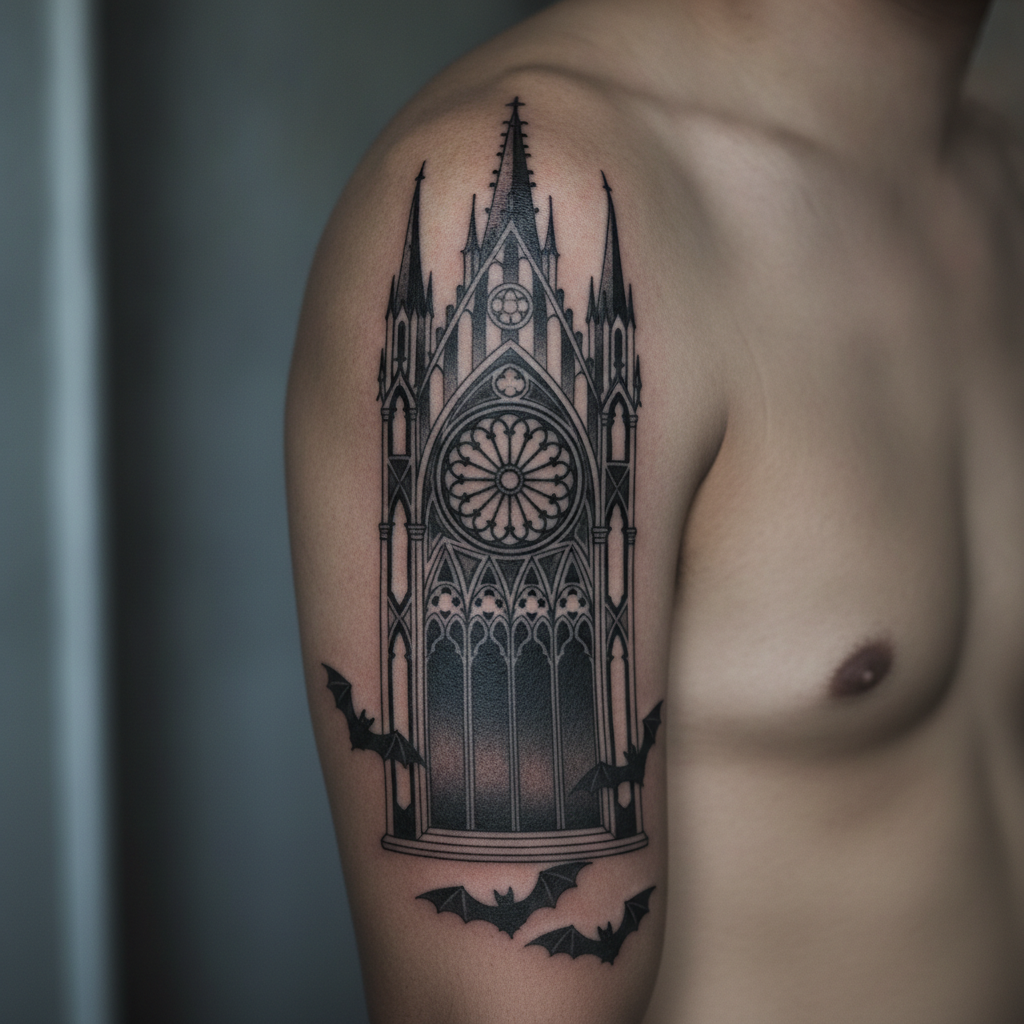
The style is defined less by subject matter than by three technical choices working together. First, heavy black saturation covering 40 to 70 percent of the design, usually in solid fills or dense whip-shaded gradients. Second, ornamental linework borrowed from Gothic Revival architecture: pointed arches, trefoils, quatrefoils, filigree. Third, a limited chiaroscuro approach to shading, where the lightest parts of the piece are bare skin and the darkest are near-pure black with no mid-tone bridge. That three-part combination is what makes a cathedral window, a dagger, or a crow read as gothic rather than just dark.
Subject matter sits on top of the technique. The dominant imagery pulls from Christian religious art (crucifixes, chalices, bleeding hearts, praying hands), memento mori (skulls, hourglasses, candles, moths), medieval weaponry (daggers, swords, maces), and natural gothic (bats, ravens, moths, dead roses, dormant trees). None of these are gothic on their own. A linework rose with no blackwork and no ornamental frame is a fine-line tattoo, not a gothic one. The style is a combination, not a vocabulary.
The main visual sub-styles
Gothic has split into four recognisable sub-styles over the past decade, and knowing which one you want saves hours of consultation time. Cathedral gothic uses architectural elements as the design spine: arches framing a central figure, rose windows as compositional anchors, flying buttresses as filler linework. Ornamental gothic replaces the architecture with filigree, lace patterns, chandelier work, and jewellery-inspired ornament. Horror gothic pushes toward the macabre: anatomical hearts, decaying faces, exposed bone, religious iconography inverted or desecrated. Minimal gothic strips everything back to a single symbolic object (a dagger, a moth, a chalice) with heavy black fill and no ornamental frame, usually sized under four inches.
The sub-style you pick drives the artist you book. Horror gothic specialists come up through blackwork and surrealism. Ornamental gothic specialists come up through ornamental tattoos and mandala work. Cathedral specialists almost always have an architecture or illustration background. Minimal gothic artists overlap heavily with the fine-line scene. Portfolio research matters more here than in most styles because the four sub-styles do not transfer skill-to-skill.
How gothic tattoos age over 10 to 20 years
Gothic ages better than almost any other style, with one condition: the artist has to understand how black saturation behaves over decades. Solid black ink spreads approximately 15 to 20 percent beyond its original edge over a 20-year window, which is why experienced gothic artists leave deliberate negative-space gaps inside blackwork fills and use slightly tighter linework than looks correct on day one. A gothic piece designed with no spread allowance looks sharp at month six and muddy at year eight.
The second longevity factor is contrast. Because gothic relies on the skin itself as the lightest tone in the composition, any tanning, sun exposure, or natural pigmentation change over time reduces contrast. People with lighter skin tones usually get 15 to 20 years before a gothic piece needs a touch-up on the lightest sections. Darker skin tones can shift this timeline earlier, but the trade-off is that heavy black holds colour fidelity longer on darker skin, so the piece ages differently rather than worse. Discuss both factors with your artist before finalising the design.
Fine linework inside gothic pieces, especially the ornamental filigree lines under 0.3mm, will blur to about 0.5mm over 10 years. This is normal, not a mistake. Artists who work in the style build the design with this in mind, which is why ornamental gothic frames often look slightly spaced-out on day one. Compare a healed photograph at year ten rather than a fresh photo at week two when evaluating portfolios.
Placement choices that affect readability
Gothic designs reward large, flat canvas placements. The outer arm (bicep, tricep, forearm), the back, the chest panel, and the thigh all give the composition room to breathe and let the architectural or ornamental framing read correctly. Ribcage placements work but require the artist to accordion the design around the body's curvature, which is a specialised skill. Hand, neck, and foot placements are possible but constrain the style to minimal gothic because the small canvas cannot support architectural detail.
- Best placements for cathedral and ornamental gothic: full back, chest panel, outer thigh, outer bicep (minimum 5 inches)
- Best placements for horror gothic: forearm, calf, inner bicep (minimum 4 inches)
- Best placements for minimal gothic: wrist, ankle, behind-ear, finger (under 3 inches)
Avoid high-friction areas (inner wrist, side of hand, inside elbow) for any gothic piece with heavy blackwork. The friction accelerates ink migration in solid-black fills, which is the opposite of what the style needs. If you want gothic on your hand or finger, pick a minimal piece with linework only, not solid fills. The general placement guide for hand tattoos covers the longevity trade-offs in more depth.
Typical pricing in 2026
Gothic sits in the mid-to-upper tier of style pricing because the blackwork saturation takes real session time. Expect $180 to $350 per hour in major US cities, $150 to $280 in secondary US markets, and $120 to $220 in Southeast Asia for comparable artist quality. A minimal gothic piece (3 inches, single session) usually runs $300 to $600 flat. A medium ornamental or horror piece (6 to 8 inches, 2 to 3 sessions) runs $900 to $2,400 total. A full cathedral back piece runs 40 to 70 hours of total work over 6 to 12 sessions, totalling $7,000 to $20,000 depending on artist tier.
Two line items are specific to gothic. Blackwork touch-ups to re-saturate solid fills typically happen at year 8 to 12 and cost $150 to $400 per hour of the original piece. Gothic artists at the top of the scene (the ones with 2-year waitlists and $400+ hourly rates) often require a non-refundable deposit of $500 to $1,500 to book, applied to the first session. Factor both into total project budgeting rather than treating the per-hour rate as the full cost.
Aftercare quirks for heavy blackwork
Gothic pieces heal differently from linework-dominant styles because the sheer surface area of saturated black ink produces more lymph fluid and more scabbing in the first 10 days. Expect heavier weeping in the first 48 hours, denser scabs forming between day 4 and day 10, and a longer total heal window of 4 to 6 weeks rather than the 3 to 4 weeks typical for fine-line work. Follow a standard tattoo healing timeline but add roughly a week to each phase.
The single most important aftercare rule for gothic is sun protection for the first full year, not just the healing window. UV exposure during the first 12 months is the main cause of premature black fading, and because gothic pieces rely on black density for the entire composition, any fading in year one is visible for decades. SPF 50 physical sunscreen on the piece whenever it is exposed is non-negotiable. Avoid picking scabs even more carefully than usual, because scab loss on a solid black fill creates permanent pale patches that require a touch-up to repair.
Frequently asked
Can I get a gothic tattoo if I have darker skin? Yes, and heavy blackwork actually holds colour fidelity better on darker skin tones than on pale skin. The one adjustment is composition. Pieces that rely on bare skin as the lightest tone need to be redesigned so the contrast is created by negative space inside the blackwork rather than contrast between ink and skin. A gothic artist experienced with darker skin tones will adjust the composition in consultation.
How many sessions does a gothic back piece take? A full cathedral or horror back piece typically takes 6 to 12 sessions of 3 to 5 hours each, totalling 40 to 70 hours of work. Sessions are usually spaced 4 to 8 weeks apart to allow full healing between passes. The outlining session is usually done first and covers the entire design perimeter in one sitting, which is the longest single session of the project.
Will my gothic tattoo turn blue or green over time? Properly packed modern black ink stays black and does not shift to blue or green in the way older carbon-based pigments did in the 1980s and 1990s. If you see a blue or green cast developing before year 15, the cause is almost always sun damage breaking down the pigment, not ink quality. Keep SPF on the piece and the colour stays black.
Is gothic a good style for a first tattoo? A small gothic piece (minimal gothic sub-style, under 3 inches) is a reasonable first tattoo. A full gothic sleeve or back piece is not, because the heavy blackwork sessions are physically demanding and the long project timeline tests your commitment to tattoo aftercare across multiple heals. Start small, confirm you handle the healing well, then commit to the larger project.
How do I pick between the four gothic sub-styles? Pull 15 to 20 gothic references you like, lay them out, and look for the pattern. If most feature architecture, you want cathedral gothic. If most feature filigree and symmetry, you want ornamental. If most feature anatomical or religious horror imagery, you want horror gothic. If most are single objects on bare skin, you want minimal gothic. Then search for artists specialising in that specific sub-style rather than any gothic artist.
Do gothic tattoos need touch-ups more often than other styles? Yes, but less often than people expect. Solid blackwork fills typically need one touch-up at year 8 to 12 to re-saturate the darkest areas. Fine ornamental linework may need touch-up at year 10 to 15 if the lines have blurred noticeably. A well-executed gothic piece should go 15 to 20 years before any work is needed, which is a longer touch-up interval than most watercolor or color realism pieces.