style guides
Ornamental Tattoos Style Guide: Filigree, Mandalas, and Adornment
Ornamental tattoos borrow from jewelry, architecture, and sacred geometry to decorate the body with filigree, mandalas, and symmetrical linework built to last.

Ornamental tattoos treat the body like a surface for jewelry. The style pulls from Indian henna, Moroccan tilework, Gothic filigree, Baroque metalwork, and sacred geometry, then rebuilds those motifs in ink so the design follows the muscle and bone underneath. Done right, an ornamental piece looks less like a picture stuck on skin and more like a pendant that grew out of it. This guide covers what makes ornamental distinct, how artists build these designs, where they sit best on the body, what sessions and pricing look like, and how the style ages compared to fine-line or blackwork.
What ornamental actually is
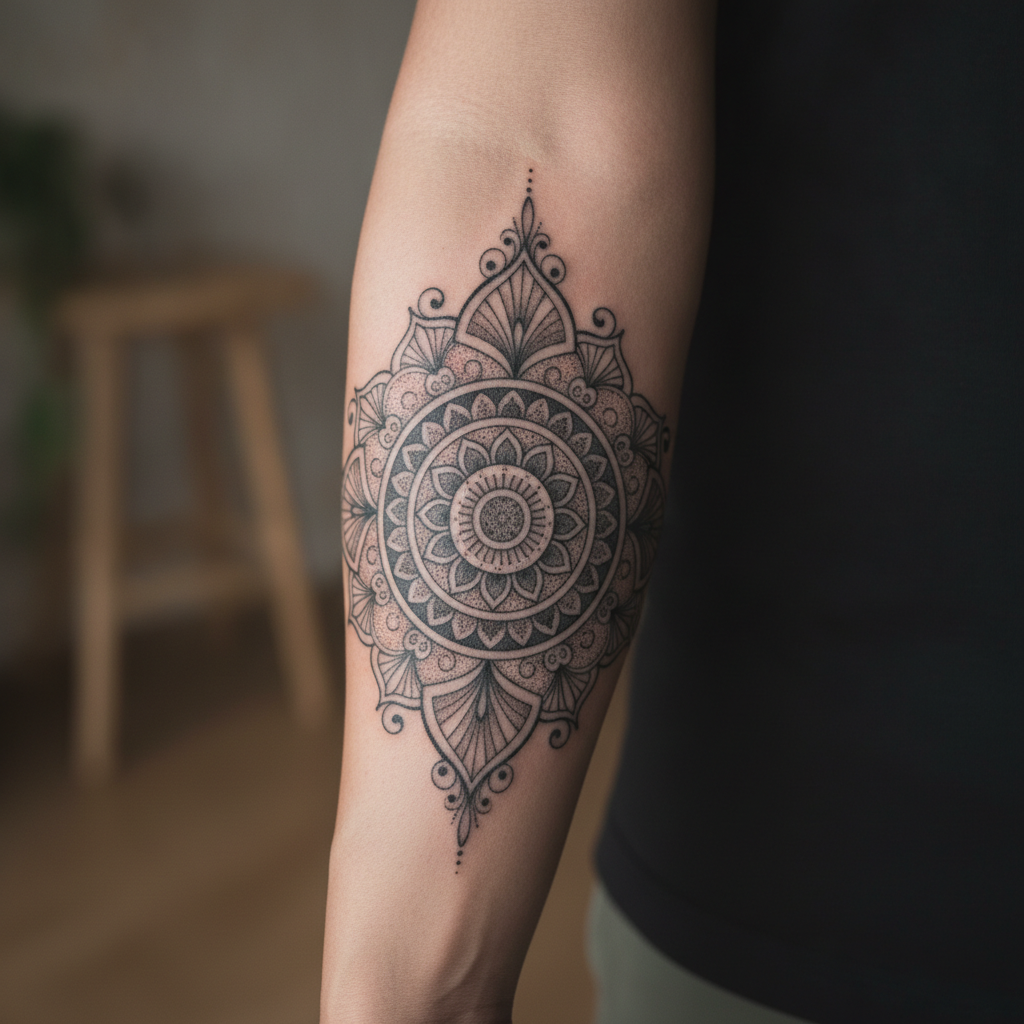
Ornamental is a decorative style built on symmetry, repetition, and negative space. The vocabulary is small and strict: mandalas, rosettes, chandelier drops, filigree curls, dotwork gradients, and clean geometric borders. Most pieces are pure black ink, though some artists add a single accent color or use grey wash for depth on larger fields. The design is not narrative. There is no scene, no portrait, no story panel. The point is the pattern and how it sits on the body.
The style is often confused with blackwork or geometric, and there is real overlap. Blackwork is the broader umbrella of heavy black ink coverage, which includes ornamental but also includes solid blackout sleeves and negative-space illustration. Geometric leans on rigid shapes, sacred geometry grids, and mathematical construction. Ornamental sits between the two: it uses geometric bones (a mandala grid, a symmetrical axis) but softens them with organic curls and jewelry-inspired flourishes. If you want to see the strict end of the family, our blackwork tattoos style guide covers where solid-black work ends and ornamental begins.
The techniques behind the linework
Ornamental artists rely on three main tools: whip-shading, dotwork, and clean line weights. Whip-shading uses a loose flick of the machine to fade a line from solid black into a soft gradient, which is how filigree edges get their depth without going grey. Dotwork stipples thousands of individual points to build shading fields, and it is how a mandala petal fades from solid black at the center to open skin at the edge. Line weight is deliberate: a heavy 9RL liner sets the frame, and finer 3RL or 1RL work handles the internal filigree.
Most ornamental artists work with the body's symmetry axis first, then build the pattern outward. On a sternum piece the vertical centerline is drawn along the sternum itself, and every element mirrors across it. On a spine piece the same rule applies down the vertebrae. This is why ornamental stencils take longer to place than a portrait or lettering piece. A crooked stencil ruins the whole design because the eye reads the asymmetry immediately.
Line stability is the other technical marker. Because ornamental is judged on precision, artists tend to use single-needle or tight liner groupings and slower machine speeds. Rotary machines dominate the style now because they run smoother than coils at the low speeds needed for clean geometric arcs. Expect longer sessions per square inch than a traditional or illustrative piece for this reason.
Where ornamental sits best on the body
Ornamental designs need the body to cooperate. The style rewards symmetric, mostly flat panels of skin where the mirrored pattern can breathe. The strongest placements are the sternum, the center of the chest, the spine, the underboob and rib panel, the back of the neck, the outer forearm, the top of the hand, the shoulder cap, and the top of the foot. These placements give the artist a natural centerline to anchor the composition.
Placements that fight the style include the inner bicep, the calf, and the ribcage sides. These areas curve too much for tight symmetry, and the design will read as warped once it settles. If you want ornamental work in a curved zone, ask for a piece designed specifically for that curve, not a flat mandala forced onto a round surface. A skilled artist will draft the stencil directly on your skin to compensate.
- Best for symmetric linework: sternum, spine, back of neck, outer forearm, top of hand
- Works with careful design: shoulder cap, upper back, thigh front
- Fights the style: ribcage sides, inner bicep, calf, inner forearm
Sizing matters too. Ornamental is one of the few styles where bigger is genuinely better for longevity. A four-inch mandala with dense filigree will blur into a dark smudge within a decade. The same design at eight inches, with proper spacing between lines, will still read as filigree in twenty years. If budget is tight, go smaller in complexity rather than smaller in overall size.
Session count, pricing, and what to expect
A small ornamental piece, roughly the size of a business card, usually takes one three to four hour session. Sternum and spine work runs two to four sessions of three to five hours each, depending on density and how much dotwork is involved. A full back ornamental piece is a five to eight session commitment spread over several months to let the skin heal between passes.
Pricing sits in the mid-to-upper range for tattooing. In major US and European cities, expect $180 to $350 per hour for a competent ornamental artist, and $400 to $700 per hour for the small handful of internationally booked specialists. Flat-rate pricing on a defined design (say, a sternum ornamental piece) typically lands between $800 and $2,500 depending on size, artist tier, and city. For context on how this compares to placement-based flat rates, our sternum tattoo cost guide breaks down what drives the number.
Booking timelines are longer than average. Well-known ornamental artists often have six to twelve month waitlists because the style attracts a small, highly loyal client base and the sessions are long. Deposits are usually $200 to $500 and are non-refundable in almost every studio.
How ornamental ages
Ornamental holds up better than fine-line but worse than solid traditional. The heavy liner frame and larger dotwork fields age gracefully because they are built with ink density and spacing in mind. Fine internal filigree is the vulnerable part. Any line thinner than 1mm will start to spread within five to ten years, especially on sun-exposed placements like the hand, forearm, and chest.
Dotwork ages in a specific way. Individual dots migrate slightly as skin cells turn over, and dense dotwork fields tend to blur into a soft grey wash over a decade or two. This is often desirable, since it gives the piece a lived-in vellum quality, but it is worth knowing before you commit. If you want your dotwork crisp forever, ask your artist to leave more space between dots than looks correct at first glance.
Sunscreen matters more here than in most styles because ornamental relies on line contrast. UV exposure fades black ink to blue-grey, which flattens the depth built by whip-shading. Daily SPF 30 or higher on any exposed ornamental work is standard care, and our tattoo sunscreen and long-term care guide covers the specifics of which formulas work best on healed ink.
Choosing an ornamental artist
The portfolio test for ornamental is different from other styles. Ignore how the piece looks fresh out of the machine. Ask the artist for healed photos taken six months to a year after the session. Ornamental work looks stunning at day one because the skin swelling makes every line crisp. The real question is how the filigree reads once the skin settles.
Look for consistent line weight across the artist's portfolio. If some pieces have wobbly arcs and others are laser-clean, the artist is still developing the technique. Ornamental is a discipline where the artist's hand needs thousands of hours of dedicated practice, not just general tattoo experience. A ten-year traditional artist who has done fifty ornamental pieces will still be less consistent than a five-year artist who has done five hundred.
- Ask for healed photos at six months and one year
- Check for line weight consistency across the portfolio
- Look for at least one piece in the placement you want (sternum work is different from forearm work)
- Confirm they draw the stencil on skin, not just paper
Frequently asked
Are ornamental tattoos the same as mandala tattoos? Not quite. Mandalas are a specific circular design rooted in Hindu and Buddhist iconography. Ornamental is the broader style that uses mandalas as one of its many vocabulary elements alongside filigree, chandeliers, rosettes, and geometric borders. Every mandala tattoo is arguably ornamental, but not every ornamental piece is a mandala.
Do ornamental tattoos hurt more than other styles? Yes, on average. The long sessions on symmetric bony placements (sternum, spine, ribs) put ornamental among the more painful commitments. Dotwork itself is not particularly sharp, but the cumulative time under the machine makes for demanding sessions. Plan for real breaks and eat a full meal before you arrive.
Can ornamental work incorporate color? It can, but most artists and clients keep it black. Adding color changes the visual weight of the piece and often clashes with the jewelry-inspired aesthetic. If color is used, it tends to be a single accent (a red dot at the mandala center, a small gold-tone leaf) rather than a full palette. If you want color-heavy decorative work, a neo-traditional artist is usually a better fit than an ornamental specialist.
How much space should I leave between ornamental pieces on the same body? Enough that each piece reads as its own object. Ornamental relies on negative space to breathe. Two mandalas placed inches apart will visually merge into a chaotic mass within a few years as the ink softens. A rule of thumb: leave at least the diameter of the smaller piece as blank skin between them.
Do I need to shave my body hair for an ornamental tattoo? The artist will shave the area at the start of the session, but the hair will grow back through the tattoo once it heals. On dense-linework ornamental this is usually fine, since the hair breaks up the pattern the same way it did on your original skin. If you have very thick body hair over a fine ornamental piece, expect the design to read less crisply than it does in the portfolio photos.
Can ornamental tattoos be covered up if I change my mind? This is the hardest style to cover. Because ornamental is symmetrical and dense with black ink, cover-ups require even denser, larger work on top. Most cover-up artists will suggest either extending the ornamental design into a full sleeve or panel, or laser-fading the piece for six to eight sessions before attempting a cover. Removal costs and timelines for dense blackwork are covered in our tattoo removal cost guide.