style guides
Engraving Style Tattoos: A Style Guide to Etching Ink
Engraving style tattoos borrow from old copperplate prints, using parallel lines and stipple to build shade. Here's how they're made, who they suit, and how they age.
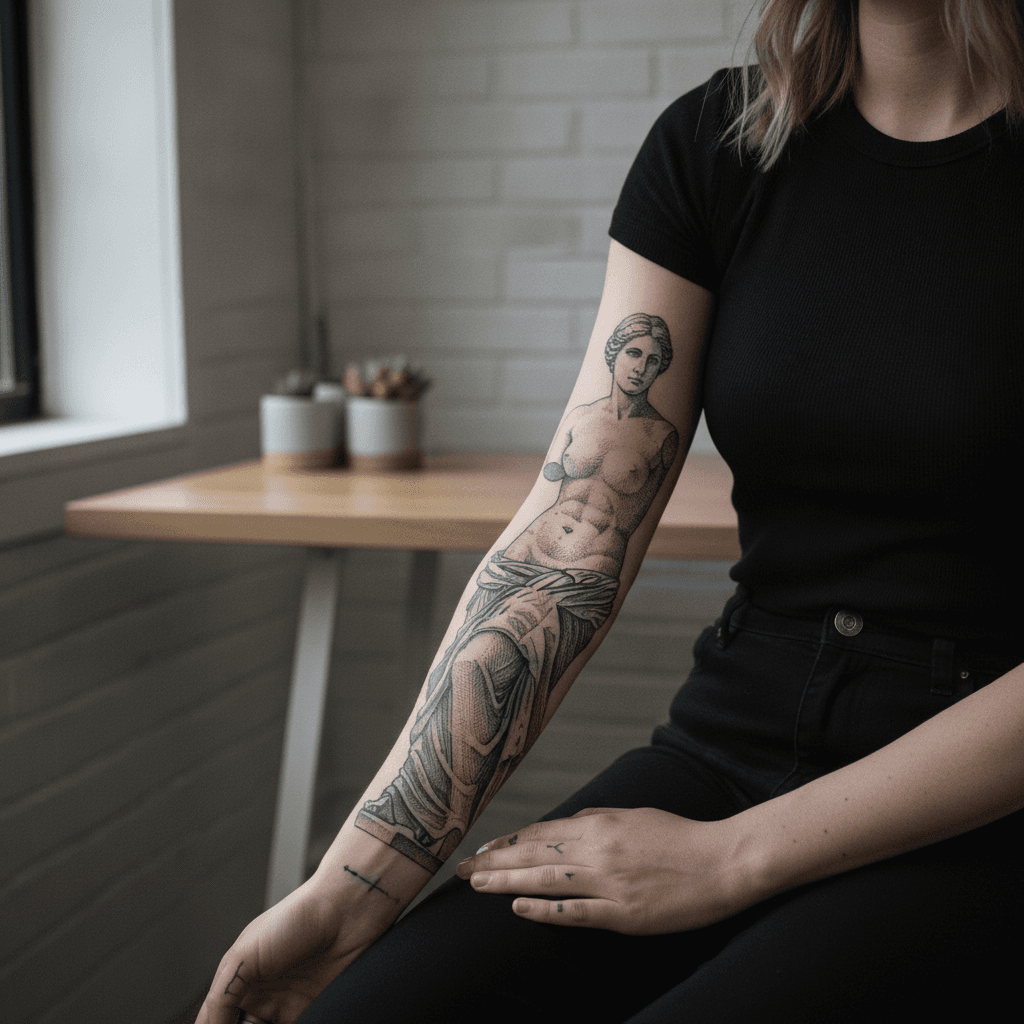
Engraving style tattoos pull their vocabulary from 16th and 17th century copperplate prints and scientific illustration. The look is built entirely from thin black lines, cross-hatching, and stipple, with no solid black fills and no grey wash. If you have seen an Albrecht Dürer woodcut or a vintage botanical plate and thought that aesthetic belonged on skin, this is the style that gets you there.
What makes a tattoo "engraving style"
The defining trait is that every tone is made from line or dot work, never from a grey wash. Shade is created by placing fine parallel lines close together, then crossing those lines with a second or third direction to deepen value. Stipple fills the softest midtones and the texture of surfaces like metal, glass, or bone. The artist is translating analog print techniques into ink, so the composition reads as a plate pulled from an old book rather than a photograph.
The subject matter tends to track the source material. Classical statues, anatomical studies, botanical illustrations, religious iconography, animals in profile, pocket watches, keys, maps, and architectural details all fit the vocabulary. The reason is practical. These subjects were originally drawn to be reproduced as engravings, so they already have the clean contours and crisp detail the technique rewards. If you want a modern photorealistic face in this style, it fights the medium.
Line weight stays relatively uniform across the piece, with slight variation to mark edges. There is no bold outline wrapping the whole image the way a traditional tattoo uses. Instead the silhouette emerges from where the hatching stops, which is how real engravings behave on paper. That makes the style feel more like an illustration you can read at any distance than a solid graphic from across a room.
How artists build the shading
Engraving work usually comes off a tight liner, often a 3 or 5 round liner, running at a slower speed than a line-heavy traditional piece. Some artists switch to a single-needle machine for the finest crosshatching passes. The ink is pure black diluted only at the artist's discretion, and even then the thinning is kept minimal to protect contrast. You are not laying wash, you are packing a ton of fine lines that need to stay separate forever.
- Primary tools: 3RL or 5RL for structural line, 1RL or single-needle for finest hatching
- Shading technique: parallel hatching, cross-hatching (two or three directions), stipple for midtones
- Ink: solid black only, occasional sparing dilution for the lightest areas
- Session count: full forearm panel typically 2 to 3 sittings, back pieces 6 to 10
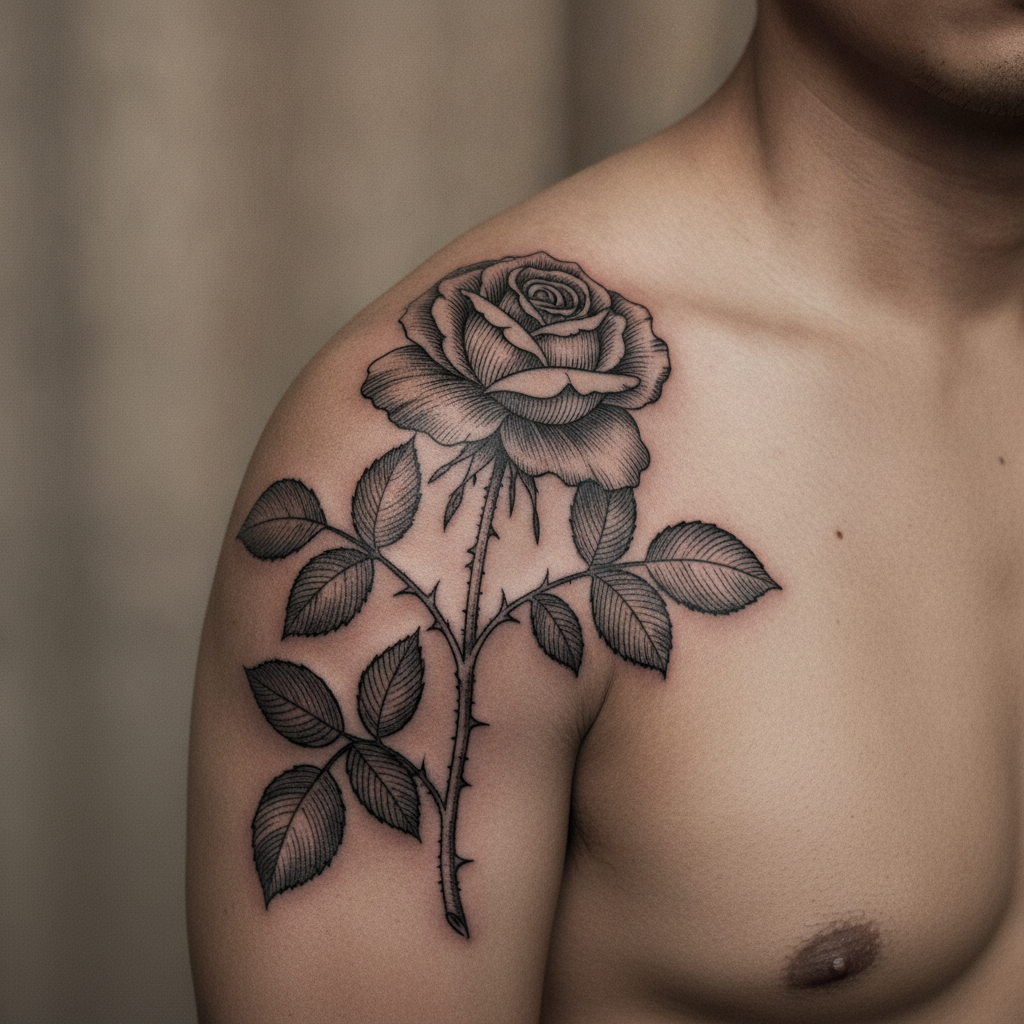
Session length matters here. Dense hatching is slow and precise work, so a four hour session often covers less real estate than you would expect for a blackwork or traditional piece of the same size. That is part of why pricing lands closer to fine line tattoo cost and blackwork tattoo cost ranges than to flash-rate work.
Who the style suits
Engraving style rewards people who already know they want something detailed, bookish, and quiet. It does not announce itself from twenty feet away. Up close it holds an enormous amount of information, and you can study a well-executed engraving piece for a long time without exhausting it. If your taste runs toward museum-plate aesthetics, antique anatomical charts, or Renaissance religious iconography, this is the vocabulary built for you.
Skin tone and healing behavior matter. The style depends on a visible contrast between black lines and bare skin, so it reads most dramatically on fair to medium skin. On deeper skin tones, contrast is still readable but softer, and artists often space hatching slightly wider so individual lines stay legible after healing. The style is not off limits on dark skin, it simply requires an artist who understands how fine black work settles and plans spacing accordingly. Our notes on tattoo aftercare for dark skin cover the healing side of that in more depth.
Age tolerance is a real factor. Fine hatching is vulnerable to the same long-term softening that affects fine line work. Lines placed too close together can blur into solid grey over a decade, which flattens the engraving effect. A good artist in this style builds in enough breathing room between hatches to survive that migration, trading a touch of initial density for aging grace.
How engraving style compares to adjacent styles
It overlaps with blackwork, dotwork, and illustrative work, but each has its own center of gravity. Blackwork leans on solid fills and bold silhouettes. Dotwork builds entire images from stipple with little or no hatching. Illustrative tattoos borrow from drawing in a looser sense and permit a wider range of line weight and even color. Engraving style sits in the specific corner where parallel lines and crosshatching are the shading, period.
Compared to single needle tattoos, engraving pieces tend to run heavier in overall ink saturation because the hatching density is higher even if each individual line is thin. Compared to dotwork tattoos, engraving reads more linear and architectural, less textural. Compared to classic blackwork, engraving looks lighter and more illustrative because it never relies on blackout fills.
Pricing and planning
Expect hourly rates between $180 and $350 at experienced studios in major US cities, with specialist engraving artists at the higher end or on day rates of $1,200 to $2,000. A palm-sized classical statue runs $400 to $700 as a flat rate. A forearm engraving panel of a botanical or anatomical subject lands in the $900 to $1,800 range across one or two sessions. A full engraving-style back piece can easily stretch to $8,000 or more over six to ten sittings.
Density is where the hours go. A piece that reads as "detailed" in engraving style often has three or four times the line count of a traditional tattoo at the same size.
Book with an artist who has a visible portfolio in this specific vocabulary, not just a blackwork or fine line generalist. Look for healed photos at six months or longer, because that is where crosshatch spacing shows its quality. Ask whether the artist stencils tight detail or freehands the hatching, since both approaches work but the planning conversation differs.
Frequently asked
Is engraving style the same as etching style tattoos? They are used interchangeably in most studios and online conversation. Historically engraving and etching are different printmaking techniques, but as tattoo terms they describe the same linework-and-hatching aesthetic.
Does engraving style work in color? Almost never in a strict sense. Introducing color breaks the illusion of a printed plate. A few artists experiment with a single spot color accent, but the core style is black ink only.
How long does an engraving style tattoo take to heal? Surface healing follows the standard two to three week window covered in the tattoo healing timeline. Deep healing takes two to three months, and fine hatching sometimes loses a touch of crispness on the last peel, which touch-ups can address if needed.
Will the fine lines blur over time? Lines placed too close together can merge over ten to fifteen years, especially on high-friction placements like hands and feet. A skilled engraving artist plans hatch spacing to survive that migration. Picking a lower-friction area and following tattoo sunscreen and long-term care habits helps a lot.
Can I get an engraving style portrait? Engraving-style portraits of historical or sculpted subjects work beautifully. Engraving-style portraits of a real living person look stylized rather than photorealistic, which is a feature of the style rather than a limitation.
What should I bring to the consultation? Reference images from actual engravings and botanical plates, not just other tattoos. Pointing to the source material tells the artist which tradition you are drawing from, which shapes line density and composition more than tattoo-only references would.