design ideas
Dragon Tattoo Ideas: Meanings, Styles, and Placements
Dragon tattoo ideas by culture, style, and placement. Meanings behind Japanese, Chinese, and Western dragons, plus what works on a sleeve, back, or ribcage.

Dragons are the single most requested mythological tattoo subject, and for good reason. The motif carries real weight in nearly every culture that invented a version of it, scales well from a two-inch wrist piece to a full backpiece, and reads clearly in almost any style a tattooer works in. The hard part is not picking a dragon. It is picking the right dragon for the placement you have, the meaning you want, and the style your artist actually specializes in.
This guide breaks down the main cultural lineages, the styles that fit each one, the placements where dragons sit well, and the decisions that tend to make or break a dragon tattoo a few years into its life.
Dragon meanings by culture
The dragon you choose carries the baggage of wherever it came from. Mixing lineages without knowing it is one of the most common mistakes in dragon tattoo design.
Japanese dragons, called ryū, are long serpentine creatures with three toes, flowing whiskers, and no wings. In Japanese mythology they are water spirits tied to rain, rivers, and the sea. They stand for wisdom and protection rather than destruction, and they read as benevolent in nearly every traditional context. If you want a dragon that curls around a limb or spirals up the back, this is the lineage that supports that composition.
Chinese dragons, lóng, share the serpentine body but are usually drawn with five toes in imperial contexts and four in common ones. They are symbols of power, prosperity, and the emperor. Classic Chinese dragon tattoos often include the flaming pearl, which represents wisdom, perfection, or the sun. Chinese dragons tend to feel more ceremonial and heraldic than Japanese ones, which lean cinematic.
Western dragons are a different animal entirely. They have wings, four legs, and a body shaped more like a lizard or a wyvern than a snake. They come out of European heraldry and later fantasy, and they carry the medieval meanings of guardian, hoarder, and destroyer depending on the story. Welsh dragons in particular carry national and clan symbolism that matters to people with Welsh heritage.
Norse and Celtic serpents are a third branch worth knowing. Jörmungandr, the world serpent, and the knotted serpents in Celtic illuminated manuscripts are not technically dragons but read as dragon adjacent and work beautifully in blackwork and ornamental compositions.
Styles that fit dragons well
Japanese irezumi is the default style for a reason. The entire visual language of irezumi, including wind bars, water, cherry blossoms, and clouds, was built around long flowing creatures like dragons and koi. If you want color, a traditional irezumi dragon with red, teal, and gold against black negative space will outlive almost any other choice. Expect multiple sessions and plan for a budget in the four-figure range for anything larger than a half sleeve. Our Japanese irezumi tattoo cost guide covers typical sitting counts.
Black-and-grey realism works for Western dragons and for photoreal Chinese pieces where you want detail in the scales. Realism dragons live or die on the artist's ability to render texture at the scale you asked for. On smaller pieces, fine scale detail collapses into noise within a year or two. Keep realism dragons at palm-sized or larger. If you are weighing color against black-and-grey for a Western dragon, the color vs black-and-grey tattoo cost comparison is worth reading before you commit.
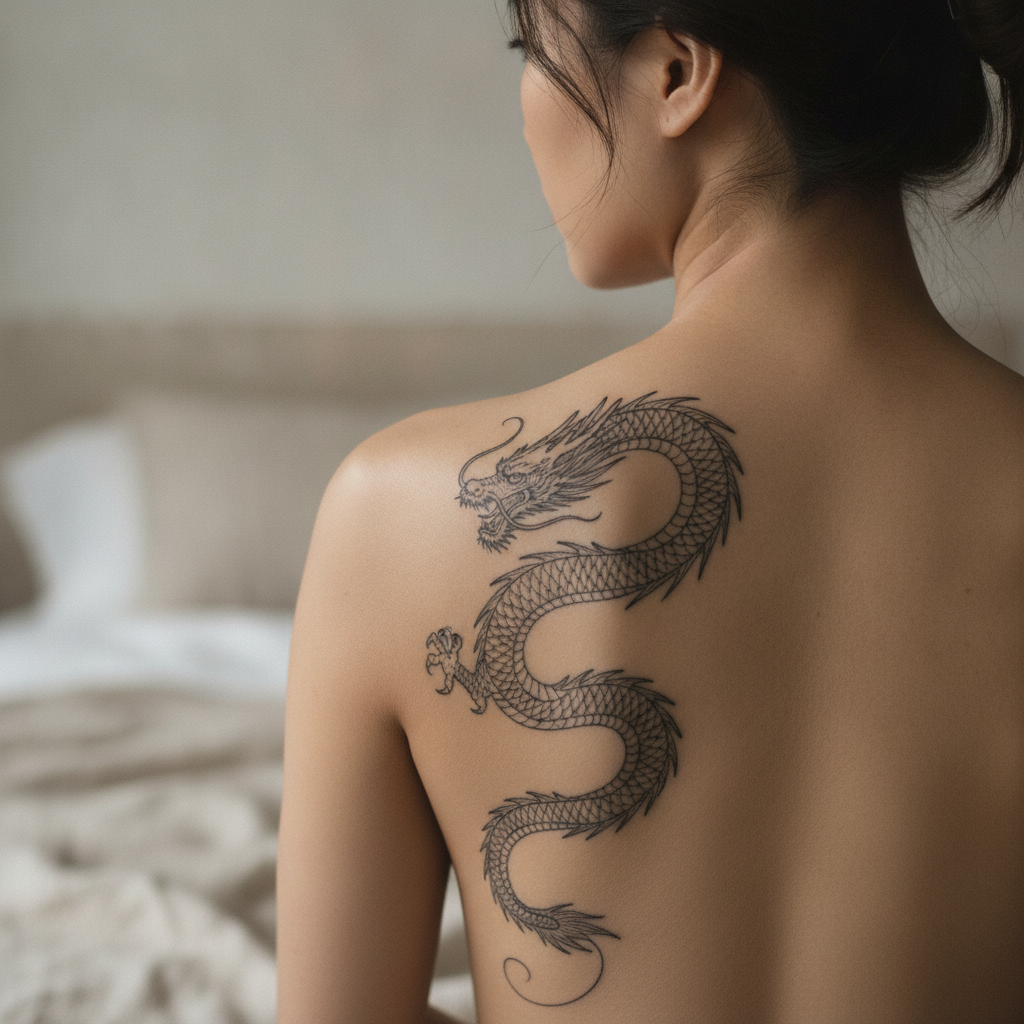
Fine-line and single-needle dragons strip the creature back to its silhouette. Done well, they work on the forearm, ribcage, or spine. Done poorly, they look like a line drawing that never got finished. If you go fine-line, pick an artist whose dragon portfolio you can actually see, not just generic florals.
Blackwork and ornamental styles suit dragons that lean toward Celtic or Norse interpretations, where knotwork and heavy black fill carry the design. Dotwork dragons sit in the same family and work well on larger canvases where the stippling has room to breathe.
Neo-traditional dragons borrow from American traditional bold lines but allow more color blending and more elaborate scale rendering. They read graphic from a distance and detailed up close, which makes them a solid middle ground if you want something readable but not minimal.
Placement by scale
Dragons are directional creatures. They have a head and a tail, and they move. Placement matters more for a dragon than for most other motifs because the body has to follow the shape of the limb or torso it lives on.
The back is the natural home for a full dragon. A Japanese dragon can spiral from the lower back up over one shoulder and down an arm, which is the classic bodysuit composition. If you want the full curl, start with a back consultation and expect the piece to extend over multiple sessions. Our back piece composition guide walks through how to plan the flow.
Sleeves suit dragons that wrap. Japanese dragons work almost unreasonably well here because the body naturally coils around the arm. Half sleeves usually fit a dragon head with partial body and clouds or waves. Full sleeves fit the entire creature plus environmental elements. See sleeve tattoo composition for how head placement affects the read.
The ribcage and side suit longer serpentine dragons that curl along the torso. These placements hurt more than most others, and the skin stretches during sessions, so plan the budget for touch-ups.
Thighs give you a vertical canvas that fits a descending dragon with its head at the top or bottom. Thigh placement is forgiving on pain and generally heals well.
Smaller dragons, under six inches, fit the forearm, calf, or shoulder blade but should stay minimal in detail. Micro-realism dragons under three inches rarely age well.
Color versus black-and-grey
Color dragons are iconic but demand upkeep. Reds and yellows are the first pigments to fade, often within five to seven years, especially on sun-exposed placements. If you commit to a color dragon, commit to sunscreen and plan on a color touch-up around year seven.
Black-and-grey dragons hold their line and shading dramatically better over decades. They also read more cinematic in most styles. If you are torn, the compromise is a black-and-grey dragon with one or two accent colors, which is a common irezumi approach.
Common mistakes
The three mistakes we see repeated often enough to name them:
- Picking a cultural style without understanding what it means, like a Japanese dragon with a Welsh flag, which reads as costume rather than design.
- Going too small for the detail requested. A three-inch realism dragon is a blob in two years.
- Treating the dragon as a standalone silhouette with no environment. Dragons need wind, water, clouds, or flame around them to anchor the composition.
Frequently asked
How much does a dragon tattoo cost?
A small single-session dragon runs around $200 to $600. A half sleeve lands between $800 and $2,500 depending on artist tier and city. A full back dragon in Japanese irezumi runs $3,000 to $10,000 across multiple sessions. See our full dragon tattoo cost guide for a detailed breakdown.
How long does a full back dragon take?
Expect four to eight sessions of three to five hours each, spaced four to six weeks apart. A full back dragon in Japanese irezumi can take six to eighteen months to complete depending on your pain tolerance and schedule.
Should the dragon face up or down on my arm?
Facing up, with the head toward the shoulder, is the traditional orientation for a rising dragon and reads as ambition or ascent. Facing down, with the head toward the hand, is a descending or guardian dragon. Both are valid. Decide based on what you want to see when you look down at your own arm.
Can I combine a dragon with a koi or phoenix?
Yes, and the combinations are traditional. Dragon and koi represent transformation, drawn from the myth of the koi climbing the waterfall and becoming a dragon. Dragon and phoenix represent balance and are a classic pairing in Chinese design. Check that your artist has done the specific combination before, since the compositions are harder than either creature alone.
Do dragon tattoos hurt more than other designs?
The dragon does not make it hurt. The placement does. A dragon on the ribcage hurts because the ribcage hurts. A dragon on the forearm is manageable. Plan the pain around the placement, not the motif.
What should I avoid in a dragon reference image?
Avoid stock art, AI-generated reference, and dragons pulled from video games or film without reinterpretation. Give your artist a mood board of real tattoos in your chosen style and let them design the dragon around your body.