cost guides
Color vs Black-and-Grey Tattoo Cost: What's the Difference
Color tattoos almost always cost more than black-and-grey, sometimes by 30 to 60 percent. Here is exactly where that price gap comes from and when paying for color is worth it.

Color tattoos almost always cost more than black-and-grey, and the gap is wider than most first-timers expect. A palm-sized color piece that quotes at $600 to $900 will often quote at $400 to $600 in black-and-grey from the same artist. The price difference is not arbitrary, and it is not the artist marking up because color looks fancier. It comes from real differences in time, materials, technique, and how many sessions the piece needs to look finished. This guide breaks down where the money actually goes so you can budget honestly before you sit down for a consultation.
Why color costs more in the first place
The single biggest reason is time. Color packing, the technique where the artist works pigment into the skin until the saturation is even and the color reads clean from a distance, is slower than line work or grey wash. A skilled color artist will spend 30 to 50 percent longer on a piece of the same size compared to a black-and-grey version. At hourly rates of $150 to $300, that time adds up quickly. A four-hour black-and-grey session might run $600 to $1,200. The same composition in full color often pushes six hours, which lands at $900 to $1,800.
Materials matter too, though they are a smaller line item. Color artists use more ink, more needle cartridges, and burn through more rinse cups per session because they have to flush between pigments. Premium ink brands like Fusion, Eternal, and World Famous run $15 to $25 per bottle, and a single complex piece can pull from a dozen bottles. None of that gets billed back to you as a separate charge, but it factors into hourly rates and minimums.
How black-and-grey saves you money
Black-and-grey work uses one base ink, usually thinned down on the artist's worktop to create grey washes of varying opacity. The setup is simpler. The line work, shading, and rendering all happen with a smaller range of needle configurations. Healing tends to be quicker too, because the trauma to the skin is less intense than with heavy color saturation. None of that lowers the artist's hourly rate, but it shortens session time and often eliminates the need for a second pass.
Here is a practical comparison at typical mid-tier shop rates of $200 per hour:
- 3-inch black-and-grey design: 2 hours, around $400
- 3-inch color design: 3 hours, around $600
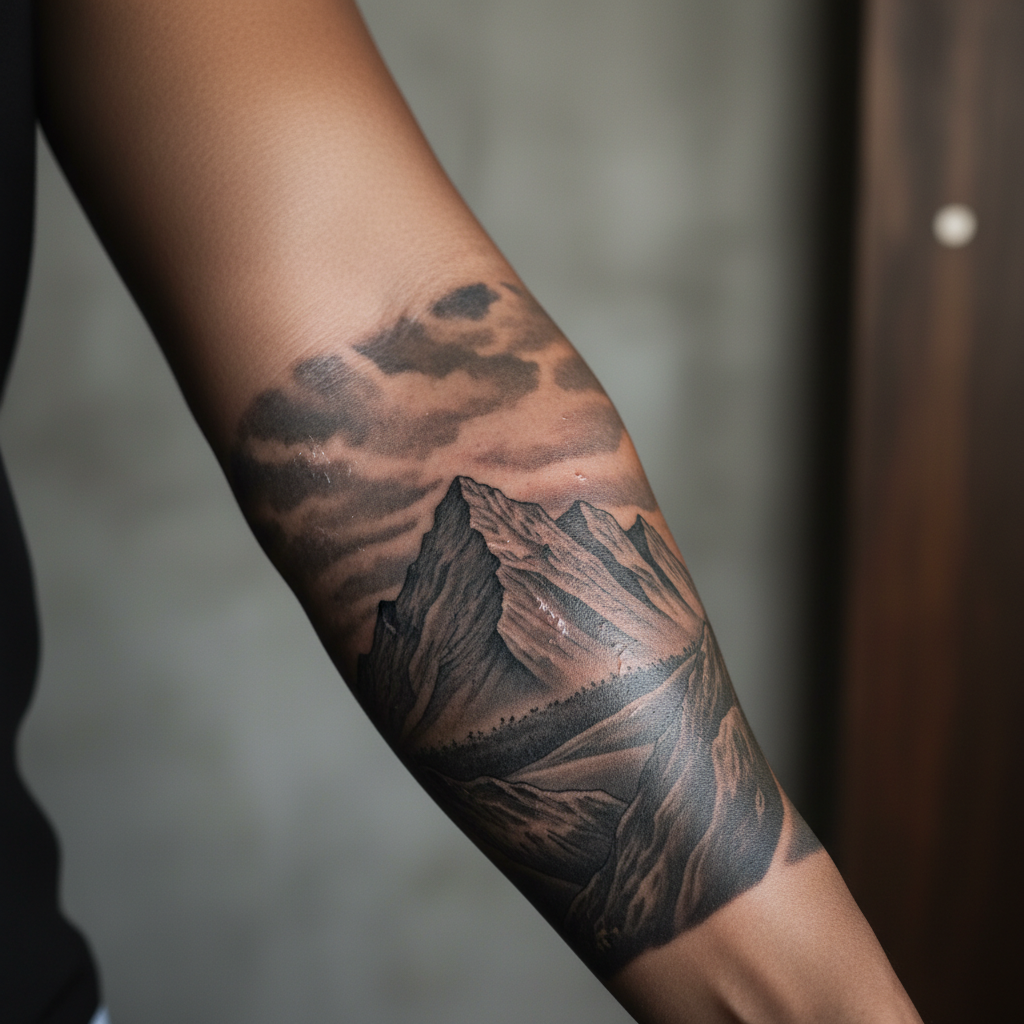
- 6-inch black-and-grey forearm piece: 4 hours, around $800
- 6-inch color forearm piece: 6 hours, around $1,200
- Half sleeve black-and-grey: 12 to 16 hours, around $2,400 to $3,200
- Half sleeve full color: 18 to 24 hours, around $3,600 to $4,800
These ranges assume the piece can be done well in those time windows. Tight realism, photo-portrait work, or heavy stippling all push the upper bound regardless of whether you go color or grey. For a deeper look at how artists structure those quotes, see tattoo pricing explained.
The second-session problem
Many color tattoos need a touch-up around six to eight weeks after the original session. This is normal. Pigments settle unevenly as the skin heals, light colors like yellow and white sometimes need a second pass to read solid, and red ink in particular can lose 10 to 20 percent of its saturation during the peeling phase. A good color artist will quote this honestly upfront, sometimes including a free touch-up in the original price, sometimes charging a half-hour or hour at their standard rate. Either way, you should budget an extra $100 to $300 for color work specifically.
Black-and-grey rarely needs the same treatment. Grey wash heals more predictably, and a black outline that sits well at week one will usually sit well at year ten. If a black-and-grey piece needs a touch-up, it is more often because the artist or the client did something wrong during healing, not because the technique demands it. The tattoo touch-up cost guide covers what to expect in either scenario.
Where the gap shrinks or disappears
Not every color piece costs more. A few situations narrow or close the gap. Small color pieces under two inches with limited palettes, like a simple flower with two or three colors, often cost the same as a black-and-grey version because both hit the shop minimum of $100 to $200. Watercolor-style tattoos, despite using color, sometimes cost less than detailed black-and-grey realism because the technique relies on loose washes rather than dense packing. Traditional American color, with bold outlines and flat fills, is faster to execute than fine-line color shading and often quotes at black-and-grey rates from artists who specialize in it.
On the other side, color realism with smooth gradients between hues can cost 60 to 80 percent more than black-and-grey realism. The blending demands extreme control, and any uneven patch becomes obvious once healed. Artists who do this work well are rare, charge $250 to $400 per hour, and book six to twelve months out.
Long-term cost: which holds up better
Cost is not just what you pay on session day. Color tattoos fade faster than black-and-grey, especially on sun-exposed skin. Reds and yellows lose visible saturation within five to seven years even with diligent sunscreen use. A color sleeve might need a refresh session at year eight or ten, adding another $400 to $1,000 to the lifetime cost. Black-and-grey work, particularly pieces with solid black outlines, can go fifteen to twenty years before needing meaningful touch-up.
If you compare total cost over a twenty-year horizon, the gap widens. A $1,500 color half sleeve plus two refresh sessions of $400 each comes to $2,300. A $1,000 black-and-grey half sleeve with one $200 touch-up comes to $1,200. That long-term math matters more for placements that get sun exposure, like forearms, calves, and shoulders. Pieces in covered areas hold color much longer. The tattoo sunscreen long-term care guide goes deeper on fade prevention if you do commit to color.
Frequently asked
Is color always more expensive than black-and-grey? No, but it usually is. Small color pieces that hit the shop minimum often cost the same as black-and-grey at that size. Once a piece runs more than two hours of session time, color almost always pulls ahead on price because of the extra time required for packing pigment evenly.
How much extra should I budget for color over black-and-grey? Plan for 30 to 60 percent more than the same composition would cost in black-and-grey. On a $1,000 piece, that means budgeting an additional $300 to $600. Also set aside $100 to $300 for a likely touch-up session six to eight weeks later, which color work needs more often than grey work.
Does color cost more because the ink is expensive? Ink cost is a small factor. A bottle of premium color ink runs $15 to $25, and even a complex piece pulls from a dozen bottles at most. The real driver is time. Color packing takes 30 to 50 percent longer than equivalent black-and-grey work, and you pay for that time at the artist's hourly rate.
Why do color tattoos need touch-ups more often? Light colors like yellow, white, and pastel pink can settle unevenly during healing. Red ink loses some saturation during the peeling phase. Artists plan for this and often build a touch-up into the original quote or charge a reduced rate for the second pass. Black-and-grey heals more predictably and rarely needs the same correction.
Will my color tattoo fade faster than black-and-grey? Yes, in most cases. Color pigments break down faster under UV exposure than black ink. Reds and yellows show fading first, sometimes within five years on sun-exposed placements. Diligent sunscreen use slows this, but does not stop it. Black-and-grey work, especially with solid black outlines, can go fifteen years or more before needing refresh work.
Is the color price difference worth it? That depends on the design. Some pieces only work in color, like watercolor backgrounds, vibrant florals, or color realism portraits. For those, paying the premium makes sense because black-and-grey would not deliver the same effect. For designs that work either way, like geometric patterns, lettering, or simple linework, black-and-grey gives you a piece that ages better for less money upfront and over time.