design ideas
Sleeve Tattoo Composition: How to Plan the Layout
A sleeve tattoo lives or dies by its composition. Here is how to plan flow, negative space, and anchor points before the needle touches skin.
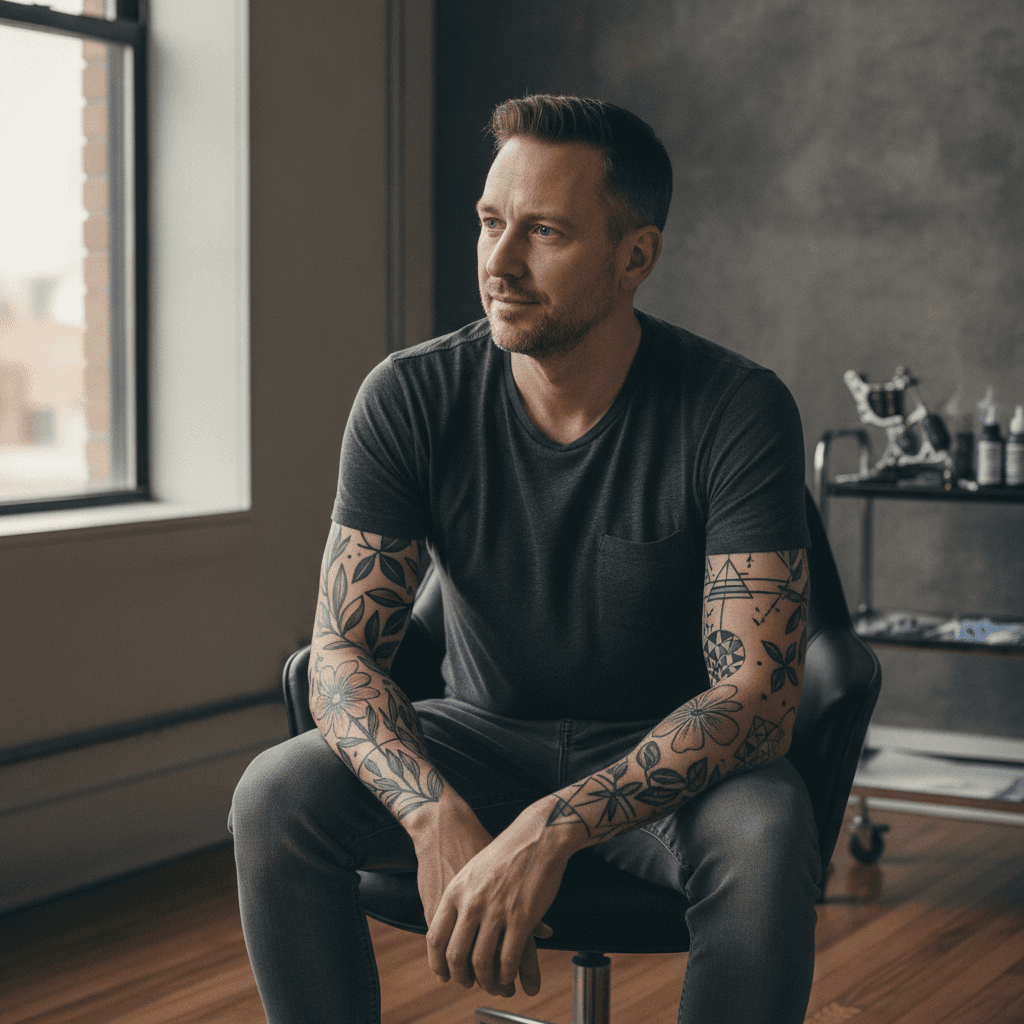
A sleeve tattoo is not a collection of tattoos on the same arm. It is one piece of art wrapped around a moving cylinder of muscle, and the difference between a good sleeve and a crowded mess is almost always composition. Most bad sleeves happen because someone booked six separate sessions with no map, ran out of skin, and tried to fill the gaps with filler that fights the anchor pieces. This guide walks through how professional artists plan layout before the first stencil goes on, so your sleeve reads as one design from ten feet away and holds up as it ages.
Start with the anchor piece, not the theme
Every strong sleeve has one focal piece that carries the eye. That is your anchor. It usually sits on the outer forearm or the outer upper arm because those surfaces sit forward when your arm is relaxed at your side. Pick the anchor before you pick the theme. A dragon head on the outer bicep, a portrait on the outer forearm, a large botanical bloom on the shoulder cap. Every other element in the sleeve is a supporting cast member for that anchor.
Artists building a full sleeve typically want the anchor to occupy roughly 25 to 35 percent of the total canvas. Too small and the sleeve reads as noise with no center. Too large and the negative space collapses, which makes the whole arm look heavier and darker than intended. If you already have a scattered set of small tattoos on that arm, the honest conversation to have with your artist is whether one of them can become the anchor, or whether cover-up work needs to happen first. A cover-up tattoo inside a sleeve plan is a normal ask and cheaper than it sounds when it is baked into the sleeve budget.
Map the flow around the natural arm shape
The arm is not a flat rectangle. It twists, it has a bicep peak, an elbow ditch, an inner wrist that pulls when you rotate. Composition has to follow those planes or the design fights the body. The classic rule artists use is that lines should sweep from the shoulder toward the wrist along a soft diagonal, roughly matching the natural muscle flow. Straight horizontal bands look like prison-tier stacking. Straight vertical stripes chop the arm into segments and kill any sense of one continuous piece.
Elbow is the hardest zone. Skin folds hard there, and any tight detail placed directly on the elbow point will smudge as it heals and stretch as you age. Good sleeve composition uses the elbow as a transition zone, not a detail zone. Think swirling smoke, water, waves, clouds, or geometric transitions. The area two fingers above and below the elbow gets the fine detail. The elbow itself gets flow.
Choose your style before you choose your subjects
Style dictates how much negative space you need, how the sleeve ages, and how many sessions it will take. A Japanese irezumi sleeve is built on wind bars, water lines, and cloud fillers that connect the main subjects. Those fillers are the composition. Take them away and the tigers and koi float in nothing. Irezumi sleeves are almost always full coverage, meaning very little skin shows through, and they typically run 40 to 80 hours of work at 150 to 300 dollars per hour depending on the artist's tier.
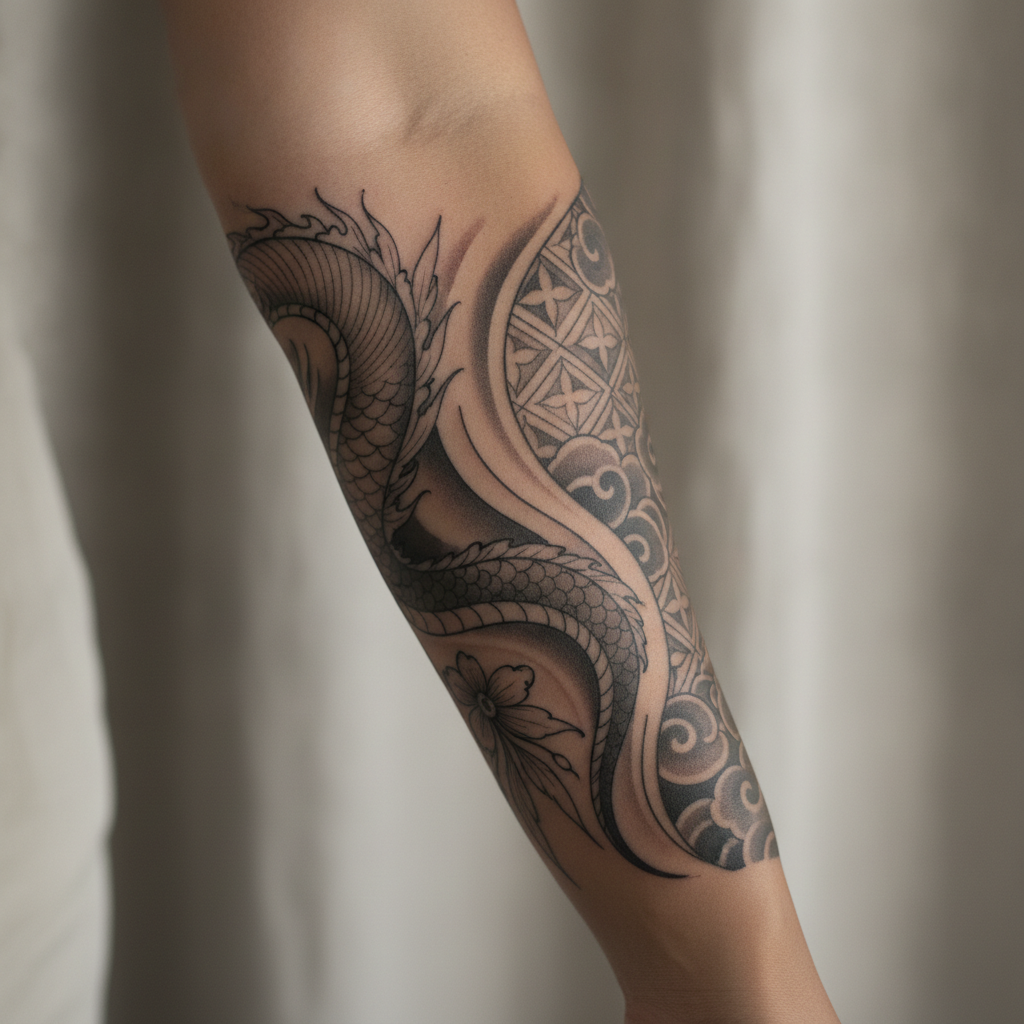
A blackwork sleeve uses solid black shapes and heavy negative space as the compositional structure. Flow comes from the silhouettes of the black masses, not from filler. Fine line and micro-realism sleeves go the opposite direction, using a lot of open skin between small detailed pieces connected by delicate linework or scattered dot fields. Neo-traditional sleeves land in the middle, with bold outlines, saturated color, and mid-density filler like leaves, gems, or banners tying the anchor pieces together. Mixing styles within one sleeve almost never works. If you want a Japanese wave transitioning into a fine-line rose, expect it to read as two unrelated tattoos on the same arm.
Plan negative space like it is a design element
Negative space is not the leftover. It is a shape you draw on purpose. Skin between elements is what lets the eye rest and what tells the brain "these two things belong together." A common ratio artists use for a balanced sleeve is roughly 60 percent tattooed, 40 percent skin visible, though full-coverage irezumi or blackwork sleeves push toward 85 to 90 percent tattooed with very thin skin lines acting as the negative space.
Two rules for negative space that hold up across every style:
- Keep negative space consistent in width along the flow. Skin channels that pinch and widen unevenly look like mistakes, even when they were intentional.
- Never leave a small isolated patch of skin surrounded by ink. It reads as an unfinished spot and your eye will keep returning to it. Either close it in or open it up.
Sequence the sessions in the right order
Composition planning is not just spatial, it is temporal. The order you tattoo a sleeve in shapes the final look. The standard sequence artists use is: anchor piece first, then the secondary pieces on the opposite side of the arm for balance, then the connective fillers, then final details and touch-ups. Do not start with the fillers. Do not start with the wrist because you are impatient to see progress. Starting anywhere but the anchor forces every later piece to react to placements that may not have been optimal.
Full sleeves typically break into 5 to 10 sessions of 3 to 5 hours each. Half sleeves usually take 3 to 5 sessions. Budget-wise, expect a full sleeve to land in the 3,000 to 15,000 dollar range depending on style, artist tier, and city. Half-sleeve pricing is roughly half that, though the composition planning matters just as much because half-sleeves have to look finished on their own rather than expecting to extend.
Space sessions at least 4 to 6 weeks apart. Fresh skin next to still-healing skin makes it hard for the artist to blend edges, and irritated skin takes ink unevenly. If your artist is booked out three months between sessions, that is normal for someone doing sleeve-level work and is not a reason to switch artists mid-sleeve.
Frequently asked
Can I plan a sleeve piece by piece over years? You can, but it rarely reads as one design. Piece-by-piece sleeves usually end up as a patchwork sleeve, which is its own valid aesthetic if that is what you want. If you want a cohesive single-design sleeve, plan the full map before session one, even if you tattoo it over two or three years. The map is the point.
How do I connect old tattoos into a new sleeve? Bring photos of every existing tattoo on that arm to your consultation. Your artist will look at whether they can be incorporated as anchor or secondary elements, hidden inside blackwork masses, or covered. Cover-up and blast-over work as part of a sleeve plan is much cleaner than pretending the old pieces are not there.
Should the inner arm be tattooed? Inner bicep and inner forearm are optional. Full-coverage sleeves include them. Half-sleeves and outer-focus designs often leave the inner arm blank or lightly filled. Inner skin fades faster because it gets less sun and thicker healing, so fine detail on the inner arm needs touch-ups more often.
How much time between finishing the sleeve and touch-ups? Wait at least 6 to 8 weeks after the final session before assessing what needs touch-up. Some spots that look uneven while healing settle in and look fine. Book the touch-up appointment as part of the final session so the slot is held.
Does age of the design matter for composition? Yes. A fine-line sleeve at 20 will look softer at 50. Bold outlined styles like Japanese, American traditional, and blackwork hold their composition for decades. If you want your sleeve to read the same way at 60 as it does at 30, weight your composition toward bold outlines and strong silhouettes rather than delicate detail work.
Can I use different artists for different sessions? It is technically possible but strongly discouraged for a single-design sleeve. Every artist has a distinct linework weight and shading style, and mixing them mid-sleeve is visible even to untrained eyes. Patchwork sleeves with intentional multi-artist collections are the exception, and those are planned that way from the start.