aftercare
Tattoo Cracking During Healing: Causes and Fixes
Tattoo cracking during healing usually means the skin is too dry. Here is what causes it, how to fix it, and when to worry.
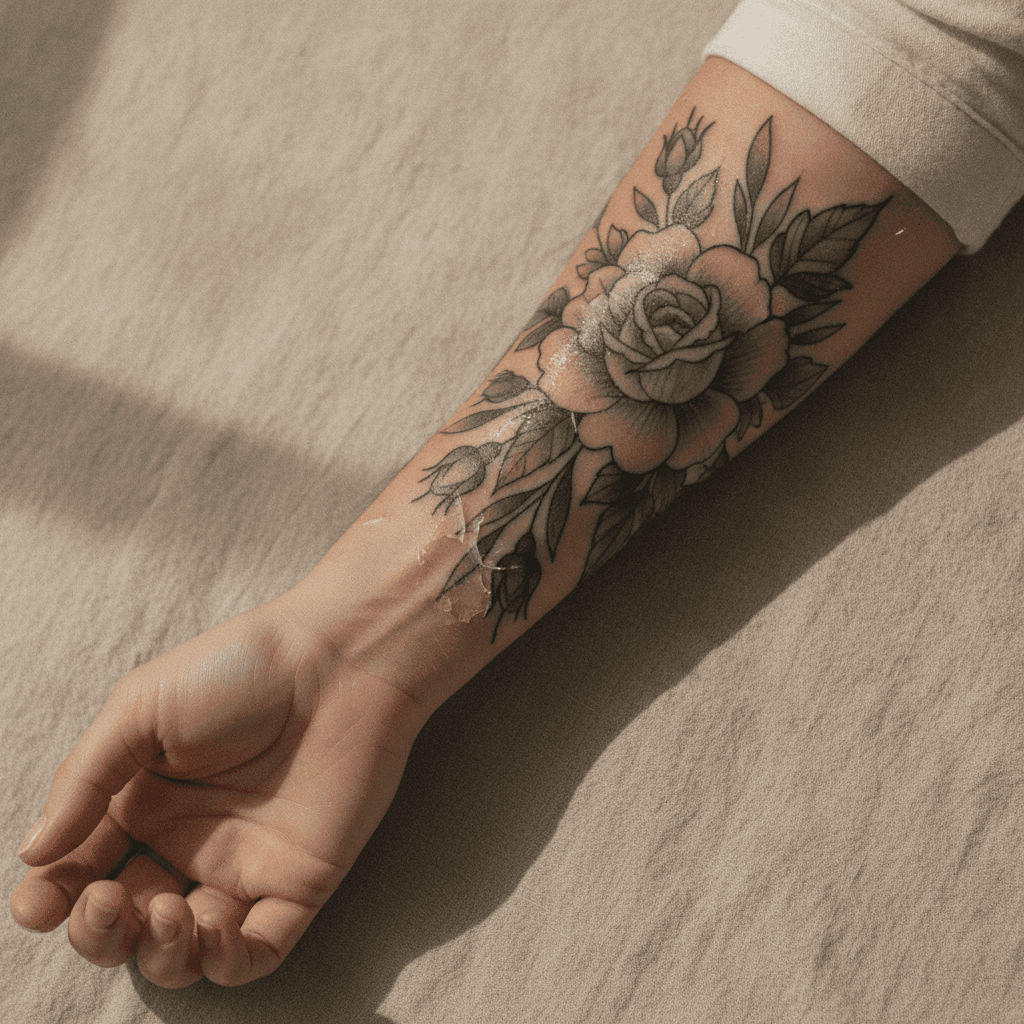
A cracked tattoo looks alarming on day six. The lines you paid $600 for now sit under a dry, split surface that flexes every time you bend your wrist. Cracking is one of the most common healing complaints between day four and day twelve, and it almost always comes down to moisture balance, not damage to the tattoo itself. This guide covers why cracking happens, what to do the moment you spot it, which products help, and the small number of cases where a crack signals a real problem worth a message to your artist.
Why tattoos crack during healing
Cracking is a symptom of dry healing skin over a still-forming scab layer. A fresh tattoo weeps plasma, blood, and ink for the first 24 to 48 hours. That fluid dries into a thin protective crust across the design. As the skin underneath rebuilds, that crust tightens. If the surface loses too much moisture, the crust splits along the lines of movement, usually across joints, tendons, and any area that flexes when you sit, walk, or grip.
Three things push a tattoo into cracking territory. First, under-moisturizing. Applying a pea-sized amount of ointment once a day is not enough for a piece larger than a business card. Second, over-washing. Rinsing four or five times a day strips the skin's natural oils faster than the healing surface can regenerate them. Third, environmental dryness. Air-conditioned bedrooms, long-haul flights, and winter heating all pull humidity out of the outer skin layer. A piece on the forearm can be fine at home and cracked by the time you land in a dry city eight hours later.
Location matters. Fine-line work on the wrist, inner elbow, back of the knee, and top of the foot cracks faster than the same style on the thigh or upper arm. Denser blackwork and saturated color pieces hold moisture in the ink layer for longer, which is why they tend to scab thicker rather than crack. If you have a small, delicate tattoo on a joint and the surface looks like dry riverbed by day seven, that is the classic cracking pattern.
How to tell cracking apart from scabbing, peeling, and blowouts
These four look similar on day six but mean different things. Normal scabbing forms a soft, slightly raised crust that stays flexible and lifts on its own between day eight and day fourteen. Peeling is thin, flaky, and comes off in translucent sheets that look like sunburn peel. Cracking is dry, brittle, and shows visible fissures across the tattoo, often deeper than the ink itself appears. A blowout is a permanent ink migration under the skin that shows up as a blurry shadow next to the line and never fades on its own.
If the surface splits but there is no bleeding, no yellow or green discharge, and no expanding redness beyond a few millimeters from the crack, you are almost certainly looking at dryness. If the crack opens and weeps clear or milky fluid, if the skin around it feels hot to the touch, or if you see red streaks radiating outward, treat it as a possible infection and read the signs of tattoo infection guide before doing anything else.
The 48-hour rehydration protocol
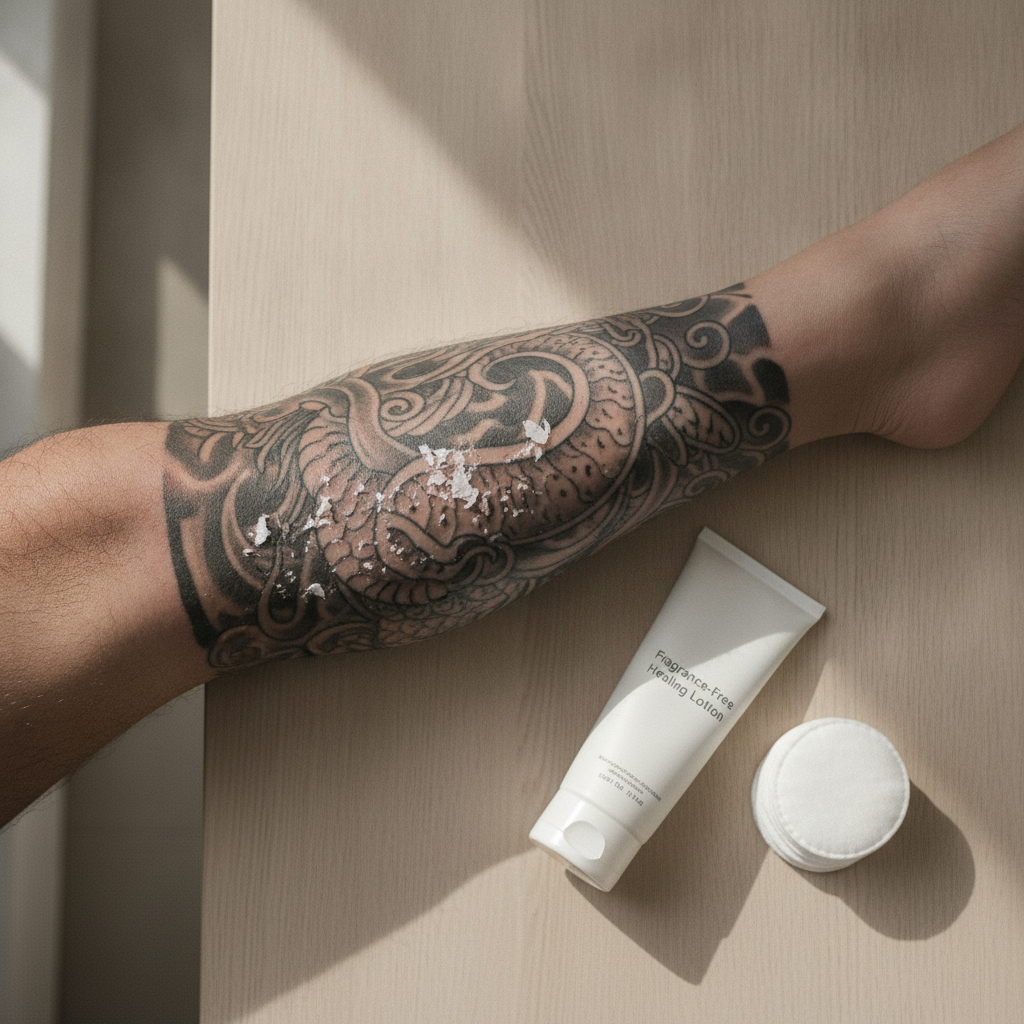
Once you see cracking, the fix is careful rehydration over the next two days. Do not soak the tattoo, do not scrub the cracks, and do not peel the loose edges. The goal is to soften the crust until it lifts naturally.
- Rinse twice a day with lukewarm water and a fragrance-free liquid soap. Two rinses, no more.
- Pat dry with a clean paper towel. Never rub with fabric.
- Apply a thin layer of unscented healing lotion three to four times a day. Aquaphor, Hustle Butter, and Cerave Healing Ointment all work. Thin means you can still see the tattoo clearly through the layer.
- Between applications, avoid tight clothing over the area. Cotton and loose sleeves only.
- Sleep with the tattoo exposed if possible. Sheets pull moisture out overnight.
Most cracked tattoos look meaningfully better within 48 hours on this protocol. By day three, the cracks should be closing, the crust should be softer, and any tightness when you flex the area should be gone. If nothing has changed after two full days, either the product is not working for your skin or something else is going on. Switch from ointment to a lightweight lotion like Cerave Daily Moisturizing and try another 48 hours before escalating.
Products that help, products that make it worse
The best product for cracking is usually not the one your artist handed you at the shop. Petroleum-based ointments like Aquaphor are excellent for the first three days but become too heavy by day five. They trap moisture the tattoo no longer needs and can actually contribute to the crust getting too tight before it splits. Switching to a fragrance-free lotion around day four or five is often the missing step. The ointment-to-lotion switch guide covers the timing in more detail.
Fragrance-free is non-negotiable. Anything scented, including "natural" essential-oil blends, irritates a healing tattoo and can make cracking worse by triggering low-level inflammation. Coconut oil is popular online but sits on the surface without penetrating, which does not help the deeper layer where the split is happening. Vitamin E oil is fine after full healing but too heavy during the crack window. Vaseline alone traps sweat and slows healing. Read the Vaseline on new tattoos breakdown if you were told to use it.
Artists report that roughly 70% of cracking calls are solved by switching from ointment to a light unscented lotion and cutting washing to twice a day. It is almost never about the ink or the technique.
When cracking means you need a touch-up
Most cracked tattoos heal without any ink loss. The line work sits deep in the dermis, and the surface crust that cracks is above where the ink lives. Once the tattoo fully heals around week four to six, the design should look identical to the day it was done, minus about 10 to 15% of the initial saturation that always fades during healing.
Ink loss from cracking happens in three scenarios. First, if you picked at the cracks and pulled the crust off early, taking pigment with it. Second, if the tattoo cracked, got infected, and the infection destroyed part of the ink layer. Third, if the crack was deep enough to reach the ink layer, which usually only happens on very heavily saturated color pieces that were also allowed to dry out severely.
Wait until the tattoo is fully healed before judging whether you need a touch-up. That means at least four weeks for surface healing and closer to three months for the deeper layers to settle. If a section still looks patchy, faded, or missing line work at the twelve-week mark, message your artist. Most reputable studios include one touch-up within the first six months at no charge. The touch-up cost guide covers what to expect if the free window has passed.
Prevention on your next tattoo
Cracking is easier to prevent than to fix. Start moisturizing on the schedule your artist gives you, but do not wait until day three to check the surface. From day two onward, look at the tattoo in good light twice a day. If any area looks matte, tight, or shiny in a dry way rather than a moist way, add a lotion application. If the tattoo is on a joint, apply lotion before any activity that will flex the area.
Hydrate from the inside as well. Healing skin needs more water than usual, and dehydration shows up in the tattoo before it shows up anywhere else. If you are traveling, treat the flight itself as a risk window. A long flight guide covers what to bring in a carry-on. Humidifiers help in dry climates and hotel rooms. A cheap USB desk humidifier next to the bed is often the difference between a smooth heal and a week of cracking.
Frequently asked
Is a cracked tattoo ruined? Almost never. Cracking happens above the ink layer, and the tattoo underneath is intact in the large majority of cases. Full ink assessment should wait until the twelve-week mark when the skin has fully settled.
Should I peel off the cracked skin? No. Peeling the loose edges tears at the healing surface and can pull ink out with the crust. Let it lift on its own. Moisturize carefully and the loose pieces will fall off in the shower within a few days.
Can I still exercise with a cracked tattoo? Light activity is fine as long as you avoid sweating heavily over the tattoo and any equipment that presses on it. Skip weights that require gripping across the piece and skip anything that soaks the area. See the working out after a tattoo guide for the full breakdown.
Why did only part of my tattoo crack? Usually because that section covers a joint or a spot with less natural oil production. Elbows, wrists, inner forearms, and tops of feet dry out faster than the surrounding skin. Focus lotion applications on the cracked area specifically for the next two days.
Does cracking mean my artist did something wrong? No. Cracking is a skin-and-moisture issue, not a technique issue. Even a perfectly executed tattoo cracks if it dries out too much during healing. The one exception is if the tattoo was worked over too heavily in one pass, but that shows up as raw, weeping skin rather than dry cracking.
How long does the cracking phase last? On the rehydration protocol above, cracks typically close within 48 hours and the surface fully smooths out by day ten to fourteen. The tattoo continues to settle underneath for another six to eight weeks after the surface looks normal.