design ideas
Mythological Tattoo Ideas: Gods, Monsters, and Legends
Mythological tattoo ideas across Greek, Norse, Egyptian, and Japanese traditions, with sizing, placement, and style pairings that actually hold up.

Mythology gives you a design library thousands of years deep, which is why it keeps showing up in tattoo portfolios across every style and every skin tone. The tricky part is choosing a figure and a treatment that survives the translation from a marble statue or an illuminated manuscript to a curved surface of skin that stretches, ages, and blurs a little every year. This guide walks through the four mythologies that show up most often in shops, the placements that suit each one, and the specific design choices that keep a mythology piece readable ten years in.
Greek and Roman: the sculptural staples
Greek and Roman figures translate well because they were designed to be read from a distance and understood by an illiterate crowd. Zeus with a thunderbolt, Poseidon with a trident, Athena with an owl on her shoulder, Medusa with snakes for hair. These attribute-based designs mean the artist can crop tight, keep the face detailed, and let a single object carry the identification. A Medusa portrait on the inner bicep with three or four snakes reads instantly. A full Poseidon rising from waves needs a half-sleeve minimum, usually 8 to 12 inches tall, because the trident and the water both need room to sit in.
Black-and-grey realism is the default treatment because it mimics marble and lets fine facial detail carry the piece. Neo-traditional works too if you want bolder outlines and a limited color palette, usually deep reds, gold ochres, and Prussian blue. Fine-line does not carry a mythology portrait well at scale beyond about 4 inches, because the detail collapses into a smudge as the ink migrates. If you want a small Greek reference on a wrist or forearm, choose a symbol instead of a face. An olive branch, a laurel wreath, or a lyre stays crisp at 2 to 3 inches even after a decade. For a broader look at how technical treatments compare, our black-and-grey style guide breaks down the shading choices that hold up longest.
Norse: knotwork, animals, and the tree
Norse mythology leans on three visual vocabularies: figurative gods and giants, animal motifs like ravens and wolves, and the interlaced knotwork that ties Scandinavian and Celtic traditions together. Odin with his two ravens on a shoulder blade, Fenrir mid-lunge across a calf, Thor's hammer Mjolnir centered on a sternum, Yggdrasil covering a full back. The knotwork pattern is where a lot of Norse pieces succeed or fail. Clean knotwork requires an artist who understands the over-under rule and can plan the interlace without breaking it, because the eye catches an inconsistency instantly.
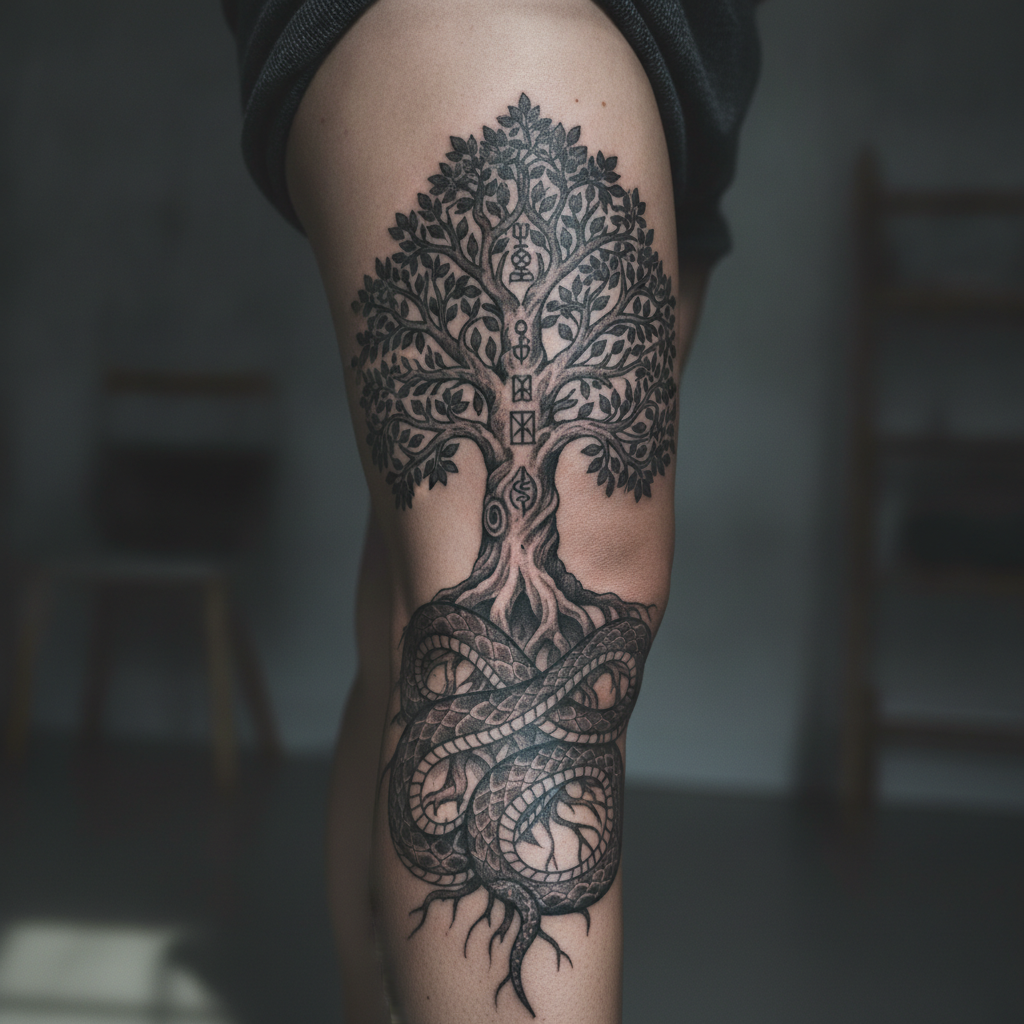
Placement usually follows the shape of the figure. Ravens work well on the collarbone or the front of the shoulder because their outstretched wings match the curve. Wolves and other running animals suit the calf, the forearm, or the outer thigh where they have a long horizontal canvas. A full Yggdrasil back piece takes 40 to 60 hours across four or five sessions and easily runs $4,000 to $8,000 depending on the artist tier. For a smaller Norse piece, a single rune or a simple Mjolnir at 3 to 4 inches is a safe entry point.
Egyptian: geometry and hieroglyphic clarity
Egyptian designs come with built-in geometry, which is why they translate beautifully into blackwork and geometric styles. Anubis in profile, Bastet seated, Horus with the eye motif, Ra with the sun disc. The Egyptian art convention of showing the head in profile and the shoulders straight-on is not a stylistic choice you invent, it is how the source material reads, and any artist tattooing Egyptian figures should either follow it or make a deliberate break from it. The Eye of Horus and the ankh are two of the most-requested small Egyptian tattoos because both hold up at 2 to 3 inches and both carry meaning most viewers recognize.
- Anubis full body: 6 to 10 inches, forearm or outer bicep, black-and-grey or blackwork
- Eye of Horus: 2 to 4 inches, wrist, ankle, or behind-the-ear, blackwork or fine-line
- Ankh: 2 to 3 inches, wrist, sternum, or spine, fine-line or dotwork
- Bastet cat portrait: 4 to 6 inches, inner arm or calf, neo-traditional or black-and-grey
- Ra with sun disc: 5 to 8 inches, upper arm or shoulder, blackwork with color accent
Color in Egyptian tattoos is worth thinking about carefully. The source material uses very specific pigments, cobalt blue, malachite green, ochre, and lampblack, and copying that palette into ink means you are asking a lot of your artist and your skin. Blues and greens fade fastest on lighter skin and hold poorly on darker skin. If you want the Egyptian palette, ask about touch-up cadence up front, and consider whether blackwork alone would give you the same effect with less maintenance. Our color versus black-and-grey cost guide covers the pricing side of that choice.
Japanese and East Asian: yokai, dragons, and full-body traditions
Japanese mythology in tattoo form is essentially the irezumi tradition, and the design rules are strict for good reason. Dragons wrap the body along a diagonal, tigers face forward with claws extended, koi swim upstream on the leg and downstream on the back to indicate transformation. Yokai like the kitsune fox spirit, the tengu, and the oni demon each carry specific iconography that a skilled Japanese-style artist will not deviate from. This is a tradition where scale matters. A dragon at 4 inches on a wrist will not read as a Japanese dragon, it will read as a smudge. Plan for a half-sleeve at minimum, ideally a full sleeve or a back piece.
The Japanese style also uses background elements deliberately. Wind bars, water, and cherry blossoms fill the negative space and unify the composition. Skipping the background to save money almost always weakens the piece, because the figure ends up floating on skin with no visual context. Budget for the background from the start. A full traditional Japanese sleeve typically runs 30 to 50 hours and $3,000 to $6,000 with a mid-tier artist, more with a specialist. The japanese irezumi cost breakdown walks through the session structure in more detail.
Frequently asked
Do mythological tattoos need to be culturally accurate? Accuracy matters more for some traditions than others. Greek, Norse, and Egyptian imagery is generally considered public heritage and rarely raises cultural concerns. Japanese irezumi and certain Polynesian traditions carry stronger cultural weight, and the best move is to work with an artist trained in that tradition and to ask about symbols you should avoid using.
Which mythology holds up best over time on skin? Greek and Roman black-and-grey pieces age the most gracefully because they lean on shading gradients that blur naturally. Highly detailed color Egyptian and Japanese pieces need more touch-up work over a 10 to 15 year window. Bold blackwork of any mythology ages the slowest.
Can I combine gods or symbols from different mythologies? Technically yes, and plenty of people do. Design-wise it usually reads better if you commit to one visual tradition per piece and let a different mythology live in a different tattoo on a different part of the body. Mixing Greek marble textures with Japanese wind bars on the same panel tends to feel unresolved.
How big should a mythology portrait be? For a face with recognizable expression, plan for 4 to 6 inches minimum. A full figure needs 6 to 12 inches depending on pose. Anything smaller loses the facial detail that carries the identification, and the piece becomes a generic figure rather than a specific god.
Are mythological tattoos more expensive than other designs? They tend to run higher than average because they require research time, more detail work, and often a specialist artist. Expect to pay 20 to 40 percent above your artist's base rate for a well-researched mythology piece, and expect the design phase alone to run one to three sessions before any ink hits skin.
What is the best placement for a first mythology tattoo? A single symbol or attribute at 3 to 5 inches on the forearm or upper arm is the safest first move. It gives you a placement that ages well, a size that heals cleanly, and a design scope that a good artist can complete in one session. Save the full sleeve or back piece for after you have lived with the smaller piece for six months to a year.