style guides
Celtic Tattoos Style Guide: Knotwork, Symbols, and Longevity
A practical guide to Celtic tattoos: knotwork rules, common symbols, ink and needle choices, session counts, and how the style ages on skin.
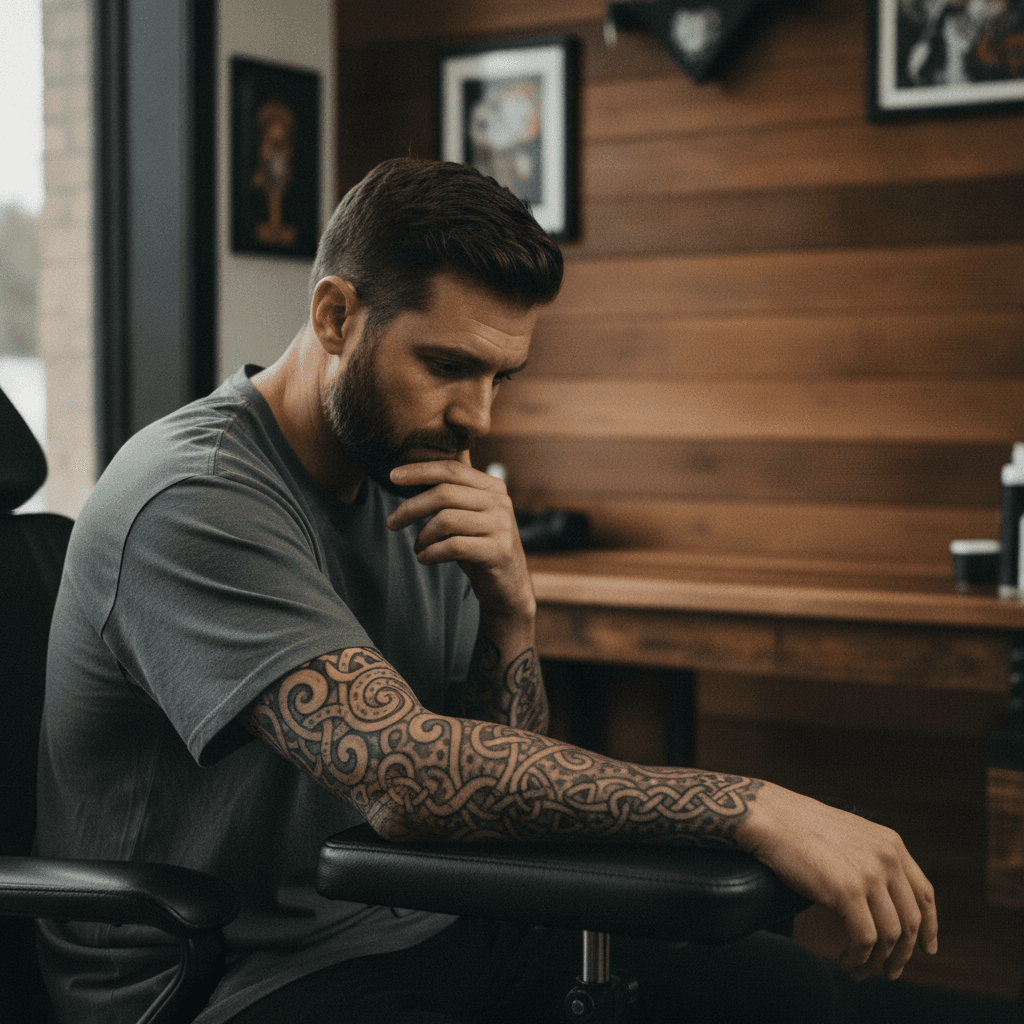
Celtic tattoos are one of the oldest continuously requested styles in Western shops, and they hold up because the underlying geometry is engineered for the human body. The style is built on interlace knots, spirals, and stylised animal or plant forms drawn from Insular manuscripts like the Book of Kells and from stone carvings across Ireland, Scotland, and Wales. This guide covers what actually defines the style, which symbols carry weight, how artists execute a clean piece, and what to expect for cost and healing.
What defines a Celtic tattoo
A tattoo is Celtic if it uses interlace knotwork, spirals, key patterns, or zoomorphic beasts derived from the Insular Celtic tradition roughly 400 to 1200 AD. The defining feature is a woven line that appears to pass over and under itself with no visible start or end. Good knotwork follows a strict grid where every crossing alternates over, under, over, under. If two crossings in a row go the same direction, the illusion of a woven cord breaks and the piece reads as flat pattern instead of knotwork.
Line weight matters more here than in almost any other style. Traditional Celtic tattoos use a single consistent line weight for the entire knot, usually laid down with a 7 or 9 round liner in solid black. Some contemporary artists shade the interior of the bands to create a rope or leather effect, but a purist Celtic piece stays flat black on skin with negative space handling the depth. Fine outlines under 3RL tend to look thin and get lost as the tattoo ages, which is why most artists push clients toward a bolder liner.

Common symbols and what they mean
The core Celtic symbols each carry a specific meaning that predates modern reinterpretation. Understanding the source helps you pick something that fits without leaning on generic pinterest translations.
- Triquetra: three interlocked arcs forming a triangle. Pre-Christian, associated with the triple goddess of maiden, mother, and crone. Adopted later as a Trinity symbol.
- Triskele or triple spiral: three connected spirals radiating from a centre. Found on the entrance stone at Newgrange, dated to roughly 3200 BC. Represents motion, cycles, and transition.
- Celtic cross: a cross with a ring around the intersection. Christian symbol layered onto older solar and cosmological imagery, especially popular in Irish and Scottish diasporic tattoos.
- Dara knot: an eight-pointed interlace pattern named for the Irish word for oak. Associated with strength and root systems.
- Claddagh: two hands holding a crowned heart. From the village of Claddagh in Galway, seventeenth century. Represents love, loyalty, and friendship.
- Zoomorphic beasts: elongated stylised animals with interlaced limbs. Common in Book of Kells illumination and in Pictish stone carving.
Placement often ties to meaning. Triskeles work well on the shoulder or upper back where the three arms can radiate cleanly. Dara knots suit forearms and calves where the eight-point structure has room to breathe. A Celtic cross is a common back or chest piece because the vertical axis benefits from a longer canvas.
Execution and needle choices
Celtic linework lives or dies by the layout. Any competent Celtic artist starts with a graph or grid overlay so every crossing is mathematically consistent. Freehand knotwork almost never comes out clean because the human eye picks up broken alternation within seconds. Ask your artist to send the stencil digitally before the session so you can inspect crossings at 100 percent zoom.
Machines and needles are typical linework equipment. Rotaries with a 7RL or 9RL bugpin for the primary interlace, sometimes a 5RL for internal detail on smaller pieces. Ink is straight-up carbon black from established brands like Solid Ink, Dynamic, or Fusion. Grey wash is optional and only used inside the bands for a dimensional look. Colour is not traditional but shows up in contemporary Celtic fusion work, usually with reds, greens, and golds pulled from manuscript illumination palettes.
Session counts scale with size. A palm-sized triquetra on the inner forearm is a single two to three hour sitting. A half-sleeve of continuous knotwork with a central symbol runs three to five sessions across six to twelve months. Full sleeves with layered zoomorphic beasts and background key patterns hit ten to fifteen hours total and are usually broken into four to six sessions.
Cost and what drives it
Celtic pricing tracks with linework rates in your region rather than with colour or realism rates. Most artists charge hourly here because the layout work eats studio time before the machine even switches on.
- Small standalone symbol (triquetra, small triskele, single knot): $150 to $350
- Palm-sized detailed piece with interlace border: $400 to $700
- Quarter-sleeve or forearm band: $800 to $1,600 across one to two sessions
- Half-sleeve with central figure and background pattern: $1,800 to $3,500 across three to five sessions
- Full sleeve with zoomorphic detail: $4,000 to $8,000 across four to six sessions
Rates vary by market. Urban shops in London, Dublin, New York, and Los Angeles run $180 to $300 per hour for experienced Celtic specialists. Rural and smaller-city rates land at $120 to $180 per hour. If you are flying in for a specialist, budget a shop minimum around $200 to $250 for a small piece.
How Celtic ages on skin
The style ages well when it is executed with proper line weight, and it ages badly when it is not. Consistent 7RL to 9RL black lines hold their crossings for fifteen to twenty years before needing a touch-up. Fine 3RL knotwork on smaller pieces often needs a touch-up at the five to eight year mark because thin lines soften as the ink settles into the dermis.
Skin tone changes how the style reads long term. On lighter skin, black interlace stays crisp with high contrast. On medium and darker skin, the negative space between bands does the work of contrast, which is why Celtic pieces designed for deeper skin tones typically use thicker bands with wider gaps between crossings. Solid black holds well across all skin tones because it is the highest-contrast pigment available.
Sun exposure is the main long-term threat. Uncovered black linework fades toward blue-grey over a decade of regular UV exposure. Daily SPF 30 or higher on any exposed Celtic piece keeps the crossings dark and the lines defined for far longer. If a piece starts to soften, a single touch-up session of one to two hours restores the crossings without recolouring the whole tattoo.
Choosing an artist
Not every blackwork artist can do Celtic well. The specific requirement is the ability to draft interlace on a grid and maintain consistent line weight across large curves. When you review a portfolio, look for these markers:
- Every crossing in the knot alternates cleanly, no broken sequences.
- Line weight is consistent from one end of the interlace to the other, with no visible thin spots.
- Curves are smooth. Look for kinks or wobbles at the tightest bends, which indicate poor freehanding.
- Healed photos, not just fresh work. Fresh linework hides a lot of technical issues that only appear after the tattoo settles.
- Custom work in the portfolio, not just flash. A specialist will show original commissions with layout notes or references.
Blackwork specialists with backgrounds in blackwork tattoos, ornamental tattoos, or Polynesian tattoos often cross into Celtic naturally because the underlying skills overlap. Compare their approach against dedicated Celtic pieces, not just their general blackwork.
Frequently asked
Are Celtic tattoos considered cultural appropriation? Celtic symbols are part of a living cultural tradition with active practitioners in Ireland, Scotland, Wales, and the diaspora. Most Celtic communities treat their symbols as open heritage rather than closed cultural property, similar to how Norse runes are treated. That said, avoid pairing Celtic imagery with unrelated Christian, Norse, or Pacific motifs in the same piece, because the mashup reads as pinterest-flat rather than considered.
How long does a Celtic sleeve take to complete? A full Celtic sleeve typically runs ten to fifteen total hours of tattooing spread across four to six sessions. Most artists schedule sessions three to six weeks apart to allow proper healing between sittings. Complex layered work with zoomorphic beasts and background key patterns can push toward eighteen to twenty hours.
Can Celtic tattoos be done in colour? Yes, though traditional Celtic tattooing stays black. Contemporary Celtic fusion work pulls colour palettes from Insular manuscript illumination, usually deep reds, oxidised greens, and mustard golds inside the bands. Expect colour work to cost roughly twenty to thirty percent more than pure black linework and to need touch-ups every eight to ten years as the pigments settle.
What is the difference between Celtic and Nordic knotwork? Celtic interlace uses smooth curved bands with alternating crossings drawn on a rectangular grid. Nordic and Viking knotwork tends to use angular bands, ribbon-like zoomorphic serpents, and origins in Urnes, Ringerike, and Mammen carving traditions. Both share interlace as a core concept but diverge in line curvature and animal styling.
Does Celtic linework hurt more than other styles? Pain is placement-driven rather than style-driven. A Celtic sleeve on the outer forearm sits at the low end of the pain scale. Ribcage, sternum, and inner bicep placements hurt significantly more regardless of style. The extended line-time in Celtic pieces can make longer sessions feel more grinding than a shaded piece of the same size, so plan for breaks every forty to sixty minutes.
Should I get my Celtic tattoo touched up? Consider a touch-up when the crossings start to soften or when line weight becomes visibly uneven. Most pieces need a first touch-up between year five and year ten depending on sun exposure and skin type. A single one to two hour session with the original artist is usually enough to restore the interlace. Check the touch-up cost guide for typical pricing before booking.