design ideas
Celestial Tattoo Ideas: Moon, Stars, and Planet Designs
Celestial tattoo ideas cover moons, stars, constellations, and planets. Here is how to pick placement, style, and composition so the design ages well.

Celestial tattoos have stayed in the top ten most-requested subjects at flash-heavy studios for over a decade, and the category is deeper than most people realize on the first consultation. Moons, stars, constellations, planets, and full solar systems each carry different design demands. Some age gracefully in fine line. Others need bold black to still read at year five. This guide walks through the main celestial motifs, the placements that suit them, the styles that hold up, and the composition choices that separate a keeper from a piece you outgrow by year three.
Moon tattoo ideas: phases, crescents, and full moons
The crescent is the most common celestial request and the easiest to place well. A simple upward-facing crescent between the collarbones sits inside 2 to 3 inches and reads instantly. A full moon in black-and-grey with soft crater shading needs at least 3 inches across to hold the tonal work, and it typically takes a two-hour session at $150 to $300 per hour depending on artist tier. Moon phase strips, running from new moon through full and back, look best along the spine, sternum, or the underside of the forearm where the line of eight symbols can breathe. If you want the phases to still register at ten feet away, keep each moon at least an inch wide and let the artist use solid black fills for the shadowed portions rather than fine stippling that will soften over time.
Blackwork moons hold up longer than fine-line moons at the same size. A hairline crescent under 2 inches will lose crisp edges by year five as the ink migrates slightly through the dermis, especially on the ribs, feet, and hands. If you love the delicate look, plan for a touch-up around year four or five and see our tattoo touch-up cost guide for what to budget. Larger black-and-grey moons on the upper arm or thigh can stay sharp for a decade or more with sun protection and basic lotion routine.
Star and constellation tattoos
Star clusters and named constellations sit in the sweet spot of small, meaningful, and easy to place. A five-star Cassiopeia along the inner wrist reads in seconds. A twelve-star Ursa Major stretched along the ribcage becomes a statement piece. The key composition decision is whether to include the connecting lines between stars. Lined constellations feel like navigation charts and stay legible even at small sizes because the eye follows the shape. Star-only versions look more organic and scatter-like but need enough spacing between dots so they do not blur into a smudge by year seven.
If you want a real star map, bring your artist the exact date and coordinates and ask them to render it from a Stellarium screenshot rather than freehand. A five-hour session at $200 per hour will get you a detailed 6 to 8 inch star map on the upper back or ribcage. For placement guidance on rib and back pieces, our ribcage tattoo ideas and back piece composition posts cover the layout math in detail.
Planet and solar system tattoos
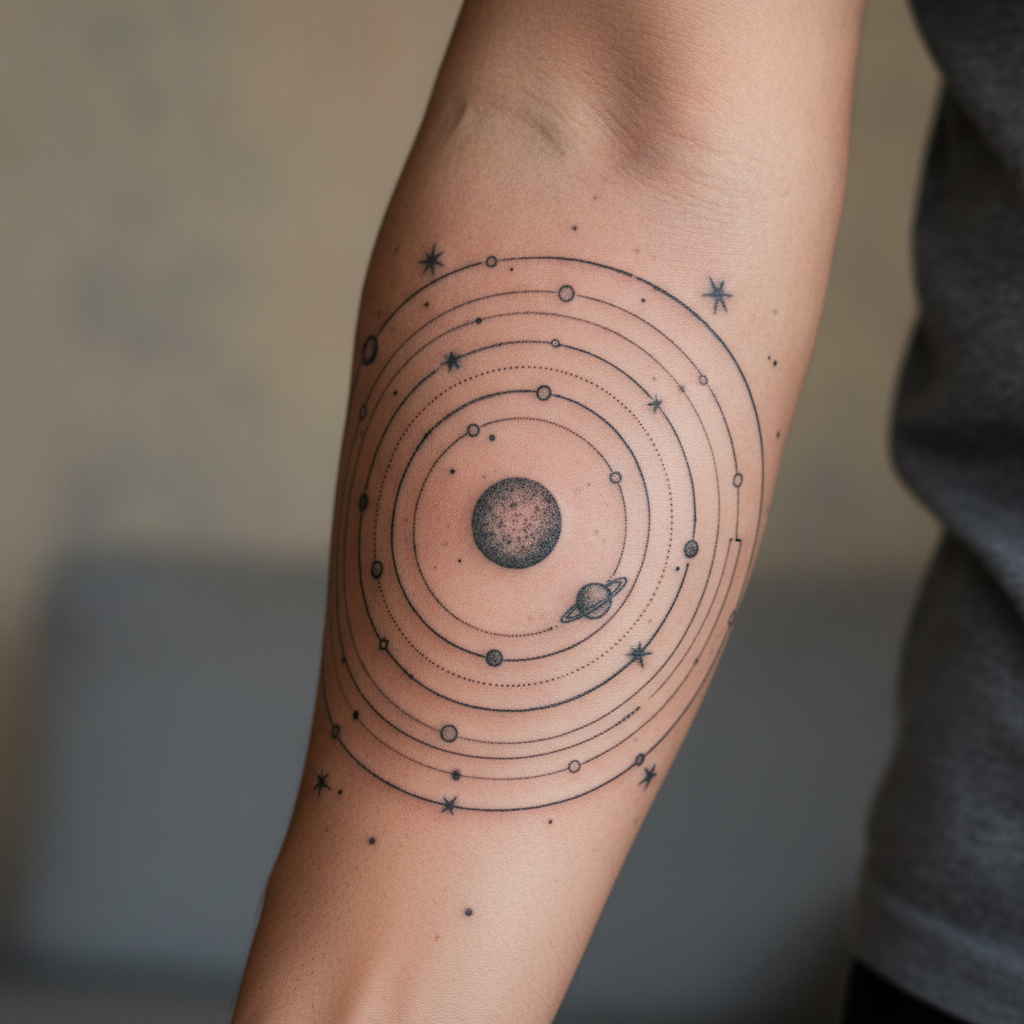
Planet tattoos work best as either a single feature planet or a full linear system, rarely anything in between. A single Saturn with its ring at 3 inches on the inner bicep is one of the most-requested minimalist celestial designs and takes about ninety minutes to complete. A full solar system running the length of a forearm needs at least 10 inches to fit all eight planets plus the sun with enough space that Mercury does not disappear into the elbow crease. Expect a $600 to $1200 flat rate for a full linear solar system in fine line, more if the artist adds textured shading or a nebula backdrop.
Jupiter and Saturn are the most forgiving planets to tattoo because their distinctive features (the great red spot, the ring system) give the eye something to lock onto even at small scale. Earth is the hardest. Continental outlines at under 2 inches look like ink blots within a year, so if you want Earth in a solar system layout, go at least 4 inches across for that single planet or accept it as a solid black dot. For pricing math on longer forearm pieces, cross-reference our forearm tattoo cost guide.
Style pairings that actually work
Not every celestial idea works in every tattoo style. Some pairings are strong. Others fight themselves.
- Fine line: crescent moons, small constellations, single planets, delicate star scatter. Best under 5 inches.
- Black-and-grey realism: full moons with crater detail, planetary surfaces, nebulae. Best 4 inches and up.
- Dotwork: star fields, Saturn rings, moon phase shadows. Extremely durable but slow to tattoo.
- Blackwork: silhouetted crescents, negative-space stars inside solid black panels. Ages best of any celestial style.
- Watercolor: nebula backgrounds, aurora effects behind linework moons. Beautiful at year one, faded by year six without careful upkeep.
Avoid combining watercolor and fine-line stars in the same piece unless you accept the watercolor portion needing a touch-up cycle every three to four years. The two techniques age at completely different rates, and the linework will start looking harsh against the softening color washes.
Placement guide by size
Where you put a celestial tattoo shapes both how it reads and how long it stays crisp. Small pieces under 2 inches belong on flat, low-friction skin: inner wrist, inner forearm, upper chest, ankle, back of neck. Medium pieces from 3 to 6 inches suit the outer forearm, shoulder blade, calf, and thigh. Large celestial pieces from 8 inches up need real real estate: full ribcage, upper back, full thigh, or wrapping the outer arm.
Placements to think twice about include the hands, feet, fingers, and inner lip. Ink loss is fast on those areas, and a delicate constellation on the side of a finger can fade to near-invisible within two years. If you want a celestial piece somewhere high-wear, plan for scheduled touch-ups and check our finger tattoo cost guide for what maintenance costs.
Composition mistakes to avoid
The most common celestial tattoo regret is scale mismatch. People bring in a Pinterest reference of a 6-inch design and ask for it at 2 inches on the wrist. Detail that reads beautifully at 6 inches turns into noise at 2 inches because line weights do not scale linearly. If you love a reference, ask your artist what the minimum size is for it to age well, and either commit to that size or pick a simpler design.
The second common mistake is overcrowding. A moon plus three planets plus a constellation plus a nebula backdrop in one 4-inch square is asking too much of the skin. Celestial designs breathe better with negative space around them. A single well-placed crescent will outlast a busy compilation piece every time.
Frequently asked
How long do fine-line celestial tattoos last? A well-executed fine-line crescent or small constellation typically holds crisp lines for four to six years before needing a touch-up. Placement matters more than technique here. The same piece will last twice as long on an inner bicep as it will on a foot or hand due to sun exposure and skin friction.
Do celestial tattoos work in color? They can, but the palette matters. Deep purples, midnight blues, and gold accents on nebula and planet designs age reasonably if the artist uses professional inks and the client stays diligent with sunscreen. Pastel washes fade fastest. If long-term crispness matters more than the initial visual, black-and-grey outperforms color for celestial subjects across the board.
What is the best placement for a first celestial tattoo? The inner forearm and upper chest are the two easiest first placements. Both areas heal quickly, sit on flat skin that shows the design cleanly, and stay out of the sun most of the year for anyone in a temperate climate. Avoid the ribs, spine, and feet for a first tattoo if you are pain-sensitive.
How much should I budget for a celestial sleeve? A full celestial-themed half sleeve with moons, planets, and star fields runs $2500 to $6000 depending on artist tier, city, and detail level. A full sleeve pushes $5000 to $12000 across four to eight sessions. See our half-sleeve and full-sleeve cost posts for session-by-session pricing.
Can I add to a celestial tattoo later? Yes, and celestial subjects are among the easiest to expand over time. A single Saturn on the bicep can grow into a planetary system, a nebula backdrop, or a full sleeve wrap over multiple sessions with the same artist. Tell your artist at the first session that you may expand the piece so they can plan initial placement with future additions in mind.
Are constellation tattoos still popular in 2026? Yes, though the aesthetic has shifted. Simple line-connected constellations from ten years ago have given way to more astronomically accurate star maps, real celestial event snapshots (like a specific eclipse date), and mixed-media designs that combine constellation linework with abstract nebula backgrounds. The trend line for celestial tattoos overall has stayed steady since 2015.