design ideas
Ribcage Tattoo Ideas: Layout, Pain, and Design Tips
Ribcage tattoo ideas that actually work with the body: layout rules, pain expectations, and design directions that age well.
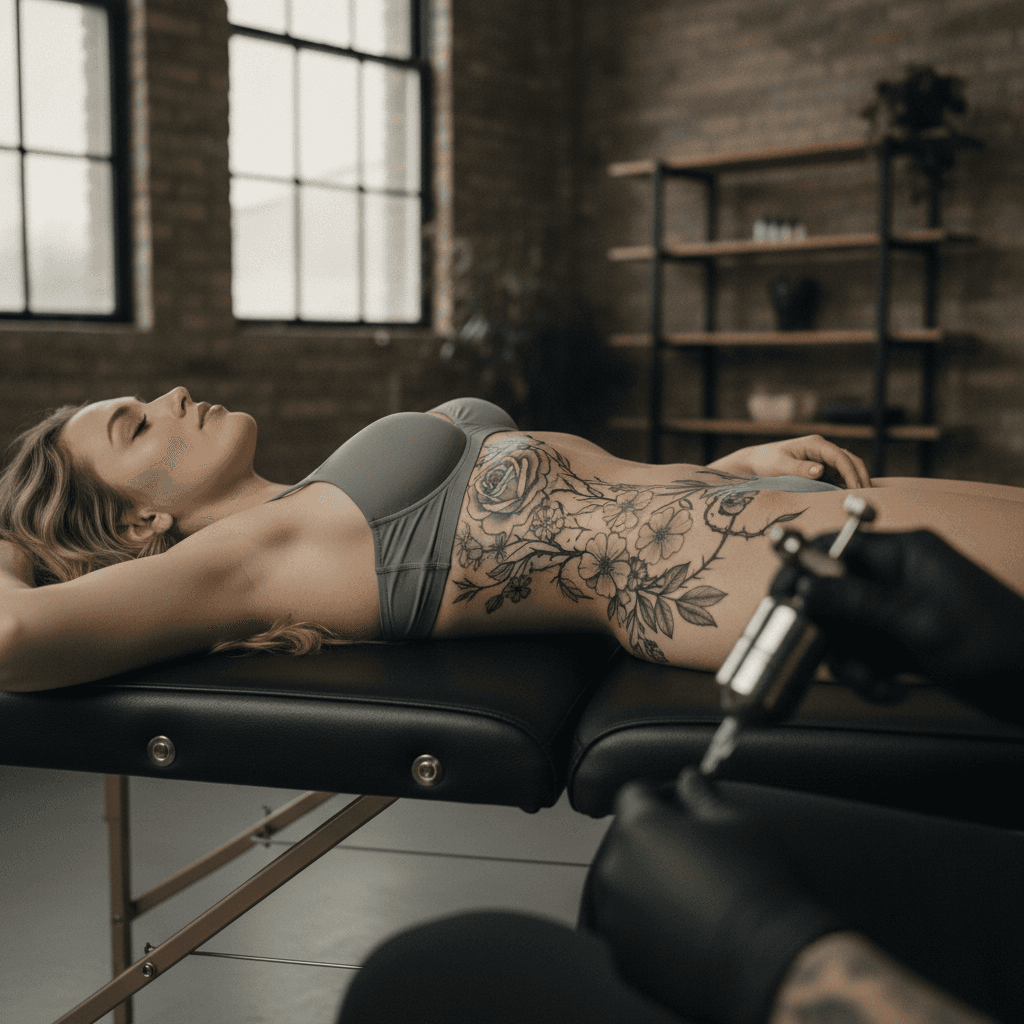
The ribs are one of the most cinematic canvases on the body and one of the least forgiving. Skin sits directly over bone with almost no fat buffer, so every stroke registers, every breath moves the surface, and every design choice gets tested by anatomy. This guide walks through what layouts hold up on the ribcage, how much pain to expect at each session, and which design directions read well ten years later instead of turning into a smudged crescent under the arm.
What makes the ribcage different from other placements
The rib panel runs roughly from the underarm to the top of the hip, about 8 to 12 inches vertically and 4 to 6 inches wide depending on frame. The skin is thin, mobile, and lies over a curved cage of bone that shifts with every inhale. That combination changes everything about how a tattoo behaves. Ink spreads faster on rib skin than on a forearm, so hairline fine-line work tends to blur over five to seven years unless the artist compensates with slightly thicker lines. Detailed shading also softens, which is why many rib pieces are designed with more open negative space than an equivalent thigh or back piece.
The curve matters as much as the texture. A design that looks balanced on a flat reference sketch will pull and distort once it wraps the ribs, especially near the intercostal grooves between bones. Good rib artists mock up the stencil directly on the body in multiple poses, standing relaxed, arm raised, torso twisted, before committing. If your artist skips that step, ask for it. A stencil that looks perfect flat and terrible in the mirror is the single most common ribcage regret.
Layout options that work with the anatomy
Ribcage designs fall into four broad layouts, and picking the right one for your idea saves you from fighting the body. The vertical strip runs parallel to the ribs from underarm toward hip, usually 2 to 4 inches wide, and suits snakes, florals on a stem, script, and vine work. The horizontal band wraps across two or three ribs and reads well for short phrases, dagger designs, or a single anchored motif like a moth or crescent moon. The full side panel fills most of the available real estate with one composition and demands a strong central subject, often a large floral spray, koi, or figurative piece. Finally, the underboob-to-hip diagonal follows the natural taper of the torso and works beautifully for asymmetric botanical or ornamental designs.
- Vertical strip: 3 to 5 hours, best for linear subjects
- Horizontal band: 2 to 4 hours, best for text and single motifs
- Full side panel: 8 to 15 hours across 2 or 3 sessions
- Diagonal wrap: 5 to 8 hours, best for organic curved subjects

Whatever layout you pick, leave a small breathing gap at the very bottom rib and near the underarm crease. Those spots move the most and heal the worst. Pushing ink all the way to the crease almost always results in patchy healing and a touch-up appointment you did not plan for.
Honest pain expectations by zone
Rib tattoos are consistently ranked in the top three most painful placements on the tattoo pain chart, and that reputation is earned. The pain is not the sharp cutting sensation you get on a forearm. It is a deep vibrating ache that travels along the bone and can make breathing feel restricted after the first hour. Most clients describe the first 45 minutes as manageable and the next two hours as the hardest sustained pain of any placement they have tried.
Not all rib real estate hurts equally. The middle of the side panel over the largest ribs is the most tolerable zone. The area directly under the armpit, where skin is thinnest and nerves cluster, is the sharpest. The lower ribs near the floating rib bones produce a hollow, echoing pain that catches people off guard even when they were fine higher up. If this is your first large piece, book a shorter first session of 2 to 3 hours to see how your body responds before committing to a full panel. Eating a substantial meal 90 minutes before the appointment and staying hydrated for two days prior genuinely changes the experience.
Design directions that age well on ribs
Botanical work is the most reliable choice for ribcage tattoos because organic shapes hide the small distortions that come with a curved, moving surface. Flowing stems, wildflower sprays, ferns, and vine wraps all read cleanly whether you are standing straight or lying down. If you want something more graphic, blackwork ornamental patterns and heavy dotwork mandalas also hold up beautifully because they are designed around geometric repetition rather than photorealistic detail. Compare the aging patterns of these approaches when you are deciding between blackwork and black-and-grey style choices.
Fine-line rib pieces are popular right now but come with a longevity trade-off. Lines under 0.5mm on rib skin routinely soften into a blurred wash within five years. If you love the fine-line look, ask your artist to use 0.7 to 0.9mm line weights and to skip the smallest details entirely. A thoughtful medium-line piece will look like a fine-line piece for ten years. A true hairline piece will look like a smudge in five.
Script and lettering also work on ribs but demand specific handling. Long phrases running vertically down the side often twist unreadably when the wearer moves. Short quotes of 3 to 6 words placed horizontally across a single rib panel are much safer. Skip cursive scripts smaller than 1.5cm in x-height because they will not survive the ink spread.
Aftercare and healing on the ribcage
Rib tattoos heal slower and messier than most other placements because the skin folds and stretches constantly. Expect 3 to 4 weeks of visible healing instead of the standard 2 to 3, and plan for looser tops that do not rub the area. Sleeping is the hardest part. Most people cannot lie on the tattooed side for at least 10 days, which means back sleeping only or a strategic pillow wall. Read through the full tattoo healing timeline day by day before your appointment so you know what each stage should look like.
Bra straps and waistbands cause more rib-tattoo touch-ups than any other single factor. If your design crosses either line, plan to skip bras entirely for the first 10 days or switch to a bralette that does not sit on the fresh ink. For the lower ribs, high-waisted pants and shapewear are off the table until week three. This is a placement that punishes shortcuts, so budget the recovery time honestly before booking.
Frequently asked
How long does a ribcage tattoo take to finish? A small horizontal band takes 2 to 4 hours in one sitting. A full side panel typically runs 8 to 15 hours split across two or three sessions spaced 4 to 6 weeks apart. Rib skin needs the longer gap to recover between sessions because the healing is more taxing than a limb tattoo.
Is a ribcage tattoo worth the pain? For clients who love the placement, yes. The ribs give you a private, intimate canvas that shows only when you choose to show it, and the natural curves flatter organic designs in a way flat placements cannot. The pain is real but finite, and most people say they would do it again for the right piece.
What is the average cost of a rib tattoo? Rib pieces typically run $150 to $300 per hour depending on artist tier and city. A small design lands around $300 to $600, a horizontal band $500 to $900, and a full side panel $1,800 to $4,500 across multiple sessions. See the full breakdown in the rib tattoo cost guide.
Do rib tattoos stretch badly with weight changes? Rib skin stretches less than stomach or hip skin because there is bone directly underneath. Modest weight fluctuations of 10 to 15 pounds usually do not visibly affect a rib tattoo. Pregnancy is a different story because the entire torso reshapes, and the lower rib area often shows the most change.
Can I get a ribcage tattoo as my first tattoo? It is possible but not ideal. The pain intensity and long healing window make ribs a rough introduction to tattooing. If you are set on the placement, start with something 2 to 3 inches to test your pain tolerance before committing to a larger session.
How do I choose between fine-line and bolder styles for my ribs? Ask yourself how the piece needs to look in ten years, not ten weeks. Fine-line reads beautifully fresh but softens fast on rib skin. Medium-line botanical, blackwork ornamental, and dotwork all hold their intended look for a decade or more. If aging matters to you, size up your line weights before you start.