style guides
Traditional Tattoo Style Guide: The American Classic
Traditional tattoos hold their lines for decades. Here's what defines the style, what classic motifs cost in 2026, and how to find a real traditional artist.
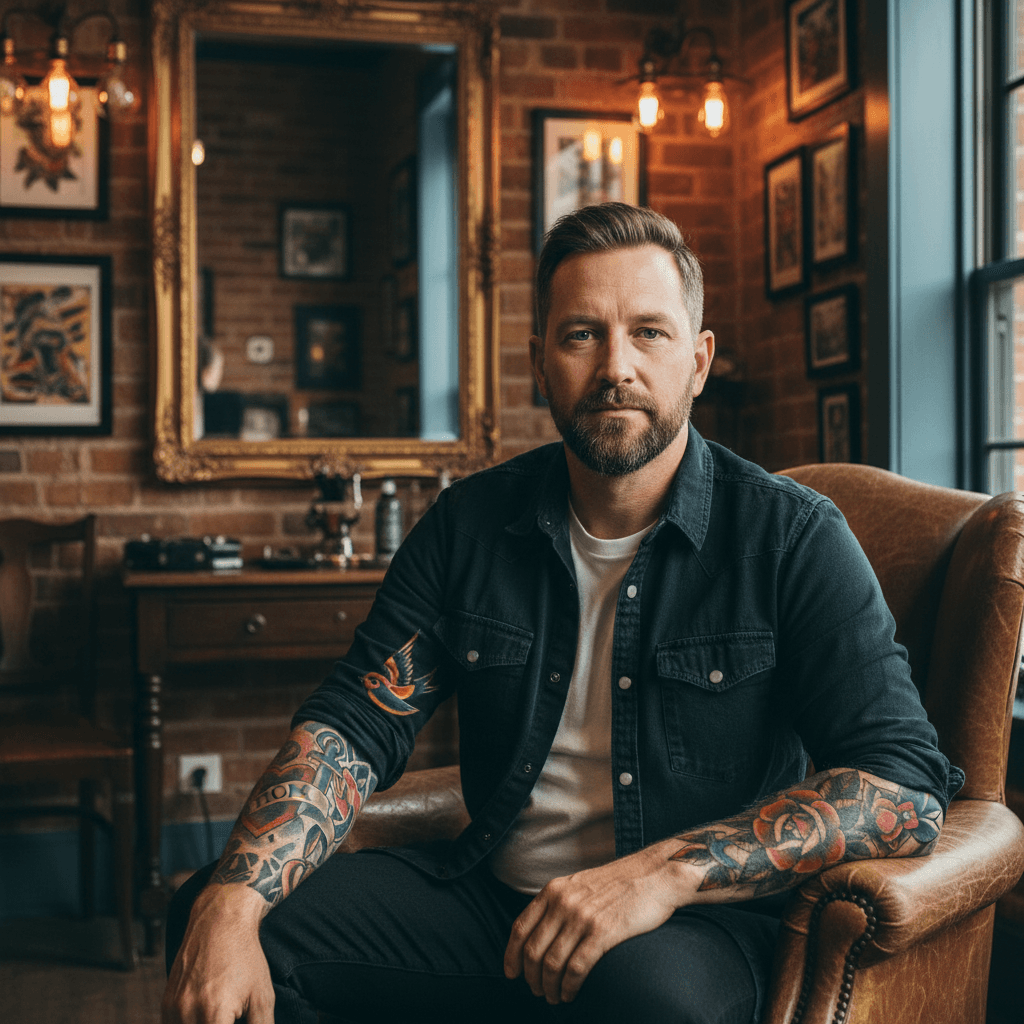
Traditional tattoos run on a tight visual rulebook: heavy black outlines, a small palette of saturated colors, and motifs that haven't shifted much since the 1940s. The style was codified by American sailors and shop tattooers like Sailor Jerry Collins and Bert Grimm, and it's still the style that ages cleanest after twenty years. This guide covers what defines traditional, what motifs sit at its core, how the style holds up over time, and what you should expect to pay in 2026.
What defines a traditional tattoo
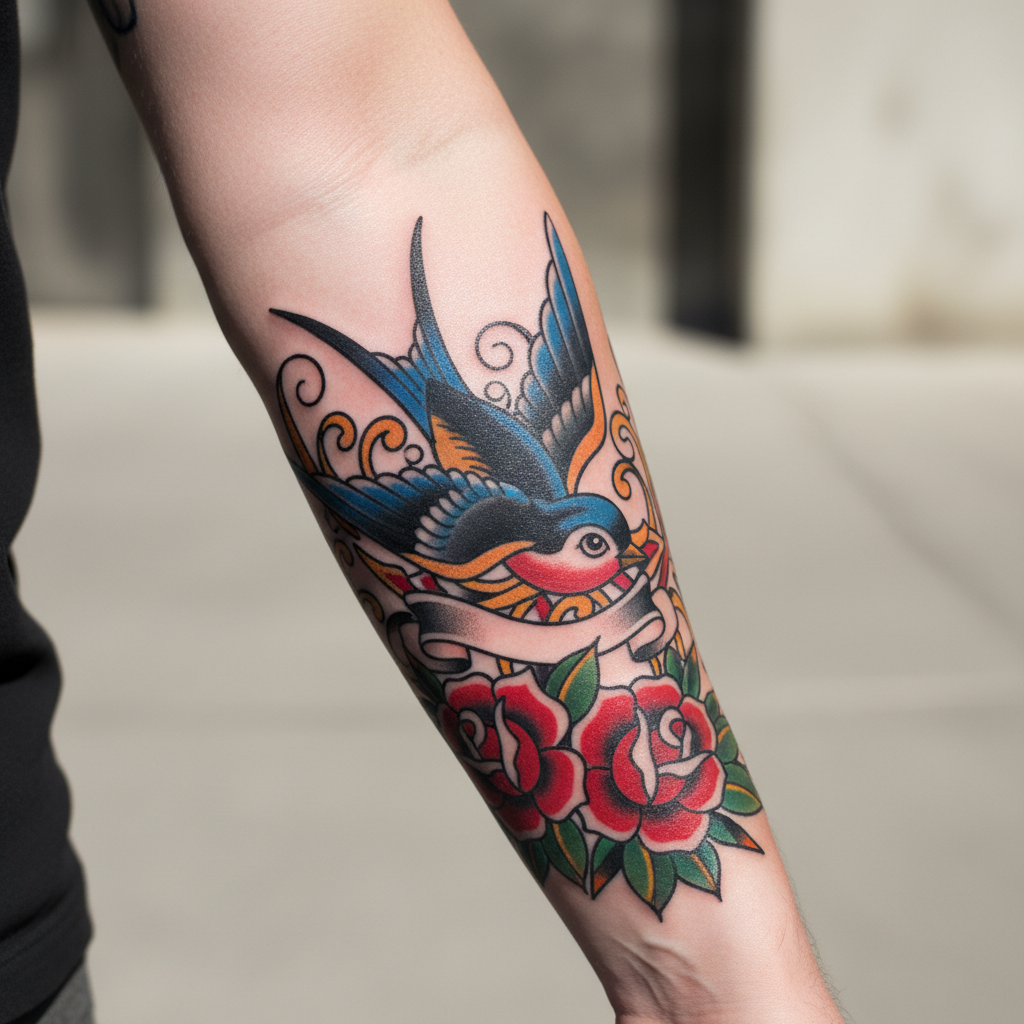
Traditional, sometimes called American traditional or old-school, is the foundational Western tattoo style. The visual signature is consistent across artists: outlines done in 7- or 9-round liners at heavy weight, large solid areas of color and black, and zero gradient or soft shading. The classic palette runs five to seven colors: red, yellow, green, blue, brown, sometimes purple, with heavy use of pure black. Stippled "whip shading" inside the fills adds dimension without breaking the rule against soft gradients. Designs are flat, bold, and read clearly from across a room.
The compositional rules are equally tight. Subjects face forward or in three-quarter profile, never naturalistic. Skin tones on pin-ups and portraits use a single mid-tone color rather than rendered shading. Negative space is built into the design from the start, not avoided. The style prioritizes legibility over realism every single time, which is exactly why it survives the way it does.
The core motif library
Traditional designs draw from a fixed set of motifs that have been tattooed since the early 1900s. Swallows are paired and chest-placed, originally signaling 5,000 sea miles for sailors. Anchors mark a sailor who has crossed the Atlantic. Roses, often with banners, sit on forearms and chest plates. Daggers pierce hearts, snakes, or skulls. Pin-ups, eagles, panthers, ships under full sail, hourglasses, and the classic "Mom" heart all belong to this canon.
The motif vocabulary is shared across every traditional shop in the world, which is one reason the style is so portable. A walk-in flash sheet at a shop in Tokyo features the same daggers and roses as a flash sheet in London or Austin. This shared vocabulary lets traditional pieces be added to over the years without breaking visual coherence. A new rose tattooed five years after a swallow will still belong to the same body of work, which matters when you're building a collection over a decade.
Why traditional ages better than other styles
The most repeated argument for traditional is longevity, and it's largely true. Heavy black outlines hold their edge for thirty years or more because the ink is packed deep with thick needle groupings. Solid color blocks, even after the saturation softens, still read as the original subject. Compare this to fine-line work, which can blur into illegibility within ten years, or watercolor, which is essentially a faded version of itself within five.
The aging math works in traditional's favor for two reasons. First, the bold lines define the shape, so even if color fades the subject stays recognizable. Second, the limited palette uses inks that hold up better against UV than the pastels and gradients of newer styles. A 1980s traditional sleeve on a 65-year-old today still reads as a swallow, a rose, an anchor. A 2015 watercolor piece on a 45-year-old today often reads as a vague smudge in the same spots.
For readers comparing styles, our fine-line tattoos style guide and watercolor tattoos style guide lay out the same tradeoffs from the other direction.
What traditional costs in 2026
Traditional tattoos sit in the middle of the cost spectrum because they balance complexity and time well. Most established traditional artists charge $150-$250 per hour in mid-tier US cities and $250-$400 per hour in major coastal markets like Los Angeles, New York, and Austin. Shop minimums run $100-$150 for the smallest flash pieces.
Common sizing and rough cost ranges:
- 3-inch flash piece (swallow, rose, anchor): one session, 1-2 hours, $200-$500
- Forearm-sized custom traditional (8-10 inches): 2-4 hours, $500-$1,200
- Half sleeve in traditional: 12-18 hours across 3-4 sessions, $1,800-$4,500
- Full sleeve: 30-50 hours across 6-10 sessions, $4,500-$12,000
Traditional pieces tend to come in slightly cheaper per square inch than hyperrealism or Japanese irezumi because the line work is fast and the color application is straightforward solid fills. For a full pricing breakdown by placement, see our tattoo sleeve cost guide and forearm tattoo cost guide.
Best placements for traditional work
Traditional was built for limbs and the chest plate. The bold outlines and large color blocks need room to breathe, which makes ribcage panels, fingers, and the inside of wrists less ideal. The strongest placements:
- Upper arm and shoulder: flat plane with room for chest plate or bicep pieces 4-8 inches wide
- Forearm: ideal for swallows, roses, daggers, and small pin-ups, with linework holding sharp on this skin
- Outer thigh: large canvas for panthers, eagles, or pin-up pieces 6-12 inches across
- Calf: holds a full eagle or rose composition cleanly without distortion
- Chest plate: the classic placement for paired swallows or a heart-and-banner
Avoid hand and finger placements for serious traditional work. The line weight that defines the style needs thicker skin sections to hold up. Hand tattoos in traditional style fade and blur faster than any other location on the body, often needing touch-ups within five years.
Finding a real traditional artist
Not every artist who calls themselves traditional actually packs solid black and color. Before booking, look at their healed work specifically, not just fresh photos. Healed traditional should show crisp lines and saturated color blocks even at three or four years out. If their healed portfolio is thin or fuzzy, the line and pack technique isn't dialed in.
Three signals of a strong traditional artist:
- Heavy line weight that stays consistent across the whole piece
- Color saturation that reads vibrant in healed photos, not just fresh
- A flash portfolio of classic motifs they execute well, not just one-off custom pieces
Booking a flash piece off the shop wall is the fastest way to get authentic traditional work from someone who actually does it daily. Custom commissions are fine once you've seen the artist's flash work hold up over time.
Frequently asked
Is American traditional the same as old-school? Yes. American traditional, old-school, and "trad" all refer to the same style: bold-outlined, limited-palette tattoos rooted in early-20th-century Western shop tattooing. Sailor Jerry Collins is the most cited reference point. Some artists distinguish "neo-traditional" as a separate evolution with expanded color and softer shading.
How long does a traditional tattoo session take? Small flash pieces take 1-2 hours including stenciling and color packing. A standard 6-inch traditional rose takes around 2.5-3 hours start to finish. Larger custom pieces in the sleeve range run 3-5 hour sessions, with most artists capping at 4 hours before color packing starts to suffer from skin fatigue.
Will traditional tattoos look outdated in 10 years? The style has been continuously popular since the 1940s, with revivals in the 1970s, 1990s, and again in the 2010s. It's the closest thing to a stylistic constant in Western tattooing. Aesthetic risk is genuinely low compared to trend-driven styles like watercolor or single-needle micro-realism.
Can you do traditional in black and grey only? Yes, and it's a recognized substyle called black-and-grey traditional. The line weight stays the same, but color is replaced with grey-wash shading and solid black fills. Healed longevity is similar to full-color traditional, and the look pairs well with portrait work in the same sleeve.
Does traditional hurt more than fine-line? Slightly, yes. Color packing involves longer time in the same spot with larger needle groupings, which generates more heat and skin irritation than a single fine liner. A 6-inch traditional rose feels notably more intense in the color packing phase than the outlining phase. Most people describe it as manageable but tiring.
Should my first tattoo be traditional? Traditional is a strong choice for a first tattoo specifically because it ages well and the style is established enough that you can predict how it'll look in 20 years. Pick a flash design rather than a custom commission for your first piece. Smaller flash also keeps your first session under two hours, which is what most people can handle their first time in the chair.