style guides
Mandala Tattoo Style Guide: Symmetry, Meaning, Placement
Mandala tattoos combine sacred geometry, dotwork shading, and mirror symmetry. Here is how the style works, what it costs, and where it sits best on the body.

Mandala tattoos borrow from centuries of Hindu and Buddhist visual language and translate it into fine black linework, dotwork shading, and radial symmetry that the eye reads as a single, complete shape. The style rewards artists who can draft with a compass and steady the machine like a printer, and it rewards clients who want a piece that reads as decorative from three meters away and detailed at arm's length. This guide covers what defines the style, how mandalas behave on curved anatomy, the tools and session counts a good piece requires, current pricing in the US and Europe, and how to care for one through the peel.
What makes a tattoo a mandala
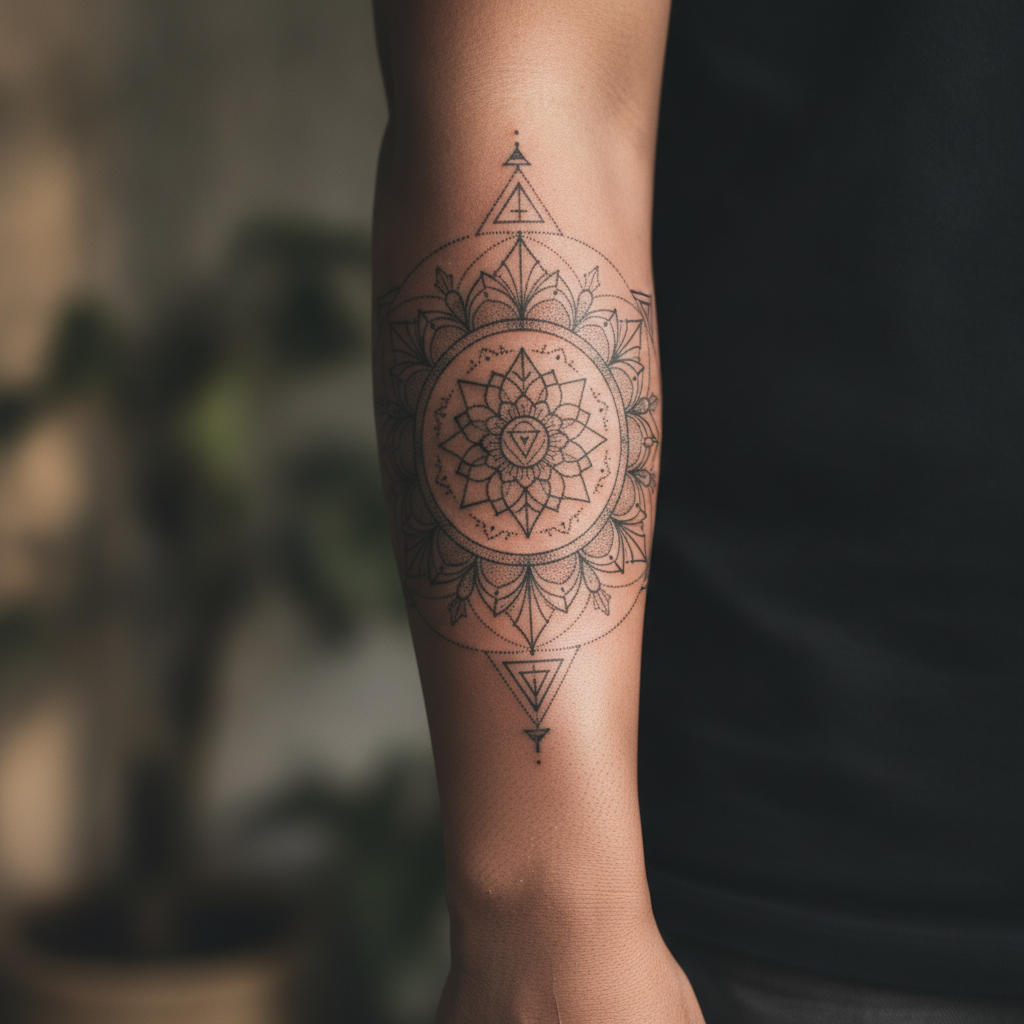
A mandala is a radial composition organized around a central point, with elements repeating in rotational symmetry (usually 6, 8, 12, or 16 divisions). The core is almost always a circle or dot, and rings expand outward in stepped layers of geometric shapes, petals, lace patterns, and negative space. Traditional Tibetan mandalas encode cosmology, with each ring representing a stage of consciousness or a specific deity's palace. Western tattoo mandalas keep the radial grammar but drop most of the religious symbolism, leaning on sacred geometry (Flower of Life, Metatron's Cube, Sri Yantra) and Art Nouveau botanical motifs.
Line weight is the single biggest tell of a competent mandala. Outer boundary lines run thicker (usually 5RL to 9RL needle groupings), inner petals and dividers step down to 3RL, and the innermost detail lives at 1RL or single-needle. That hierarchy is what keeps a mandala legible after ten years of skin stretch and pigment softening. Flat, uniform lines look tidy on paper and turn to mush on aged skin. Pair mandalas naturally with geometric tattoos and dotwork, which share the same reliance on precision linework and controlled negative space.
Symmetry, anatomy, and why placement is math
The problem with radial symmetry on a human body is that no part of a human body is flat. A perfect 8-division mandala drawn on paper becomes a warped ellipse the moment it sits on a shoulder cap or a ribcage. Good mandala artists solve this by drafting the stencil twice: once flat, then re-drafting the outer rings to compensate for the curve. On the shoulder blade, the outer 20 percent of the design usually needs to be pinched or stretched by 5 to 10 degrees to look circular when the arm hangs at rest.
Placement decisions follow from that math. Flat or gently curved surfaces read cleanest: upper back, sternum, outer thigh, forearm. Highly curved or high-motion zones (elbow ditch, knee, inner bicep) fight the symmetry and demand a smaller, simpler design or a hemispheric half-mandala that acknowledges the curve instead of hiding it. Placement also drives pain level. A back-of-shoulder mandala sits in the mid range of the tattoo pain chart, while a sternum mandala pushes into the top tier because the piece almost always crosses bone.
Sessions, needle configurations, and how long a mandala takes
Size is the honest predictor of session count. A 4-inch wrist or forearm mandala with moderate detail runs one session of 3 to 4 hours. A palm-sized shoulder blade mandala with two rings of petals and negative-space detail lands in the 5 to 7 hour range, usually split across one long session or two shorter ones. A full back piece with a central mandala and satellite geometric fills is a 25 to 40 hour project spread across 4 to 6 sessions, with two to four weeks between sittings for healing.
Needle work is specific. Most mandala artists cycle between three or four setups per piece:
- Liners: 3RL for inner detail, 5RL or 7RL for structural rings, 9RL for outer boundary
- Shaders: 5M1 or 7M1 magnums for smoked-out backgrounds, though many mandala artists skip shaders entirely
- Dotwork: 1RL or 3RL used at low voltage, with the artist manually stippling each dot to control density gradients
Ink is almost always straight black, sometimes stepped with a diluted grey wash for interior fills. Color mandalas exist but are rare in the modern Western style, because color dulls the geometric crispness that defines the aesthetic.
Pricing: what a mandala costs in 2026
Mandalas are hourly-priced almost everywhere because the artist labor scales with detail density, not size. In major US cities, expect $180 to $280 per hour for a specialist. In Europe (Berlin, Amsterdam, Barcelona), $130 to $220 per hour is normal. In Southeast Asia (Bangkok, Bali), high-end mandala specialists still charge $80 to $150 per hour, and low-end shops go as low as $40, though the results at that tier rarely hold up past a year.
Concrete ranges by piece:
- Wrist or forearm mandala, 3 to 4 inches: $450 to $900 in the US
- Shoulder blade mandala, 6 to 8 inches: $900 to $1,800 in the US
- Full back piece with mandala centerpiece: $4,500 to $12,000, paid across sessions
- Sternum or chest mandala, 5 to 7 inches: $700 to $1,600 in the US
A deposit of $100 to $300 is standard, and most mandala artists want a two-week booking window because they draft custom stencils rather than pulling from flash. For a fuller breakdown of session pricing math, see the hourly vs flat-rate pricing guide.
Design variations worth knowing before you book
Pure geometric mandalas are the strictest form: compass-drawn circles, straight-edge polygons, no organic elements. Floral mandalas soften the grid with lotus petals, roses, or peonies laid into the radial structure and are the most common hybrid in modern shops. Lace mandalas add jewelry-like drops, chains, and negative-space fills that mimic Victorian filigree. Ornamental mandalas blend into full sleeves or chest pieces and lose the strict circle in favor of a symmetric axis that trails across the body.
Sacred geometry mandalas overlay specific mathematical forms (Metatron's Cube, Flower of Life, Sri Yantra) and appeal to clients who want the visual weight of a mandala with a specific philosophical reference. Unalome mandalas incorporate a rising spiral through the center, borrowed from Thai and Cambodian Buddhist symbolism, and read as a personal journey piece. Each variation has different aging behavior. Denser designs need line-weight discipline more than sparse designs do.
Healing and long-term care
A mandala peels the same way any blackwork piece does, but the fine linework makes early scab-picking especially costly. A single lifted scab in the middle of a 3RL detail area can leave a dropout that requires a full touch-up. Follow the aftercare timeline strictly for the first ten days, and expect the piece to look dusty and slightly blurred until day 21 when the outer epidermis finishes reforming.
Sun exposure is the long-term enemy. Mandalas depend on line contrast, and UV fades outer boundary lines fastest because they hold the most pigment on the surface. Reapply SPF 50 to any visible mandala at every beach or pool day, and expect a touch-up cycle of every 5 to 8 years for pieces on high-exposure areas like forearms and shoulders. Interior back and thigh placements can go 10 to 15 years without touch-up if kept out of direct sun.
Frequently asked
Are mandala tattoos culturally appropriative? The geometric grammar is public visual language shared across dozens of cultures. Wearing a generic geometric mandala is not appropriation. Copying a specific ritual Tibetan sand mandala, a Sri Yantra used in tantric practice, or a religious deity mandala without understanding it is where the line usually sits for people who care about the distinction. If you want a specific traditional design, ask a practitioner from that tradition, not a tattoo artist.
How long does a shoulder mandala take? A palm-sized shoulder mandala with two to three rings of detail runs 5 to 7 hours, usually done in one long session or split across two three-hour sittings. A larger piece that wraps toward the shoulder blade adds 3 to 5 hours per additional ring.
Do mandalas hurt more than other tattoos? Placement matters more than style. The fine-line and dotwork techniques used for mandalas actually run at lower voltage than solid black fill or color packing, so the buzz feels less aggressive. Bone-adjacent placements (sternum, spine, ribs) still hurt because bone conducts vibration, not because of the mandala technique.
Can a mandala be covered or reworked later? Yes, but the outer boundary is the constraint. A mandala can be extended outward into a larger ornamental piece, blended into a sleeve, or filled with additional negative-space work. Full cover-ups of a mandala require heavy blackwork or a much larger design that swallows the circle, because half-covering a symmetric piece leaves an obvious ghost. See the cover-up tattoo cost guide for pricing.
How do I choose a mandala artist? Look at their line weight hierarchy in healed photos, not fresh work. Healed mandalas that still show crisp inner detail at 1RL are the mark of an artist who understands ink saturation for fine lines. Ask to see 2-year and 5-year healed photos, not just day-of-shoot images.
Is a mandala a good first tattoo? Small ones (wrist, ankle, back of neck) work well as first tattoos because the pain is manageable and the design is decorative rather than personally loaded. Larger pieces are a poor first choice because sitting still for 5 hours on a shoulder blade is a lot to ask of someone who has never been tattooed. Start with a 3-inch piece and build from there if the aesthetic stays with you.