style guides
Anime Tattoos Style Guide: Cel-Shading, Lines, and Longevity
Anime tattoos borrow cel-shading, bold outlines, and expressive faces from manga. Here's how the style works and what to expect on skin.
Anime tattoos moved from a niche fandom request into a mainstream style category over the past decade, driven by streaming platforms making titles like Naruto, One Piece, Demon Slayer, and Chainsaw Man household names. The style borrows the visual grammar of 2D animation cel-shading, hard black linework, exaggerated eyes, motion lines, and flat blocks of saturated color and translates it onto skin, where the physics of ink migration and healing change how those choices behave over time. This guide covers how anime tattoos are built, which techniques hold up, realistic sizing, pricing, and the questions to ask an artist before committing to a character piece you plan to wear for the next 40 years.
What makes a tattoo read as "anime"
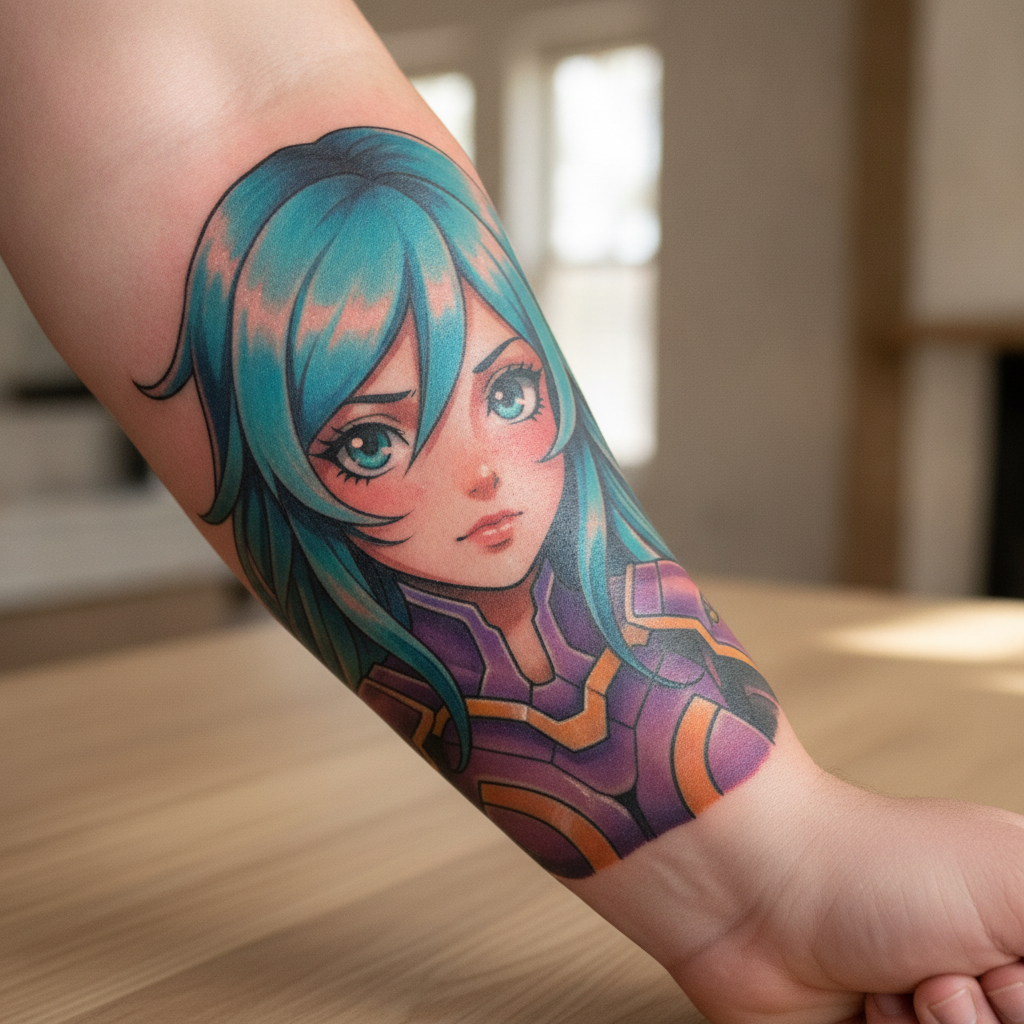
Anime as a tattoo style is defined by four visual choices that mirror animation cels. Bold black outlines, usually 3RL to 7RL liner needles, do the structural work and hold the piece together as it ages. Cel-shading replaces smooth gradients with two or three flat tonal values per surface, giving faces and hair that distinct stepped look you see in a single animation frame. Saturated flat color fills, often using magnetic pinks, electric blues, and pure cyans, sit inside those outlines with minimal blending. Facial features get exaggerated: eyes take up a third of the face, mouths compress to a line, hair splits into geometric shapes with highlight stripes rather than realistic strand rendering.
Not every tattoo of an anime character qualifies as an anime-style tattoo. A photorealistic rendering of Goku, blended in black and grey with soft transitions, is realism using an anime subject. A watercolor splash under a manga character is watercolor with anime iconography. True anime-style work reads unmistakably as a frame lifted from an episode, complete with the flatness that makes cel animation feel like cel animation.
Cel-shading vs. manga panel vs. watercolor anime
Three sub-styles dominate anime tattoo work, and each ages differently. Cel-shading is the most faithful to on-screen anime and typically uses three or four discrete color values with hard breaks between them. It reads clean at every distance, holds up well for 8 to 15 years before needing a color refresh, and forgives skin tone variation better than photorealism. Manga panel style skips color entirely and reproduces black-and-white ink work with screentone dot patterns, speech bubbles, and hard shadows. These are the longest-lived anime tattoos on skin, often looking sharp at 20 years with only outline touch-ups.
Watercolor anime hybrids replace cel-shading with soft color washes bleeding outside the linework, referencing the paint-splash aesthetic popular in anime opening sequences. They photograph beautifully in year one but soften considerably by year five, since watercolor techniques rely on the fine edges that migration blurs first. If you want a piece that stays sharp through your forties, cel-shading or manga panel is the safer pick. If you love the effect and accept a color refresh every five to seven years, watercolor hybrid still works.
Sizing, placement, and detail preservation
Anime relies on facial expression, so the face of your character determines minimum size more than any other factor. A single character head with functional eye detail needs at least 4 inches tall on the forearm, 5 inches on the thigh or calf, and 6 inches on the back or chest to preserve pupil highlights and mouth linework past the five-year mark. Below those thresholds, small details compress and blowout risk climbs as thin linework in the eyes and hair migrates into blobs. A full-body character in an action pose needs 8 to 12 inches vertically to keep hands, weapons, and hair points readable.
- Forearm single character: 4-7 inches, one session
- Half sleeve multi-character scene: 8-12 inches, 2-3 sessions
- Full back panel with background: 14-20 inches, 4-6 sessions
- Thigh action pose: 8-10 inches, 2 sessions
- Ribcage character portrait: 5-7 inches, one session, pain heavier here
Placements with heavy skin movement, like the inner bicep, hands, and feet, chew through color faster than flatter areas. If you want an anime piece to age well, prioritize the forearm, outer bicep, thigh, calf, chest panel, and back. For a broader look at layout on multi-panel pieces, the sleeve composition layout guide walks through how to sequence characters and background elements without visual clutter.
Color, ink, and how anime tattoos age
The saturated pinks, cyans, and yellows central to anime work sit at the fugitive end of the ink spectrum. Reds and magentas fade fastest, especially on skin that gets regular sun exposure, and yellows can shift toward green as they age against tanned skin. Reputable studios stock World Famous, Eternal, and Solid Ink for their tattoo-grade pigment stability, and most anime specialists mix custom brights rather than pulling straight from the bottle. Ask your artist which ink line they use and how they handle color refresh scheduling.
Skin tone matters more with anime than with black-and-grey styles. On deeper skin, the flat pastels that make cel-shading pop on pale skin can lose contrast quickly, and experienced artists compensate by widening the tonal gap between shadow and highlight values, using deeper base colors, and thickening outlines to hold the structure. If your artist has a portfolio dominated by one skin tone, ask to see healed work on skin closer to yours before booking. For the full pricing picture on color anime pieces, see the color vs. black-and-grey tattoo cost breakdown.
Long-term care matters more here too. Daily SPF 30 or higher on the piece, especially in the first two years, prevents the color shift that turns a $2,000 anime sleeve into a muddy blur by year seven. The tattoo sunscreen long-term care guide covers the specifics.
Session count, pain, and pricing
A single 5-inch anime character with cel-shaded color and background takes 4 to 6 hours in one session for most competent color artists. Multi-character scenes and panel layouts stack: expect 8 to 14 hours for a half sleeve and 25 to 45 hours for a full back panel spread across multiple sittings. Sessions typically run 4 to 6 hours before ink saturation drops off and skin trauma stops taking pigment cleanly.
Anime specialists in the US and Europe charge between $180 and $350 per hour, with waitlisted artists pushing $400 to $500. Southeast Asian studios with strong anime portfolios often run $80 to $150 per hour with comparable technical execution.
Expect the following ballparks in 2026:
- Small anime character (3-4 inches, forearm or calf): $400-$900
- Medium single character with background (5-7 inches): $900-$2,000
- Half sleeve multi-panel: $2,500-$5,500
- Full back anime scene: $6,000-$14,000
- Manga black-and-white panel piece: 30-40% less than color equivalent
Pain scales with placement, not style. Anime work on the ribs, sternum, spine, and inner arm hurts significantly more than the outer forearm or thigh. Long color sessions also hurt more late as adrenaline drops, so book cel-shading heavy pieces in the morning when your pain tolerance is highest.
Choosing an anime artist
Portfolio evidence beats social media follower count. Ask for healed photos taken at least a year after the session, not fresh-out-of-the-chair shots that hide fine-line quality behind swelling and residual redness. Strong anime artists show consistent line weight across pieces, clean color transitions where cel-shading meets outline, and character faces that read at both arm's length and phone-camera distance. Weak signs include blown-out fine outlines around eyes, muddy color blends where flat blocks should sit crisp, and character faces that look mechanically traced rather than redrawn to fit the anatomy of the placement.
Bring reference frames from the actual anime or manga panel, not fan art, and be open to your artist reworking the composition to fit skin. A frame that reads well on a widescreen 16:9 aspect ratio rarely translates directly to a vertical calf or curved bicep. The best anime tattoos are collaborations where the artist adapts the source material to the canvas rather than copying flat images pixel for pixel.
Frequently asked
Will an anime tattoo look dated in ten years? Character choice matters more than style choice. Iconic long-serialized franchises like Dragon Ball, One Piece, Naruto, and Studio Ghibli have held cultural weight for 20 to 40 years and read as classics rather than trends. A character from a single-season 2024 release carries more style-risk. The technical execution of cel-shading itself does not date, since it references a visual language older than the person wearing it.
Can I get an anime tattoo covered up later? Yes, though the bold black outlines central to the style make cover-ups harder than covering fine-line work. Any cover-up needs to be roughly 30% larger than the original and darker in overall value. Budget for laser lightening sessions first if you want a lighter cover piece. The cover-up tattoo cost breakdown covers the tradeoffs.
Do anime tattoos need more touch-ups than other styles? Cel-shading holds up comparably to American traditional, needing color refresh every 8 to 12 years. Watercolor anime hybrids need attention every 5 to 7 years. Black-and-white manga panel style ages the slowest of any anime sub-style. Sun exposure and skin placement affect the schedule more than style alone.
What is the difference between anime and Japanese irezumi tattoo styles? Irezumi is a centuries-old traditional Japanese tattoo style built around dragons, koi, oni masks, and cherry blossoms, executed with dense linework, wind bars, and muted color palettes across full body suits. Anime tattoos reference contemporary Japanese animation and manga aesthetics. They share cultural roots but live in different visual worlds, and most artists specialize in one or the other rather than both.
Are anime tattoos considered disrespectful in Japan? Anime tattoos specifically carry no cultural taboo around subject matter. Tattoos in general still carry stigma in traditional Japanese spaces like onsen and some gyms, but the association is with organized crime tied to full-body irezumi, not with cel-shaded anime character work. Cover the piece in traditional spaces and you will be fine.
How much should I tip my anime artist for a long session? Standard tipping applies. 15 to 25% of the session cost, delivered in cash at the end of the appointment when possible. Long multi-session pieces get a tip at the end of each session rather than one lump sum at completion. The tipping guide covers the full etiquette.