cost guides
How Much Does a Tattoo Sleeve Cost? Real Numbers and Timeline
Sleeve tattoos run $1,200 for a basic half sleeve to over $15,000 for a top-tier full sleeve. Here's the math by hours, sessions, and artist tier.
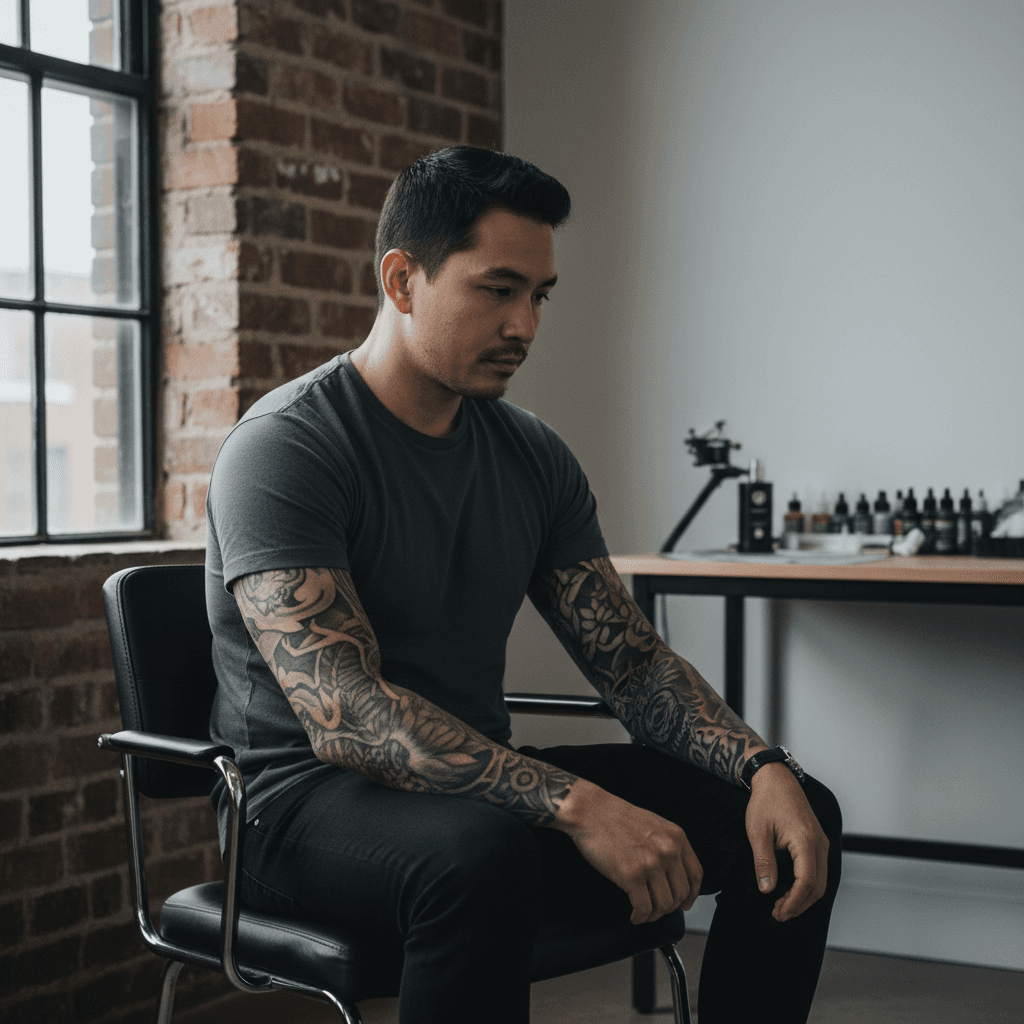
A sleeve tattoo is the largest single project most people commission in their lives, and the cost reflects that. You are buying somewhere between eight and forty hours of work from a trained artist, spread across multiple sessions over months or years. The number on the final invoice depends on five concrete things: hours, hourly rate, artist tier, complexity, and city. This guide breaks down each of those with real ranges so you can plan a budget that survives contact with reality.
What a sleeve actually costs in 2026
A basic half sleeve from a competent mid-career artist in a mid-sized US city runs $1,200 to $3,000. That assumes 8 to 15 hours of work at $150 to $200 per hour, simple to moderate complexity, mostly black-and-grey, and no exotic ink work. A full sleeve from the same artist falls between $3,000 and $8,000 for 20 to 40 hours of work. Move up one tier to a well-known artist with a multi-month waitlist and the hourly rate jumps to $200 to $300, putting full sleeves between $4,000 and $12,000. At the top of the market, name artists in Los Angeles, New York, Tokyo, and London charge $300 to $500 per hour. A full sleeve at that level typically lands between $12,000 and $30,000, sometimes higher for international travel and rush bookings.
These numbers assume no cancellations, no major redesigns mid-project, and on-time payment at each session. They do not include tip. Tipping conventions and amounts are covered in our separate guide on how much to tip your tattoo artist, but plan for 15 to 20 percent on top of session totals as a working baseline.
Hourly rate vs flat rate: which one you will get
Most sleeve projects are priced hourly, not flat. Artists quote flat rates for predictable pieces like flash designs or small custom work where the time-to-completion is tight. Sleeves are unpredictable. Skin reactions, breaks for the client, line work that takes longer than expected, and adjustments to flow mid-session all stretch sessions in ways flat pricing cannot absorb. Expect an hourly quote with a session minimum of two or three hours.
Some artists offer a deposit-and-day-rate hybrid for big projects: you pay a non-refundable deposit (often $100 to $500) that holds your spot and applies to the final session, then full-day rates of $1,000 to $2,500 per session. Day rates can work out cheaper per hour if the artist moves fast and you have the stamina to sit six to eight hours straight. For broader context on what drives any tattoo quote, our tattoo pricing explained breakdown covers the underlying factors in detail.
How many sessions a sleeve really takes
A half sleeve in straightforward black-and-grey usually completes in 2 to 4 sessions of 3 to 5 hours each, finished within 3 to 6 months. A full sleeve runs 4 to 10 sessions of 3 to 6 hours each, with the full timeline stretching 6 to 18 months. Color work adds 20 to 40 percent to total time because color packing requires slower passes and more rest breaks for the skin. Heavy detail styles like realism or biomechanical can push session counts to 12 or more.
Most artists space sessions 4 to 8 weeks apart. The gap exists for two reasons: the skin needs to finish healing before the next section can be tattooed, and the artist needs time to develop the next part of the design. Pushing for shorter gaps does not help. Both the work and your skin suffer. The tattoo healing timeline breaks down exactly how long each section needs before it can be worked on again.
What pushes the price up
- Color work: color packing is slow and tough on the skin. Plan for 20 to 40 percent more time vs black-and-grey of the same size.
- Hyper-detail styles: realism, micro-realism, and biomechanical add hours per square inch compared to traditional or neo-traditional.
- Tough placements: inner bicep, elbow ditch, and the back of the hand take longer and often require multiple touch-ups.
- Custom design fees: many artists bill design time separately at $50 to $150 per hour, especially for full custom sleeves with several revision rounds.
- Travel or guest spots: booking a touring artist at a guest studio often adds $200 to $500 in artist fees on top of the higher hourly rate the visiting artist charges.
Pain tolerance also matters in a hidden way. If you need frequent breaks or cannot sit longer than two hours at a stretch, your project takes more sessions to complete. The tattoo pain chart maps which placements hurt the most, useful both for choosing where to start and for planning session length.
City and country price differences
Geography moves the number more than people expect. A full sleeve in Bali averages $1,800 to $5,000. The same quality work runs $6,000 to $12,000 in Los Angeles. Bangkok, Ho Chi Minh City, and Bali sit at $80 to $150 per hour at experienced studios. Tokyo and Seoul have crept up to $150 to $300 per hour at established shops in the last five years. Major European cities (London, Berlin, Amsterdam) run €150 to €300. New York and LA top-tier studios are the highest priced market in the world for tattooing right now, with name artists clearing $400 per hour and full-day rates above $3,000.
International tattoo travel is real and increasingly popular, but factor in flights, accommodation, and the risk of healing complications far from your home artist. If something goes wrong, you cannot easily walk back in for a touch-up. The savings only pencil out for full sleeves and other large projects where the discount covers the trip cost.
Hidden costs people forget
The hourly quote is rarely the final cost. Plan for at least 20 percent above the artist's quoted estimate to account for tip, design fees, touch-ups, and the always-inevitable session that runs long.
Touch-up sessions are not always free. Some artists include one free touch-up within 6 months at no charge if the client followed aftercare correctly. Others charge a reduced rate of $50 to $150 for short touch-up appointments. Get the touch-up policy in writing before the first session, not after the work is done.
Aftercare supplies add up too: balm, fragrance-free soap, breathable bandage film, and clothing you do not mind staining all run $30 to $80 for a full sleeve project. Lost wages from healing time are real if you do physical labor or work in a sterile environment that prohibits visible new tattoos. The first 24 hours determine how the work heals, and our first 24 hours aftercare guide covers the protocol hour by hour.
Frequently asked
What is the cheapest way to get a sleeve done without sacrificing quality? Book with a mid-career artist who has 5 to 10 years of experience in a smaller city or in Southeast Asia. Look for a strong, focused portfolio in the specific style you want, not a generalist resume. A 7-year artist in Chiang Mai or Lisbon can deliver work that competes with $300-per-hour LA artists at a third of the cost. Avoid the absolute cheapest end of the market: shops charging under $80 per hour in the US often signal inexperience or equipment that should not be going into skin.
How long does a full sleeve usually take from start to finish? Six to eighteen months for most projects. Faster is possible with full-day sessions every 4 to 6 weeks if you tolerate long sits. Two-year timelines are normal for highly detailed work or when scheduling around an artist with a long waitlist. Booking the next session at the end of each appointment is the easiest way to keep momentum.
Should I pay everything up front or session by session? Session by session is standard, with a non-refundable deposit at booking. The deposit usually applies to the final session. Be wary of any artist asking for full payment up front before work begins, especially for a multi-thousand-dollar project.
Does insurance ever cover tattoo costs? No. Tattoos are cosmetic, not medical. The only related expense your health insurance might touch is treatment for an infection, and only if you have medical coverage and meet your deductible. Tattoo studios sometimes carry liability insurance, but that protects the studio, not the client's budget.
Can I negotiate the hourly rate? Usually not. Established artists set their rates based on demand and rarely negotiate. You can negotiate scope (smaller piece, simpler design, fewer sessions) but not the rate itself. Apprentice rates are the exception: apprentices often charge $80 to $120 per hour and accept negotiation on practice pieces, though the skill ceiling is lower.
Is it cheaper to get a sleeve in one country vs another? Yes, dramatically. Bali, Vietnam, Thailand, and parts of Eastern Europe run 40 to 70 percent below US prices for comparable quality. Factor flights and accommodation into the total. If you are already traveling, the savings are real. Flying specifically for a tattoo usually only pencils out for projects above $5,000.