style guides
Tribal Tattoos Style Guide: History, Motifs, and Modern Design
Tribal tattoos carry thousands of years of meaning behind the bold black lines. Here is how the style works, what motifs mean, and how to design one that ages well.

Tribal tattoos are the oldest continuous tattoo tradition on the planet, and they still read as instantly recognizable on skin today. The bold black lines, tight curves, and negative space patterns come from real cultural systems in Polynesia, the Philippines, Borneo, and dozens of other regions, each with its own visual vocabulary. This guide covers the actual regional styles, what the common motifs mean, how the ink ages on different skin tones, and what to think about before you sit for your first tribal piece.
Where tribal tattoos actually come from
The word "tribal" gets used as a catch-all in Western studios, but it points at several distinct traditions. Polynesian tattooing, which includes Samoan pe'a, Marquesan patutiki, and Hawaiian kakau, is the most visually influential. The Samoan word tatau is where the English word tattoo comes from. Maori ta moko from New Zealand uses chiseled linework carved with an uhi tool rather than punctured, giving it a raised texture that flat needle work cannot fully replicate.
The Philippines has its own living tradition through Kalinga batok, kept alive by artists like Whang-od in Buscalan who tap ink into skin with a thorn hammer. Iban and Kayan people in Borneo carry hand-tapped designs with rosette and spiral motifs. In East Africa, the Berber and various Amazigh groups used facial and hand tattoos with geometric marks. Each of these systems has rules about who wears which patterns and when, and those rules matter if you plan to reference them.
Modern Western "tribal" from the 1990s pulled shapes from these traditions and stripped the meaning, which is why a lot of shops now offer neo-tribal work that acknowledges the source or invents new geometric vocabulary entirely.
Regional visual signatures
Each regional style has a look you can learn to spot. Polynesian designs from Samoa and the Marquesas fill space densely with layered symbols, and the negative white space between motifs is treated as intentional design, not empty background. You will see rows of small enata figures representing people, spearhead patterns for courage, ocean waves for continuity, and shark teeth called niho mano for protection.
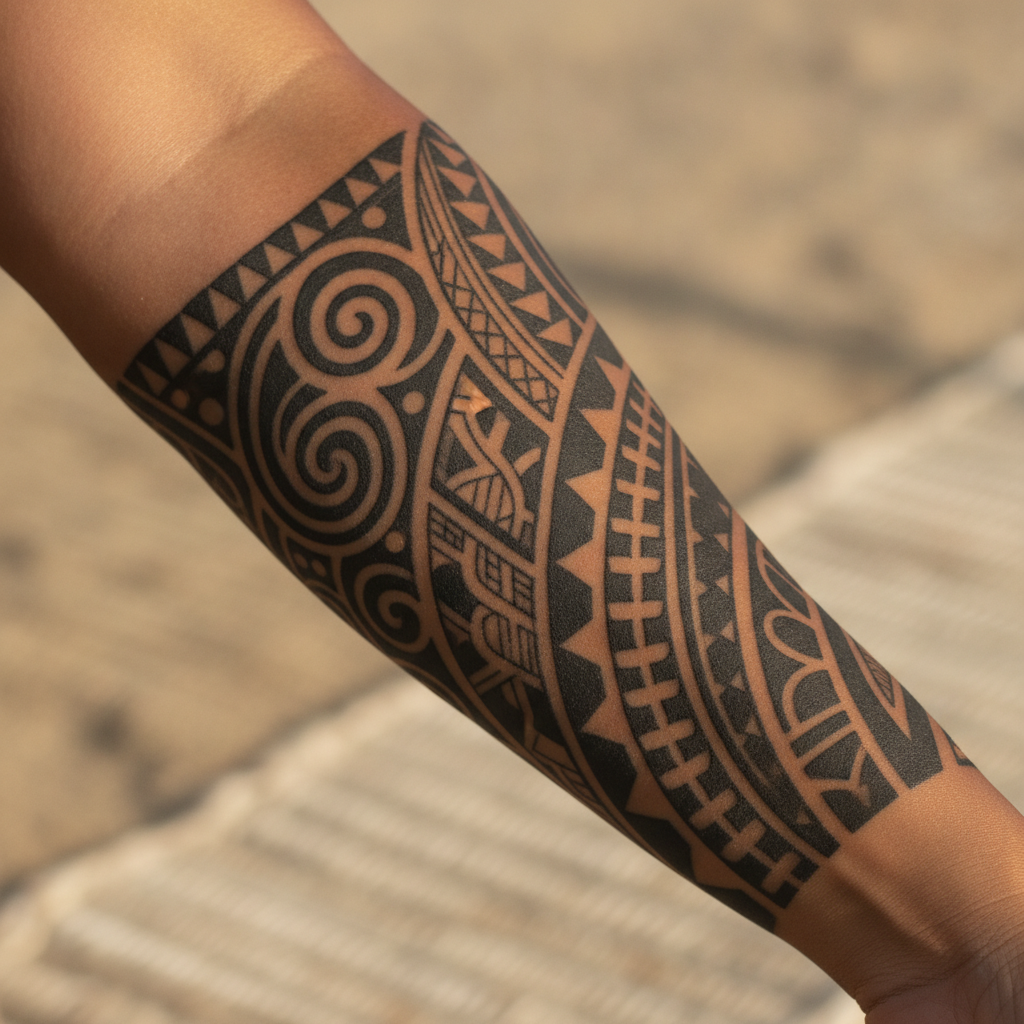
Filipino Kalinga work uses more open compositions with individual motifs sitting in negative space rather than filling every inch. Common shapes include the centipede for warrior status, the python skin pattern, and rice grain bands. Borneo Iban designs favor spiral rosettes on shoulders and throat pieces, and the bunga terung eggplant flower on the front of the shoulder is one of the most recognizable motifs. Maori ta moko uses koru spirals and unfurling fern patterns with heavier chisel-style negative space. Neo-tribal, the version that boomed in the 90s and never fully died, tends to be pure abstract blackwork with sharp thorn tips and mirror symmetry, no cultural referent required.
How tribal ink ages on skin
Because tribal work is almost entirely solid black, it ages better than most other styles when the artist knows what they are doing. There are no color fades to worry about and no fine grey wash to blow out. What actually goes wrong over ten to twenty years is line spread, where the ink migrates a few tenths of a millimeter and thin negative space channels start to close up.
A good tribal artist plans for that migration by leaving negative space wider than looks necessary at the time. If you look at 20-year-old tribal work that still looks crisp, the answer is almost always generous white space and clean line weight, not fresh touch-ups. On darker skin tones the black reads with less contrast, so many artists working on Fitzpatrick V and VI skin will use slightly bolder line weight and wider negative space to keep the pattern legible over decades. If you want a deeper look at the general aging question, black-and-grey tattoos hold up on a similar timeline for related reasons.
Placement and composition
Tribal designs are traditionally placed with the body's shape, not against it. Shoulder caps, upper arms, calves, chest panels, and half-sleeves are the classic zones because the flowing lines follow the muscle. A tribal piece designed as a flat rectangle then slapped on a curved bicep will look distorted the moment the arm moves. Good tribal artists sketch directly on the skin with a marker and adjust in real time.
For a first tribal piece, upper arm bands and shoulder caps are the most forgiving. They give the artist enough real estate to run a proper composition and they are quick healers. Full sleeves and back pieces are multi-session commitments, usually four to eight sessions depending on density. If you are budgeting, the tattoo sleeve cost breakdown applies here since dense blackwork sleeves fall on the higher end of the sleeve range because of the amount of black pack time.
- Upper arm band: 1 session, 2 to 4 hours, single-shot design
- Shoulder cap into chest: 2 to 3 sessions
- Half sleeve: 3 to 5 sessions
- Full sleeve: 5 to 8 sessions
- Back piece: 6 to 10 sessions across several months
Cultural respect and what to avoid
This is the part most style guides skip. If you are not from Samoa, Marquesas, or a specific Polynesian group, wearing sacred motifs like the tuiga headdress pattern or exact family lineage markings is considered offensive by many practitioners. The same goes for direct copies of Maori ta moko facial designs, which carry specific ancestral information.
The safe path is to work with an artist who either belongs to the tradition or has trained under someone who does, and to commission a piece inspired by the visual language rather than a copy of a sacred symbol. Neo-tribal is the other clean option because it uses tribal composition principles without borrowing specific meaningful marks. If you want a piece that references your own heritage, ask the artist to research the actual regional tradition and design accordingly.
- Avoid direct copies of ta moko facial designs unless you have Maori whakapapa
- Avoid tuiga-style headdress motifs unless commissioned within a Samoan context
- Do not mix motifs from Polynesian, Filipino, and Borneo traditions in the same piece
- Ask your artist to name the tradition each element comes from
Pricing and what to expect at the studio
Tribal blackwork is priced by the hour at most modern studios, and the rate falls into the standard blackwork range of to 0 per hour in the US, with senior artists in major cities charging . Because the style requires long black pack sessions, expect longer sit times than fine-line pieces of the same footprint. For a full breakdown by piece size, the blackwork tattoo cost guide covers the ranges in detail.
Sessions are physically demanding on both sides. The buzz of the machine over a long pack session is heavier than a line-only session, and you should eat properly beforehand and bring snacks. If your artist works in the traditional hand-tapped style, expect longer session times and a very different sensation, closer to firm rhythmic pressure than the vibration of a coil machine.
Once the piece is finished, blackwork actually heals faster than color work in most cases because there is no layered ink packing to worry about. Follow the standard first 24 hours aftercare protocol and keep the sun off it for the first three to four weeks so the black settles at maximum density.
Frequently asked
Are tribal tattoos out of style? No, but the 90s Western neo-tribal look with mirror-symmetric thorn tips has cooled off. Actual regional traditions like Polynesian, Filipino batok, and Borneo work are seeing a strong revival, often driven by artists returning to their heritage traditions. Neo-tribal is also being reworked with more organic, less mirror-symmetric compositions.
Do tribal tattoos hurt more than other styles? The line work itself is not worse than any other tattoo, but tribal pieces involve long black pack sessions that build up as fatigue rather than sharp pain. The last hour of a four-hour session is usually the hardest part regardless of style. If it is hand-tapped, the sensation is different but not necessarily more painful, just more rhythmic.
Can tribal tattoos be covered up later? Solid black is one of the harder things to cover, especially without going bigger and darker. Laser removal can fade black ink significantly over 6 to 10 sessions, and many people combine partial removal with a cover-up design. Plan the piece as if it is permanent.
How much negative space should a tribal design have? Enough that a fingertip can trace between the black shapes without touching two edges at once. This rule of thumb helps the design stay legible after 15 to 20 years of natural line spread. Artists working on darker skin tones tend to leave even more.
What is the difference between tribal and blackwork? Blackwork is the broader category of any tattoo done entirely in solid black. Tribal is a subset with roots in specific regional traditions and a defined visual vocabulary of motifs. All tribal is blackwork, but not all blackwork is tribal.
Is it appropriation to get a tribal tattoo if I am not from that culture? It depends on the specific motif and how you commission it. Generic neo-tribal geometric work carries little cultural baggage. Direct copies of specific ceremonial designs from a living tradition can be offensive to that community. The safest path is to work with an artist inside the tradition and let them design what is appropriate for you to wear.