aftercare
Tattoo Aftercare: The First 24 Hours, Hour by Hour
Most of how your tattoo looks in five years gets locked in on day one. Here's the calm version of what to do in the first 24 hours, hour by hour, with no mystique.
The first day matters more than people think. Most of the long-term look of your tattoo gets locked in by how you treat it before you go to sleep on day one.
This is the calm version of every cautious thing every artist has told you, organized by what to actually do, hour by hour. We are not adding mystique. Just the steps.
What is happening to your skin right now
A fresh tattoo is technically an open wound. The needle has driven ink past the epidermis (the top layer) and into the dermis (the layer below it, where the ink settles for life). Your immune system has noticed and is sending plasma, white blood cells, and clotting agents to the area. That is why a fresh tattoo weeps a clear-to-pinkish fluid for the first day or so. That is lymph and plasma, not infection.
The skin around the tattoo will feel hot, look slightly puffy, and may bleed a little if disturbed. All of this is normal. Your goal in the first 24 hours is to give that wound a clean, dry, protected environment so the surface can scab over and start sealing.
Hour 0 to 2: leave the bandage alone
Your artist will wrap the finished tattoo in one of two things:
- Cling film or plastic wrap (the old-school option, still common)
- Saniderm, Tegaderm, or Dermalize (a clear adhesive medical film)
If you got cling film, leave it on for 2 to 4 hours. Long enough to get home, settle in, eat. Not long enough that plasma starts pooling under the wrap.
If you got Saniderm or a similar second-skin product, your artist will tell you to leave it for 24 hours up to 5 days depending on how much fluid is collecting underneath. Do not peel it off early just because you want to look at the tattoo.
Either way, do not poke, scratch, or fuss with it in this window.
Hour 2 to 6: the first wash
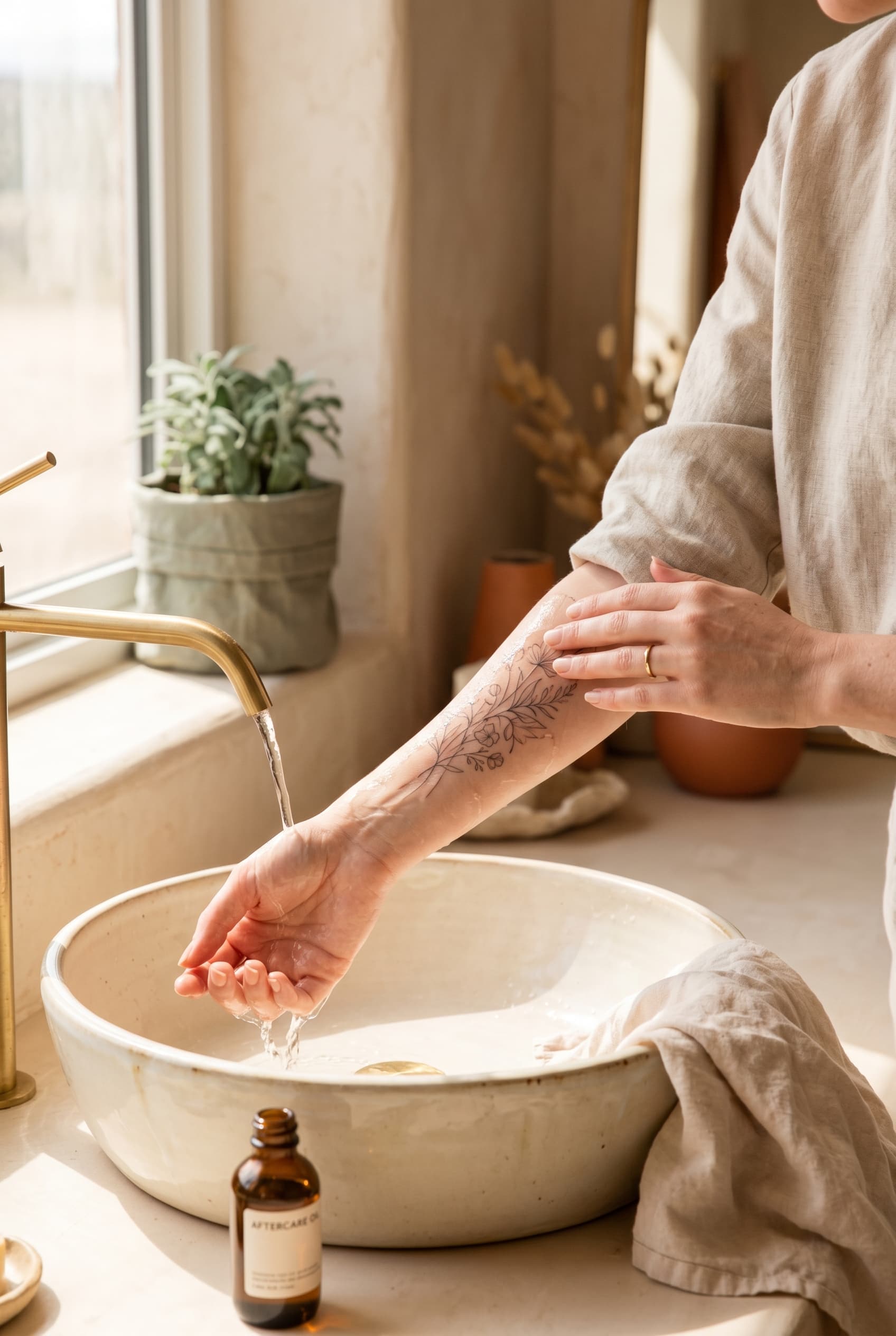
Once you take the wrap off (or it is time, per your artist's instructions):
- Wash your hands first with soap and warm water. This is not optional.
- Use lukewarm water (not hot, not cold) and a fragrance-free liquid soap. Brands artists recommend include Dr. Bronner's Baby Unscented, Cetaphil Gentle Cleanser, or Dial Gold antibacterial. Anything heavily perfumed is a no.
- Use only your hand. No washcloth, no loofah, no scrub.
- Gently rinse off any plasma, blood, and excess ink. The tattoo may look duller after this first wash. That is normal because the milky film on top was lymph and bits of ink that got pushed back out.
- Pat dry with a clean paper towel. Do not rub. Cloth towels can shed fibers into the wound.
- Let the tattoo air-dry for 10 to 15 minutes before applying anything.
Hour 6 to 24: thin ointment and patience
After that first wash and air-dry, apply a thin layer of healing ointment. The keyword is thin. A common mistake is slathering on a thick layer thinking more is better. More just suffocates the tattoo and traps bacteria.
What "thin" means in practice: enough to make the skin look slightly shiny, not enough to feel greasy or see white on top.
Good first-day ointment options:
- Aquaphor Healing Ointment, the dermatologist standard, available everywhere
- CeraVe Healing Ointment, similar formula, slightly less greasy
- A&D Ointment (the version without sunscreen), old-school but works
- Hustle Butter Deluxe, tattoo-specific, plant-based, lighter feel
- Mad Rabbit Soothing Gel, tattoo-specific, water-based, very light
What to skip on day one:
- Anything that says "lotion" and feels watery (will not protect a wound)
- Anything with fragrance, alcohol, lanolin, or active ingredients like retinol
- Coconut oil, vitamin E oil, "natural" remedies, which smother the wound and trap bacteria
Re-apply the thin layer 2 to 3 times in the first day. Wash gently before each application if anything has built up on the surface.
What not to do in the first 24 hours
This is the do-not list, ranked roughly by how much damage it causes:
- Do not go swimming, soak in a bath, or sit in a hot tub. Submerging an open wound is the fastest path to a serious infection. Showers are fine if you keep the tattoo out of the direct stream.
- Do not sweat heavily. Skip the gym, the run, the sauna. Sweat opens pores and irritates the wound.
- Do not drink alcohol. It thins your blood, which means more bleeding and weeping, and a worse-looking tattoo as that fluid pushes ink back out.
- Do not pick at it. Even if it itches. Even if there is a scab forming. Pulling at scabs pulls out ink with them.
- Do not sleep on it. Use a clean cotton sheet, and find a position that keeps the tattoo above or beside you, not pressed into bedding.
- Do not put on tight clothing. Friction is your enemy. If the tattoo is on your forearm or calf, wear loose clothes for a few days.
- Do not show 14 people at the bar tonight. Hands carry bacteria. Every reveal is an exposure.
Red flags to watch for in the first 24 hours
Most "is this normal?" questions are normal. But a few things mean call your artist or a doctor.
Call your artist if:
- The tattoo is bleeding heavily after the wrap is off (some pinkish weeping is fine; active red bleeding for hours is not)
- The wrap your artist used is causing a rash where it touches uninked skin (you may be reacting to the adhesive, not the tattoo)
Call a doctor if:
- You develop a fever above 100.4°F (38°C) within 24 hours
- Red streaks are spreading outward from the tattoo
- The area becomes increasingly painful instead of less so
- You see thick yellow or green pus
- You feel sick or fatigued in a way that goes beyond "I sat for a long tattoo and I am tired"
The American Academy of Dermatology's tattoo aftercare page covers the warning signs in more detail. When in doubt, send a photo to your artist. Most artists genuinely want to know.
Setting yourself up for the next two weeks
What you do in the first 24 hours determines how easy the next two weeks are. If you keep the tattoo clean, lightly moisturized, and unbothered today, you will thank yourself when the peeling stage starts on day 3 to 5 and the itchy stage starts on day 7 to 10.
A quick checklist before you go to sleep on day one:
- Last gentle wash done
- Thin layer of ointment applied
- Clean sheets on the bed
- No bath, hot tub, or pool today
- Hands washed every time you touched the area
- Quick check for red flags
That is it. You did the hard part. Healing does the rest.
Frequently asked
Should I sleep with cling film on overnight?
Most artists say no. Leave it on the 2 to 4 hours after the appointment, then wash and air it out. If your artist applied Saniderm or another second-skin product, that one stays on overnight (and longer). Follow your artist's specific instructions because they applied it and know their preference.
My tattoo looks duller after the first wash. Is that normal?
Yes. The first wash takes off the layer of plasma, lymph, and excess ink sitting on top of the tattoo. The actual tattoo underneath looks brighter once the surface stops weeping in a few days.
Can I shower in the first 24 hours?
Yes, but keep the tattoo out of the direct water stream. Lukewarm water on the tattoo is fine; high pressure or hot water is not. Do not let shampoo or body wash run over a fresh tattoo because the surfactants are harsh on healing skin.
Is it okay if my tattoo is hot to the touch?
A fresh tattoo runs warmer than the surrounding skin for the first day or two because your immune system is working on it. Heat plus increasing pain, redness spreading outward, or fever is a different story. That combo means call a doctor.
What if my tattoo stops weeping fluid sooner than expected?
Some tattoos weep for an hour after the wrap comes off; others weep for a day. Body location, ink density, and your individual healing all affect the timeline. Less weeping is not a problem because it usually means your skin is sealing faster.
Can I use Vaseline on a new tattoo?
Vaseline (petroleum jelly) is debated. It is occlusive, which means it traps moisture and creates a barrier. Some artists use it; many prefer Aquaphor because it has additional emollients like glycerin and lanolin alcohols that support healing. If Vaseline is what you have on hand, a very thin layer is acceptable for day one. Switch to a tattoo-specific product or a healing ointment by day two.