design ideas
Snake Tattoo Ideas: Meanings, Styles, and Placements
Snake tattoos carry heavy symbolism and work in nearly every style. Here is how to pick a meaning, style, and placement that still reads well in a decade.

Snake tattoos sit near the top of every artist's most-requested list, and for good reason. The shape is adaptable, the symbolism is thick enough to pick what you want from it, and a serpent will wrap, coil, and stretch into almost any body contour. This guide covers the meanings worth knowing, the styles that render snakes best, the placements that flatter a long sinuous subject, and the technical choices that decide whether your snake still looks sharp in ten years.
What a snake tattoo actually means
The snake is one of the oldest tattoo motifs on earth, and almost every culture that uses it attaches a different meaning. In Japanese irezumi, the hebi represents protection against illness and misfortune, often paired with peonies or chrysanthemums. In Greek iconography, the ouroboros, a snake eating its tail, stands for cyclical renewal and the unity of beginning and end. In Mesoamerican traditions, the feathered serpent Quetzalcoatl is a creator deity tied to wind and knowledge. The Judeo-Christian reading is darker: temptation, deception, exile from Eden.
Modern wearers tend to pick personal readings over strict traditional ones. Rebirth and transformation are the most common, drawing on the snake's shedding of skin. Protection is next, especially for people who had the tattoo done after a major life event. A smaller faction leans into the duality angle, the snake as a creature that is simultaneously feared and revered, which pairs well with half-light, half-shadow compositions. The practical point is to settle on your reading before you book, because it affects which style you should choose. A protective amulet reads very differently from a predatory viper, even if both are technically snakes.
Styles that render snakes best
Snakes have two features that reward the right style and punish the wrong one: scales and continuous curves. Japanese irezumi tattoos are the historical gold standard because the style was built around animals like this one. Thick bold outlines, flat color blocks, and background elements like wind bars and waves give the snake a sense of motion and context. A full hebi back piece or sleeve is the most committed version of this choice, usually running six to twelve sessions depending on size and detail.
Blackwork is the second natural fit. Solid black fills exaggerate the shape and let scale textures emerge through negative space and dotwork. This style ages exceptionally well because there is no color to shift and no light grey to fade into skin tone. Fine-line serpents are the current trend, especially single-needle work for small wrist or spine pieces. They are elegant but technically demanding. A fine-line snake under three inches long will struggle to show scale detail without blowing out, so artists either stylize the scales as simple dots or skip them entirely in favor of smooth linework.
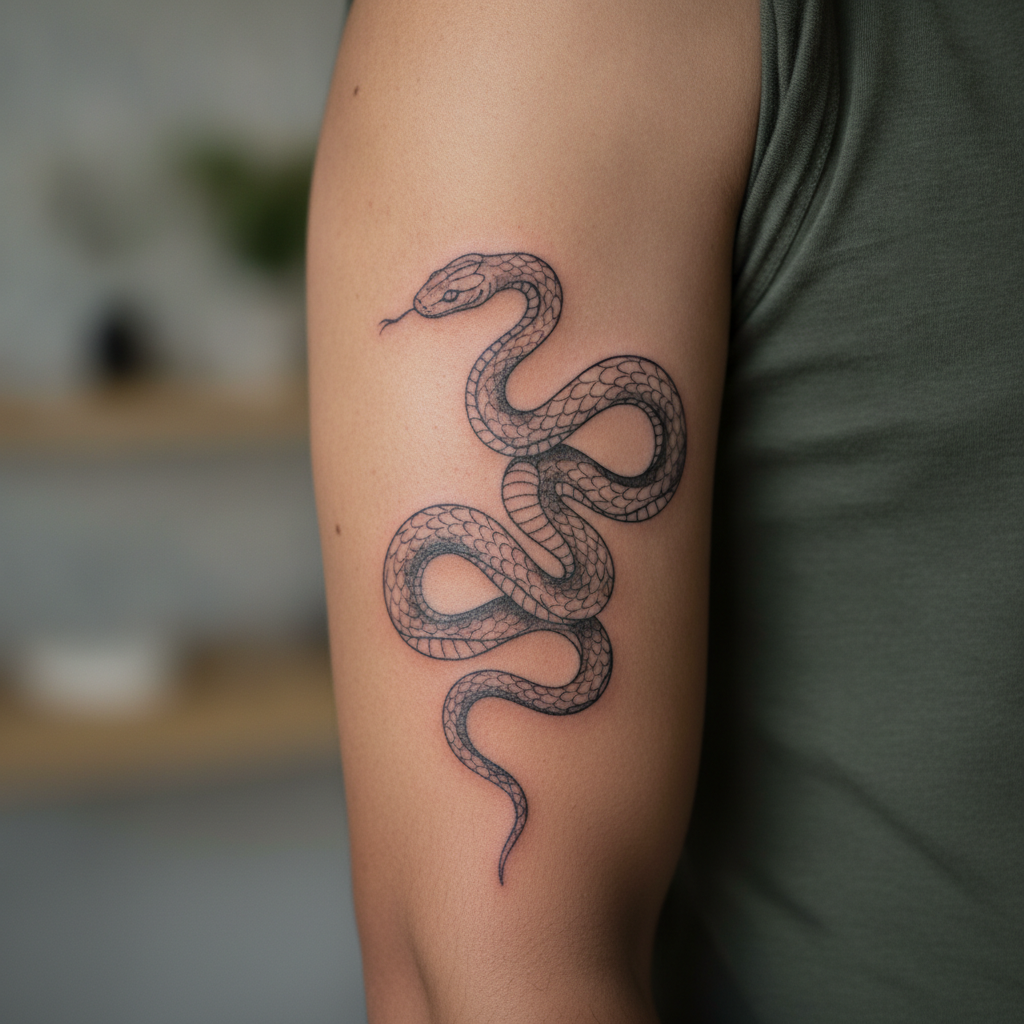
Neo-traditional and American traditional both suit a shorter striking-pose snake, often paired with a dagger or rose. Realism works for a specific commission like a portrait of a particular species, but the surface area needs to be large enough to carry the gradient. A photo-real king cobra under a palm-sized footprint will look muddy within five years.
Placements that flatter the shape
A snake wants length. Placements that give it a long uninterrupted run read best, and placements that force it to bend awkwardly around muscle groups tend to look cramped.
- Forearm wrap: 6 to 10 inches of visible skin, lets the snake spiral once with the head on the inner wrist or back of hand. Ages well, high visibility, no clothing conflict.
- Spine: the strongest natural line on the body for a stretched serpent, usually 12 to 18 inches tip to tail. Painful placement, long single sessions, but the silhouette is unmatched.
- Thigh: generous flat canvas for coiled compositions and large irezumi pieces. Low pain, slow fading because of limited sun exposure.
- Full sleeve: lets the snake weave through other elements across the upper and lower arm. Best for a planned multi-session project.
- Ribcage: dramatic for a striking downward serpent, but painful and prone to blowout on thin skin.
- Behind the ear or neck: works for very small stylized snakes only, and expect fading within three to five years.
A long design across the spine or sleeve also lets the artist use the body's own curves to suggest motion, which is harder to pull off on a static flat surface like the thigh. Before you commit, trace the design on skin with a stencil in multiple positions. A snake that looks great in flat art can read differently once it wraps a bicep.
Technical choices that make or break the piece
Snakes are detail traps. Scales, forked tongues, slit pupils, and venom glands all push toward smaller linework than most skin can hold cleanly. The three decisions that matter most are size, line weight, and whether to include color.
Size first. For a scaled serpent with visible texture, plan on at least a 4-inch body length minimum, and 6 to 8 inches is safer. Anything smaller forces the artist to compress scales into a texture that blurs within a decade. Line weight comes next. Thicker outlines around 1.2 to 1.8 millimeters hold up for 15 to 20 years before touch-up. Hair-thin single-needle lines on a small snake can soften noticeably within three to five years, which is a known trade-off of the style, not a flaw. Color is the third lever. Green and red fade faster than black or dark blue, so a bright emerald viper will dull within a decade on sun-exposed skin, where a black-and-grey rattler holds its contrast much longer. Price-wise, a mid-size blackwork snake on the forearm typically runs $400 to $900, a Japanese sleeve snake runs $1,500 to $4,000 across sessions, and a small fine-line wrist serpent sits around $200 to $400. For more context on how style affects cost, see our blackwork cost guide and the Japanese irezumi cost breakdown.
Design pairings that work
Snakes rarely sit alone in traditional work, and modern tattooing has mostly kept that habit. Peonies and chrysanthemums are the classic Japanese pairings, each with their own symbolism of prosperity and longevity. Daggers suggest struggle or triumph. Roses soften the aggression and are common in American traditional pieces. Skulls lean the composition toward memento mori and look best in heavy blackwork. Moons and celestial elements are a current trend in fine-line work, pairing a slim serpent with crescent moons or constellations for a mystical feel.
If you want the snake to be the clear focal point, keep secondary elements small and desaturated. A full-color peony next to a black snake pulls the eye away from the serpent. If you want balance, scale the companion elements to roughly match the snake's visual weight. The one pairing to avoid is cramming too many symbols into a single piece. A snake, a dagger, a rose, a skull, and a moon in one sleeve segment reads as a sticker sheet, not a composition.
Frequently asked
Do snake tattoos have a bad meaning? Not inherently. The negative reading comes mostly from Judeo-Christian iconography where the serpent is a tempter. Most other cultures treat the snake as a positive or neutral symbol of transformation, protection, or wisdom. Pick the reading you connect with and tell your artist so the composition supports it.
How long does a full sleeve snake tattoo take? A Japanese-style sleeve with a snake as the central subject typically runs six to ten sessions of three to five hours each, so 20 to 50 hours of chair time total. Expect four to twelve months of calendar time once you account for healing between sessions.
What is the smallest snake tattoo that still looks good? About 2 to 3 inches for a stylized fine-line serpent with minimal scale detail. Any smaller and you lose the ability to show the forked tongue, eye detail, or scale pattern that makes a snake read as a snake rather than a wavy line.
Will a colored snake tattoo fade faster than a black one? Yes, especially red, green, and yellow. Expect noticeable fading on bright colors within 8 to 12 years on sun-exposed placements, versus 15 to 20 years for black ink. Diligent sunscreen use on healed tattoos is the single biggest factor in extending color life.
Does snake placement affect pain level? Significantly. Ribcage, spine, and inner bicep are the most painful spots because of thin skin over bone or nerve clusters. Forearm, thigh, and calf are moderate. The outer upper arm and shoulder are the mildest. A long spine piece done in one session is a serious endurance test, which is why most artists split spine snakes across two or three sittings.
Can I add a snake to an existing tattoo? Usually yes, as long as the existing piece has breathing room. Snakes work well as composition anchors in sleeves because they can weave through other elements without needing a dedicated panel. Bring reference images for both the existing work and the proposed snake to your consultation so the artist can plan the flow.