aftercare
Retinol Over a Tattoo: Fading, Timing, and Safe Routines
Retinol speeds up skin turnover, which is exactly what fades tattoos. Here is how long to wait after a new piece, where to use it, and how to protect healed ink long term.

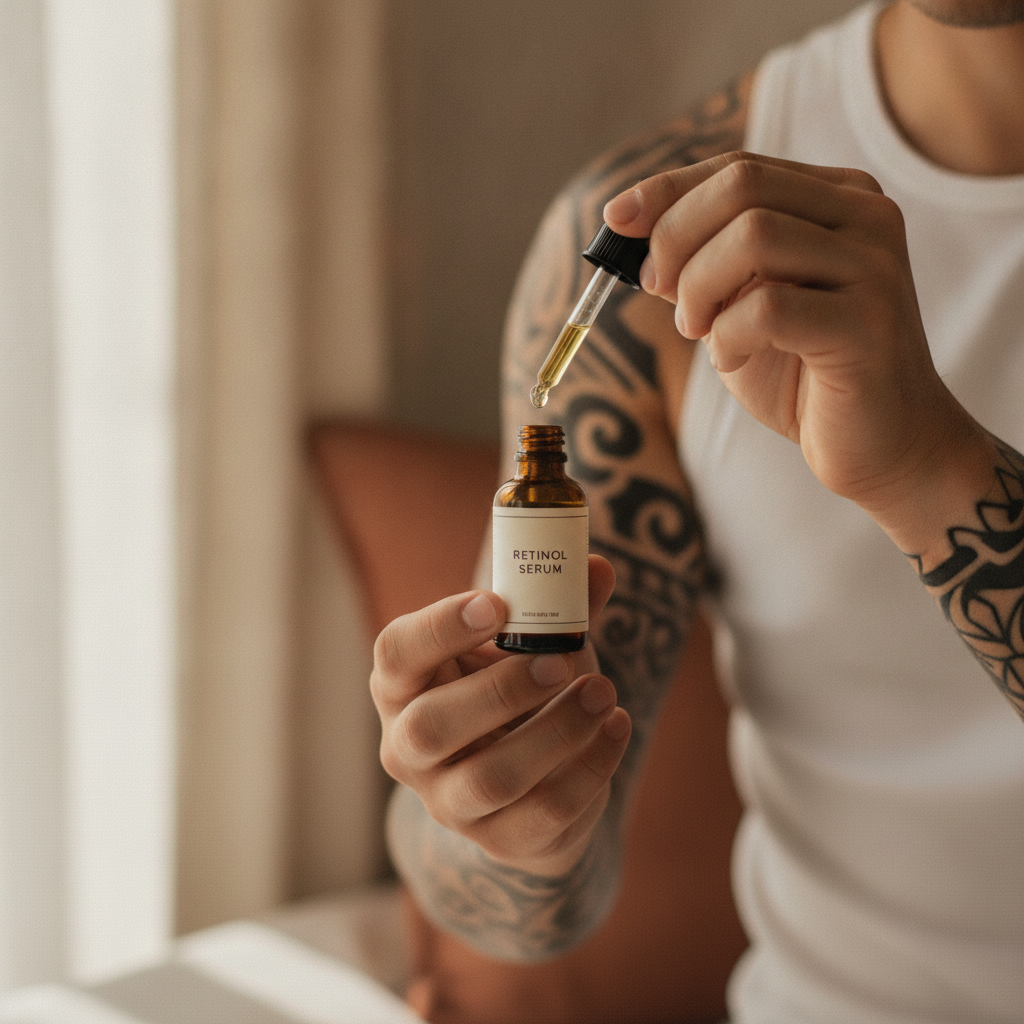
Retinol is the most effective over-the-counter ingredient for fading pigment. That is great news for sun spots and acne scars, and bad news if you are slathering it on an arm that happens to have a tattoo. The pigment particles sitting in your dermis do not care that you were targeting fine lines. If retinol or prescription tretinoin lands on inked skin night after night, that tattoo will look duller a year from now than one that was left alone. The fix is not to quit retinol. It is to understand the timing and the geography.
How retinol fades tattoo ink
Retinol and its stronger prescription cousin tretinoin accelerate keratinocyte turnover and stimulate collagen remodeling in the dermis. Both effects nudge pigment particles upward and outward over time. Your tattoo is held in place by macrophages that engulf ink and sit in the dermis long term. Faster cell cycling means a slow drip of those particles getting carried into the epidermis, where they shed. One study on tretinoin 0.1% applied daily over six months showed measurable epidermal thinning and increased melanin dispersion in treated skin, and the same mechanism acts on tattoo pigment. You will not see a result in a week. You will see it in year three, when your blackwork looks grey and your fine-line botanical reads like a smudge.
Strength matters. A gentle 0.1% retinol serum used two nights a week on a forearm is a slow erosion. A pea-sized nightly application of 0.05% tretinoin is a landslide by comparison. If you use any prescription retinoid, assume the fading effect is three to five times faster than an OTC product at common consumer concentrations.
Never use retinol on a healing tattoo
A fresh tattoo is an open wound for the first 48 to 72 hours and a healing wound for the next three to four weeks. Retinol on broken or healing skin causes irritation, delayed closure, and in some cases chemical burn, which can translate directly into blowouts and patchy healing. The outer barrier is already compromised. Retinoids are designed to disrupt that same barrier to drive turnover. Combining them makes no sense.
Hard rule: no retinol, retinal, retinaldehyde, tretinoin, adapalene, or tazarotene on or near a tattoo until the piece is fully healed. For most people that means a minimum of six weeks, and ideally eight to twelve weeks for larger or color-heavy work. If you are unsure what fully healed looks like, read our breakdown on how to tell when a tattoo is fully healed before reintroducing actives.
Waiting periods after a new piece
Here is a reasonable timeline for someone with a standard black-and-grey or color piece on a non-facial area:
- Weeks 0 to 2: no actives at all. Only gentle fragrance-free cleanser and the aftercare routine your artist recommended.
- Weeks 2 to 6: plain moisturizer and SPF only. No retinol, no AHA, no BHA, no vitamin C within the tattooed area.
- Weeks 6 to 12: you can resume retinol on untattooed skin. Still avoid direct application over the tattoo.
- After week 12: tattoo is fully healed. You can touch the inked area with retinol but with the geography rules below.
Face tattoos and finger tattoos take longer. Both areas have unique healing timelines and are closer to the areas you probably treat with retinol anyway, so account for that overlap. If you had multiple sessions, start the clock from the last session, not the first.
The geography fix: treat around the tattoo, not through it
If your tattoo is on your face, chest, or neck and you use retinol for aging or acne, you do not have to pick one or the other. You have to adjust where the product lands.
Dispense retinol into your palm, then apply it with your fingertip to each target area in dabs rather than smearing it across the whole face. Avoid passing over inked zones. Follow with a plain ceramide moisturizer that you can safely apply to the entire area including the tattoo. The moisturizer dilutes any migrating retinol film and gives the tattooed skin a buffer. If the tattoo is on your neck or chest and you have been in the habit of carrying leftover retinol down from your jawline, stop. That reflex is what dulls jawline-adjacent neck tattoos within two to three years.
For body tattoos on the arms, legs, or torso, the fix is easier. Simply do not apply retinol body lotion to tattooed areas. Use a plain ceramide or shea-based moisturizer on the tattoo and your retinol product on the untattooed skin. If you cannot keep them separate because the tattoo covers a large zone like a full sleeve, you have to accept that daily retinol over that sleeve will fade it faster than the rest of your work.
What to do if your tattoo already looks dull
Reversing retinol-driven fade is not realistic in the same way you cannot un-exfoliate. What you can do is stop the ongoing damage and plan a touch-up strategy. Stop applying retinol to the tattooed area immediately. Give the skin eight weeks of just moisturizer and daily broad-spectrum SPF 30 or higher. SPF compounds matter here because UV accelerates tattoo fading on its own, and retinol-thinned skin burns and fades faster.
After that reset window, book a consult with your original artist or a technically similar one. A single refresh pass can restore saturation on blackwork and black-and-grey in one session, usually priced at a shop minimum or a short hourly block. Color work is harder because faded color often needs a full rework rather than a touch-up. Expect to pay more, and expect to let the area heal retinol-free from that point on. For a sense of what a refresh costs, see our breakdown on tattoo touch-up cost.
Prescription retinoids and acne patients
If you are on tretinoin for acne or anti-aging under a dermatologist's care, the stakes are higher. Prescription strength works deeper and faster. Patients using 0.025% to 0.1% tretinoin nightly on the face should treat any face, neck, or upper chest tattoo as off-limits for direct application. Adapalene 0.1% and tazarotene 0.05% behave similarly. If you are an acne patient who wants a chest piece, time the tattoo during a planned prescription break, let the piece heal fully over eight to twelve weeks, and then resume on untattooed skin only. Talk to your dermatologist about swap options like azelaic acid in the inked area if you need an active there. Azelaic acid treats acne and hyperpigmentation without the same turnover effect on tattoo pigment.
Frequently asked
Does retinol fade tattoos through the whole dermis or just the surface? Retinol primarily affects the epidermis and the upper dermis, where it accelerates turnover and remodels collagen. Tattoo pigment lives slightly deeper, but macrophages are mobile. The upward migration of pigment particles over months of use is what produces visible fading. The effect is cumulative and gets worse the longer you use retinol over the same tattoo.
Can I use bakuchiol instead of retinol over my tattoo? Bakuchiol is often marketed as a plant-based retinol alternative and the data on its effect on tattoo pigment is limited. It appears to be far gentler than retinol on skin turnover, which suggests less fading risk. If you want an anti-aging ingredient over a tattooed area, bakuchiol at 1% is a reasonable swap. It will not match prescription retinoid results for wrinkles, but it will not fade your tattoo at the same speed either.
What about vitamin C serums? Vitamin C is a brightening antioxidant and does not drive the same turnover mechanism as retinol. Pure L-ascorbic acid at 10% to 20% is generally safe on healed tattoos and even helps with UV defense when layered under SPF. Avoid vitamin C on any tattoo that has not fully healed, since the low pH formulations sting on compromised skin.
How long should I stop retinol before a tattoo appointment? Stop retinol on the area you plan to get tattooed at least one week before your appointment, and ideally two weeks for prescription strength. Retinol-thinned skin bruises more easily, bleeds more during the session, and can affect ink retention. Your artist will thank you.
Does SPF protect against retinol-driven fade? No. SPF protects against UV-driven fade, which is a separate mechanism. You need both: SPF daily and retinol kept away from the tattoo. Think of them as two different risks that each need their own fix.
Is tattoo numbing cream a problem with retinol? Numbing creams like lidocaine are a short-term topical and do not interact with retinol in a meaningful way. The issue is the state of your skin on the day. If you are on nightly tretinoin and your skin barrier is thin, numbing cream absorption can be inconsistent and irritation risk is higher. Pause retinol for a week before a session and your numbing experience will be more predictable.