style guides
Micro-Realism Tattoos: Style Guide for Tiny Detail
Micro-realism tattoos pack portrait-grade detail into a coin-sized footprint. Here's what the style demands of artist, skin, and aftercare.

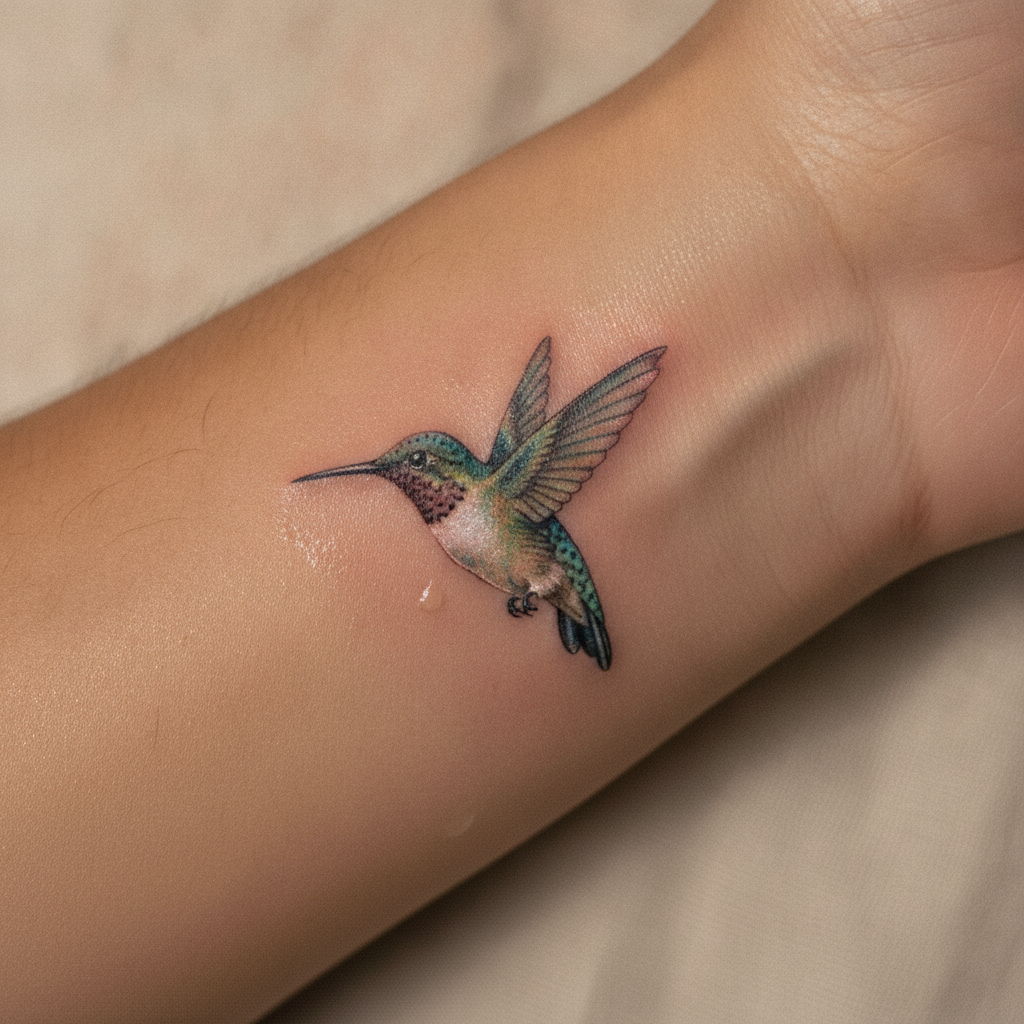
Micro-realism is realism shrunk to the size of a coin. Think a recognizable portrait of your dog in a 5cm circle on your inner forearm, or a tiny hummingbird mid-flight rendered with the same shading values a portrait artist would use on a sleeve. The style sits at the intersection of fine line work and traditional realism, and it has become one of the fastest-growing requests in the last five years. This guide covers what makes a micro-realism piece actually work, what it costs, how it ages, and what to look for when you pick an artist.
What micro-realism actually is
Micro-realism applies the tonal logic of full-scale realism to a piece typically between 3cm and 8cm. The artist still has to render light direction, surface texture, and depth, but every value transition happens across a few millimeters instead of a few centimeters. That compression is why the style is hard. There is no room to "save" a wobbly line in the next pass, and shading has to commit on the first or second go before the skin gets too irritated to take more pigment cleanly.
The needle setup is almost always single-needle (1RL) or a very tight 3RL liner. Shading uses 1RL or a 3RL run at low voltage, and some artists work with a rotary pen specifically tuned for slow, controlled passes. Ink is usually a dedicated black like Dynamic Triple Black or Solid Ink Greywash diluted to two or three values. Heavy color is rare in true micro-realism. When color appears, it is usually a single accent (an iris, a flower petal) rather than a full palette, because shifting between cartridges interrupts the precision the piece depends on.
A common confusion: not every small realistic tattoo is micro-realism. A 12cm portrait done in a realism style is just small realism. Micro-realism is specifically the discipline of preserving portrait fidelity at coin-sized scale.
Why the style is so technically demanding
Skin is not paper. It stretches, it bleeds plasma into the cartridge during long passes, and pigment migrates under the surface in the months after the session. A 3mm eye on a portrait has to survive all of that and still read as an eye in five years. Most failures in micro-realism are not about the artist's drawing skill. They are about pigment depth, needle speed, and machine voltage.
Push too deep and the dot blows out into a 1mm smudge that erases the iris entirely. Stay too shallow and the pigment falls out during the heal, leaving a faded patch right where the focal detail should be. The window between "saturated" and "blown out" is roughly 0.3mm of needle travel. That is why artists with backgrounds in black and grey work tend to translate better into micro-realism than artists from a heavy color realism background.
Sitting time is short. A typical micro-realism portrait runs 90 minutes to 3 hours in a single session. Anything longer and the skin starts to swell and reject pigment, which is the opposite of what the style needs. Artists who specialize in this style often book back-to-back short sessions rather than the all-day appointments common in large-scale realism.
Best placement choices
Placement matters more in micro-realism than in almost any other style because the skin's behavior at each location changes how the detail will read at six months and at five years. The forearm (inner and outer), the upper bicep, the calf, and the upper back hold detail best. These are flat, low-friction zones with stable skin that does not move dramatically with daily activity.
Avoid these placements for true micro-realism:
- Fingers and hands: high turnover skin, constant friction, faded detail within 18 months
- Feet and ankle bones: thin skin over bone, pigment migrates quickly
- Inner wrist crease: constant flex, detail collapses
- Ribs and sternum: skin stretches with every breath, fine lines drift
If you want a micro piece in one of those zones, you are essentially signing up for a touch-up every 18 to 24 months as a maintenance cost. Some clients accept that. Most do not.
What it costs
Micro-realism is priced like high-end realism even though the piece is small, because the difficulty per square centimeter is much higher. Expect $300 to $600 for a 3 to 5cm piece from a mid-tier specialist, and $600 to $1,500 for the same size from a recognized name. Artists with waitlists running six to twelve months routinely charge $200 to $400 per hour of work, with most pieces taking 2 to 3 hours.
Compare that to a fine-line tattoo of similar size, which usually runs $200 to $400 total, and you see the premium the style commands. The price reflects three things: the time the artist spent learning the technique, the rejection rate on bookings (most specialists turn away 70% of requests), and the cost of consultation and reference work that happens before the needle ever touches skin.
How it ages
A well-executed micro-realism piece on good placement, healed correctly, holds up for 5 to 8 years before any noticeable softening of detail. After that, the finest internal lines start to blur slightly and the lightest grey values lift. The piece does not "disappear." It softens into something closer to a small grey portrait that still reads from a meter away but loses crispness up close.
Aging accelerates with sun exposure, weight fluctuation, and skin type. Oily skin holds micro-realism slightly worse than dry skin because sebum continues to push pigment toward the surface over years. Sun is the biggest enemy. A consistent SPF 50 habit (see our long-term sunscreen guide) is the single biggest predictor of whether a micro piece still looks sharp at year seven.
Industry rule of thumb: a 3cm micro-realism portrait at $500 with two $150 touch-ups over a decade still costs less per year of wear than most pieces of jewelry.
Choosing an artist
Portfolios tell almost everything you need to know. Look for healed photos, not fresh ones. A fresh micro-realism tattoo looks crisp on every artist's Instagram because the skin is still swollen and the pigment has not settled. The real test is what the piece looks like at the three-month mark. Specialists who are confident in their work post healed shots routinely. Artists who only post fresh work are usually hiding heal results.
Ask three questions before booking:
- Can I see healed photos from at least three months after the session?
- What needle and machine setup do you use for this style?
- How many micro-realism pieces have you done in the last six months?
If the artist hesitates on healed photos, walk. If they cannot answer the needle question with specifics, they are probably using the same setup they use for larger work, which is a yellow flag. A specialist running 10 or more micro pieces a month has the muscle memory the style requires. Someone doing one a quarter is still learning, and you do not want to be the practice piece.
Frequently asked
Is micro-realism more painful than other small tattoos? Slightly, because the needle passes over the same small area multiple times to build up shading. A 5cm micro piece on the inner forearm feels roughly comparable to a 10cm fine-line piece in the same spot. The pain is dull and persistent rather than sharp.
How long does a micro-realism tattoo take to do? Most pieces take 90 minutes to 3 hours. Larger or more detailed work might run to 4 hours, but artists rarely go longer in a single session because skin response degrades the result.
Can micro-realism be done in color? It can, but most experienced artists discourage it. Color requires more passes, more needle changes, and more skin trauma, all of which work against the precision the style needs. A single color accent in an otherwise black-and-grey micro piece is the standard compromise.
Will it look the same in ten years? No tattoo does. A well-placed, well-healed micro-realism piece will soften but stay recognizable for 8 to 10 years. After that, expect a touch-up to restore the lightest values and finest internal lines.
What is the smallest a micro-realism portrait can go? The practical floor for a recognizable face is around 2.5cm. Below that, skin grain and pigment migration make it almost impossible to preserve the features that make a portrait readable.
Should this be a first tattoo? It can be, but you give up the option of using your first tattoo as a low-stakes learning experience. A small fine-line piece in the same placement teaches you how your skin heals without the financial and emotional weight of a $500+ portrait. Most artists recommend at least one prior tattoo before booking serious micro-realism.