style guides
Chicano Tattoos: Style Guide for Black-and-Grey Realism
Chicano tattoos blend single-needle black-and-grey realism, script lettering, and cultural iconography. Here is how the style works and how it ages.
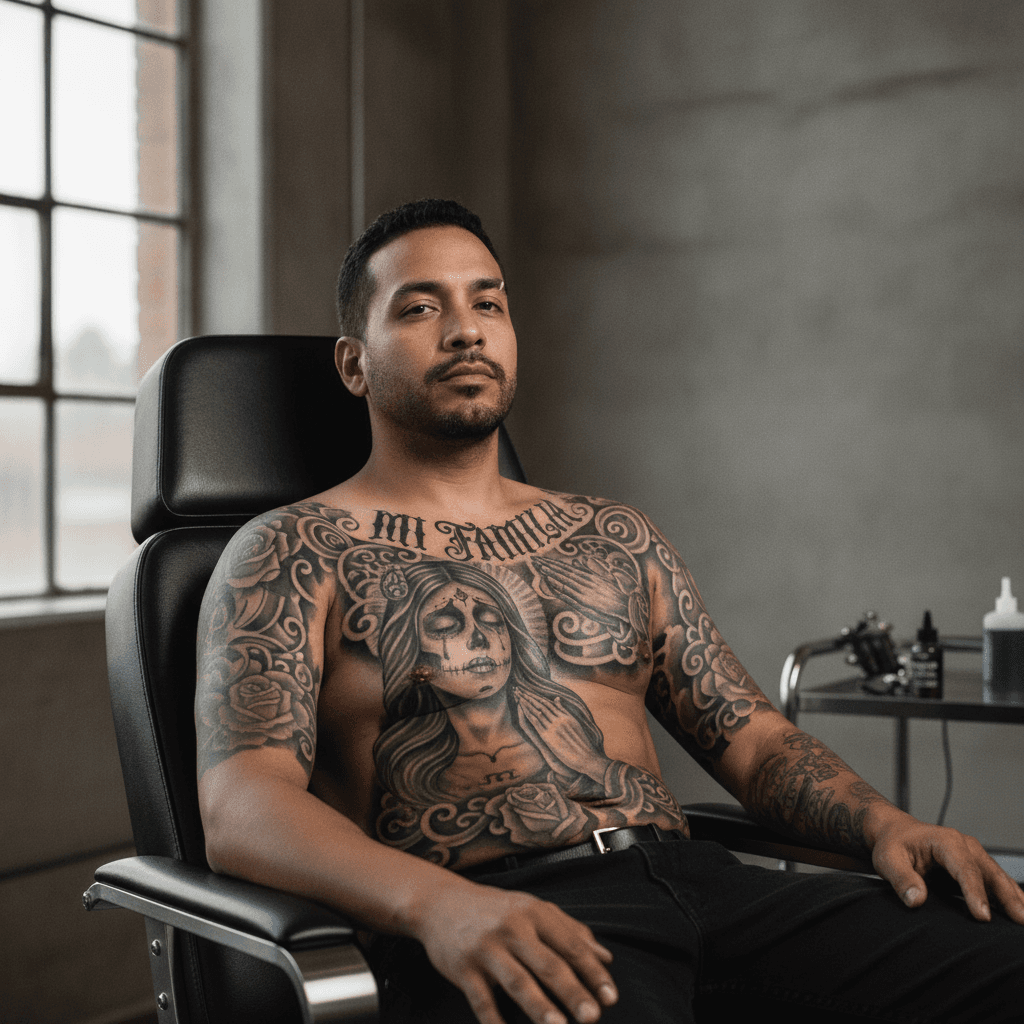
Chicano tattooing came out of East Los Angeles in the late 1940s, took shape inside the California prison system through the 1970s, and now sits among the most recognizable black-and-grey traditions in the world. The look is unmistakable: smooth grey washes, fine script lettering, religious iconography, lowriders, and portraits rendered with single-needle precision. If you are considering a piece in this style, the choices you make about artist, placement, and composition matter more than they do in almost any other tradition.
What defines Chicano style
Chicano tattoos are black-and-grey almost without exception. Color appears occasionally as a small accent, usually a red rose or a flag stripe, but the body of work is built on a grayscale gradient. Artists thin black ink with distilled water to create a stepped palette, sometimes five or six grey values from a wash so light it reads as skin tone up to solid black. That tonal range is what gives the work its photographic quality.
The line work is fine, often pulled with a single needle or a tight three-round-liner. Lines stay thin so they can sit alongside soft grey shading without overpowering it. Compare that to American traditional, where bold 7-round-liner outlines carry the design. In Chicano work the linework is a delivery system for tone, not the main event. For context on how that compares to other shaded styles, see our black and grey tattoos style guide.
Imagery comes from a defined visual vocabulary. Religious figures: the Virgen de Guadalupe, praying hands, rosaries, sacred hearts. Family portraits, often of children or grandparents, rendered from photographs. Lowriders, 1964 Impalas, hydraulics, dice. Script lettering with names, dates, neighborhoods, or single words like "loyalty" or "familia." Roses, smiling and crying clown faces, pin-up women with high arched brows. The iconography is specific and the style does not borrow casually from outside it.
The single-needle technique
A single-needle machine setup uses one needle on a long taper, run slow with low voltage. The artist works with a light hand, building shading through hundreds of light passes rather than one heavy one. A medium-sized portrait can take six to ten hours spread across two or three sessions because the technique simply cannot be rushed.
The trade-off is fragility. Single-needle work is among the harder styles to keep looking sharp over decades. Fine grey washes blur as ink particles migrate through the dermis, and thin lines can fade unevenly on certain skin types. We get into the full picture below.
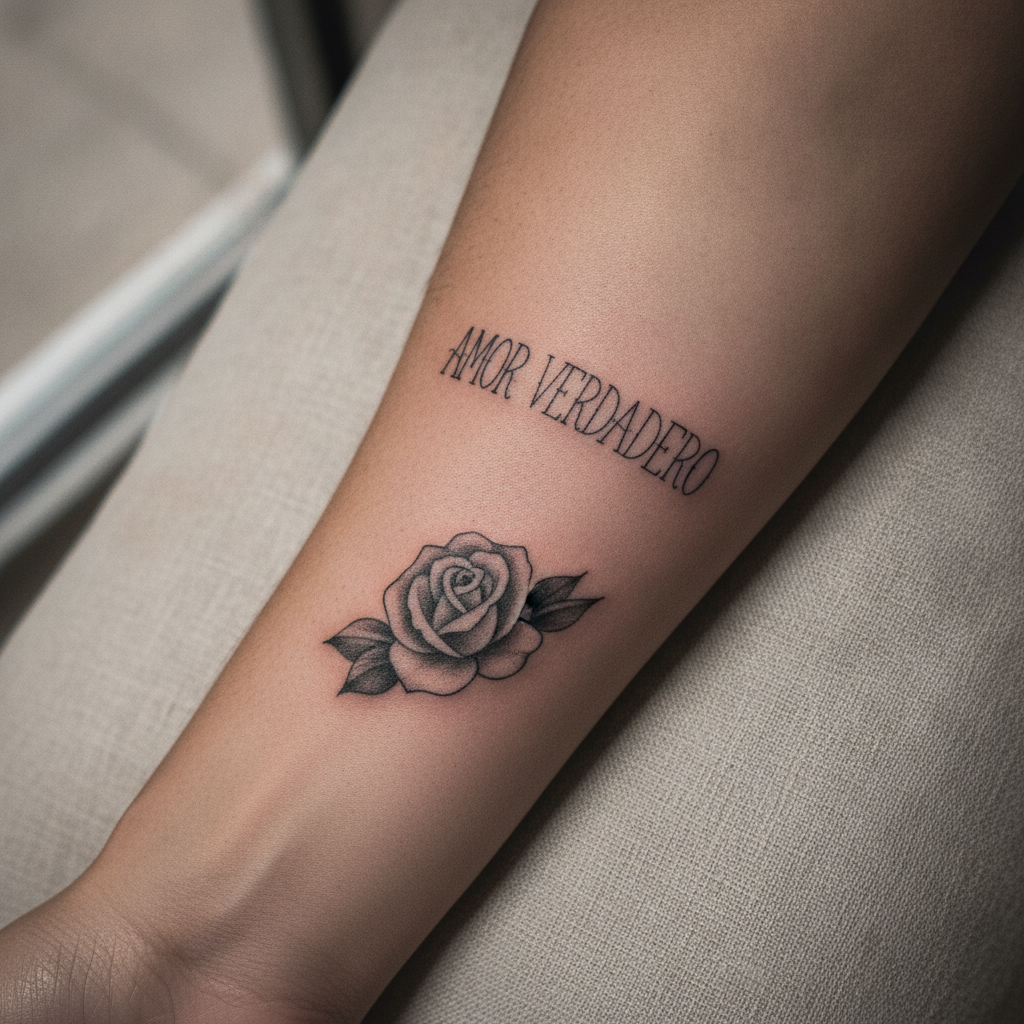
Script lettering done right
Lettering is half of what makes a Chicano piece read as Chicano. The script is typically based on Old English blackletter or a flowing cursive sometimes called "gangster script," with high contrast between thick downstrokes and hairline upstrokes. Letter spacing is tight. Words sit on a slight curve that follows the muscle group, not a rigid horizontal baseline.
A few rules separate good lettering from amateur work. Letters should be sized so the thinnest hairline is at least 0.3mm wide on the skin, otherwise the upstrokes will drop out within two years. Names and dates should be drawn freehand or hand-lettered by the artist, not pulled from a font file and stenciled, because font letterforms designed for paper rarely sit well on a curved limb. Ask to see a portfolio of healed lettering, not just fresh photos, before you book.
Common placements for script are the collarbone, the side of the neck, the ribs along the lat line, the inside forearm, and across the stomach. Single words or short phrases work better than long sentences. Long script on a curved body part tends to look crowded by year five.
Pricing and session structure
Chicano work is priced like any high-skill black-and-grey: by the hour, with rates set by the artist's reputation. Expect roughly the following ranges in major US cities in 2026:
- Mid-career Chicano specialist: $200 to $300 per hour
- Established name with a waiting list: $300 to $450 per hour
- A few top portraitists working in this tradition: $500 to $800 per hour, often booked a year out
A full sleeve in this style typically runs 25 to 40 hours and lands somewhere between $7,000 and $20,000 depending on whose chair you sit in. A medium chest piece is usually 12 to 18 hours. Smaller standalone pieces, a hand of cards or a single rose with script, can finish in a three to four hour session. For broader context on shaded work pricing across body areas, our fine-line tattoo cost guide covers the same single-needle territory from a pricing angle.
Deposits in this tradition are standard. Most specialists ask for $200 to $500 down to secure a booking, applied to your final session. The wait time to get on the books of a well-known Chicano artist is often six to twelve months.
How Chicano work ages
This is the conversation worth having before you book. Single-needle black-and-grey ages well when three conditions are met: the artist saturates the ink correctly at the right depth, the wearer protects the piece from sun exposure, and the placement avoids high-friction body parts.
When those conditions hold, a Chicano piece on the inner bicep or chest can still read clearly at twenty years. The grey washes soften slightly but the tonal hierarchy remains. The lettering thins by maybe 15 percent. Touch-ups every eight to ten years can keep the work looking close to fresh.
When those conditions fail, the same piece looks tired by year seven. Hand and finger placements blow out within two years. Fingers in particular are a poor canvas for single-needle work because the skin sheds quickly and ink rarely holds in the lateral edges. If your heart is set on a finger piece, our finger tattoo cost guide covers the longevity trade-offs in more depth.
Sun is the second killer. Chicano black-and-grey washes are particularly vulnerable to UV degradation because the lightest grey values are already thin. Daily SPF 50 on exposed pieces is not optional if you want the work to last.
Finding the right artist
The single biggest variable in how your tattoo turns out is who tattoos it. Three filters help narrow the field.
First, look at healed work. A portfolio of fresh photos shot under studio lighting tells you the artist can take a good photograph. A portfolio of healed pieces shot two years later under daylight tells you the artist can put ink in skin that stays there. Ask. Most serious artists keep a "healed" folder for exactly this reason.
Second, look at the lettering specifically. Any Chicano specialist worth their booth can letter freehand. If the only script in the portfolio looks identical to common Old English fonts, the artist is stenciling from a computer and you can find better.
Third, look at portrait work if you want a portrait. Portrait tattooing is its own discipline within Chicano style and not every black-and-grey artist does it well. The eyes are where amateur portraits fall apart, so study the eyes in the portfolio.
Frequently asked
Is Chicano tattooing only for people of Mexican heritage?
The style originated in Mexican-American communities in California and many artists working in the tradition are of Mexican descent. Getting tattooed in this style as a non-Mexican wearer is not off-limits, but the iconography carries cultural weight. Avoid imagery tied to gang affiliations, neighborhoods, or religious figures you do not have a personal connection to. Stick to elements like roses, lettering of words meaningful to you, or portraits of your own family.
How long does a half sleeve in this style take?
A half sleeve typically runs 15 to 25 hours across three to five sessions. Most artists book sessions of four to six hours, with at least two weeks between visits to let the skin heal before working the next section.
Can Chicano tattoos be done in color?
Traditionally no. The black-and-grey palette is core to the style. Some modern artists incorporate small color accents, usually a red rose or a small flag, but a fully colored piece moves the work into a different tradition. If you want color, neo-traditional or realism are better starting points.
Does single-needle work hurt more than regular shading?
It hurts about the same during the session because the needle penetrates the same dermal depth. Sessions tend to feel longer because the technique is slower, so most wearers describe the pain as a marathon rather than a sprint. The inner bicep, ribs, and the back of the knee are the harder placements. Forearms, calves, and the outer thigh sit at the easier end.
How soon can I get a second session?
Most Chicano specialists want at least two to three weeks between sessions on the same area. The skin needs to fully reform its outer layer before being worked again, otherwise the new pass deposits ink unevenly. If your artist is willing to work the same patch a week later, that is a flag worth asking about.
What does the deposit cover?
The deposit holds your appointment slot and covers the artist's time spent on the custom design. If you cancel without enough notice, the deposit is usually forfeit. If you complete the work, the deposit comes off your final session cost. Confirm the studio's specific cancellation policy in writing before you pay.