design ideas
Zodiac Tattoo Ideas: Signs, Symbols, and Placement
A practical guide to zodiac tattoo ideas: glyphs, constellations, and element motifs, with placement advice that keeps the design readable for decades.

Zodiac tattoos sit in a sweet spot. They carry personal meaning without needing a backstory, they read as design even to people who skip the astrology, and they scale from a 2 cm glyph on the wrist to a full ribcage constellation. The twelve signs each come with three design doors: the glyph (the simple shorthand symbol), the constellation (the dot-and-line star pattern), and the symbolic animal or figure (ram, bull, archer, crab). Picking the right door and the right placement is the difference between a piece that still looks sharp at year ten and one that blurs into a smudge.
The three design directions for every sign
Every zodiac tattoo comes down to a choice between glyph, constellation, or symbolic figure. Glyphs are the cleanest option. They are small, instantly recognizable to anyone who knows the signs, and they age extremely well because they are built from thick, deliberate lines. A Leo glyph at 3 cm will still read as a Leo glyph at year fifteen. Constellation designs lean toward the fine-line and dotwork end of the spectrum, with dots representing stars and thin lines connecting them. They are elegant but demand a skilled hand because any blowout in a star or wobble in a connecting line is immediately visible. Symbolic figures (the Taurus bull, Sagittarius archer, Virgo maiden) open the door to full illustrative, neo-traditional, or Japanese treatments and can scale up to half-sleeves without feeling thin.
Price ranges track the direction you choose. Expect roughly:
- Glyph only, 2–5 cm: $100–$250 flat
- Constellation, 5–10 cm fine-line: $200–$450
- Symbolic figure, 10–20 cm illustrative: $400–$1,200
- Full sleeve or back piece with zodiac narrative: $2,500–$8,000 across sessions
If you are new to tattoos, start with the glyph or a small constellation. The tattoo pain chart is worth checking before committing to a ribcage or sternum placement, because zodiac tattoos migrate toward those spots for aesthetic reasons that do not always account for how painful they are.
Sign-by-sign design notes
Each sign has quirks worth knowing before you book. Aries works beautifully as a geometric ram head or a single-line horn silhouette, and the glyph itself resembles a stylized ram face which lets artists blend symbol and figure. Taurus benefits from heavier blackwork because the bull translates well into bold neo-traditional treatments. Gemini traditionally shows twins or paired faces, and the modern move is to split the design into two mirrored elements rather than one combined figure. Cancer leans into the crab symbol or a soft moon pairing since cancer is a water sign ruled by the moon.
Leo is one of the most tattooed signs because the lion gives artists endless room to work. A realistic lion head, a geometric lion silhouette, or the simple glyph all read as Leo. Virgo often appears as a hand holding wheat or a stylized woman, and the glyph with a looped tail is one of the more visually distinctive shorthand symbols. Libra is almost always rendered as scales, sometimes abstracted into pure geometry. Scorpio has the strongest single-image appeal: the scorpion itself is already a tattoo-ready silhouette, and the glyph with its arrowed tail reinforces it.
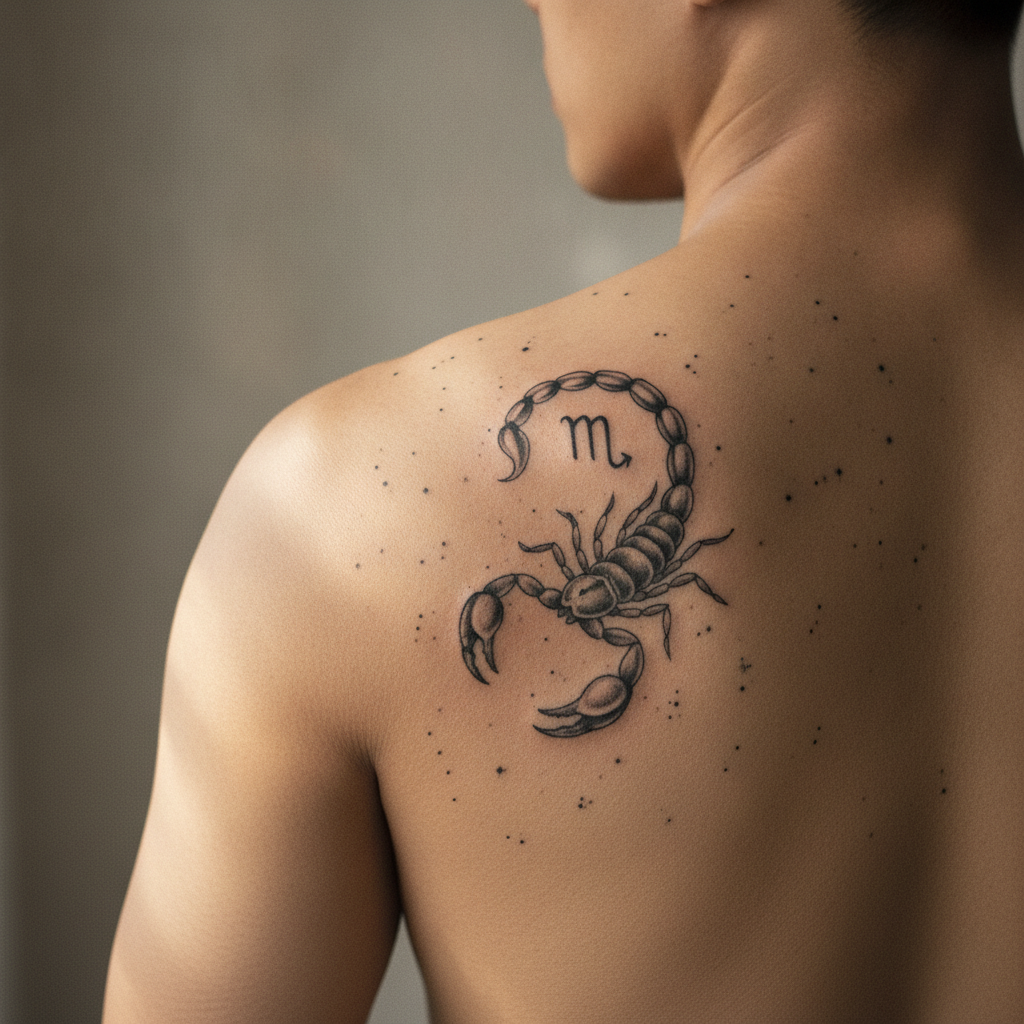
Sagittarius typically shows the archer or just the arrow, and the arrow-only version has become one of the most popular small tattoos in general, zodiac or not. Capricorn uses the sea-goat, which is an unusual hybrid that most people do not recognize, so many Capricorns opt for the glyph instead. Aquarius leans into water-bearer imagery or wave patterns, which pairs well with watercolor styles. Pisces almost always shows the two fish in a yin-yang circle, which is one of the most immediately recognizable zodiac designs even to non-astrology people.
Placement by size and visibility
Zodiac tattoos are small-to-medium by default, which gives you more placement flexibility than larger pieces. For glyphs and tiny constellations under 5 cm, the best placements are the inner wrist, back of the neck, behind the ear, inner forearm near the elbow, and the ankle. These spots are visible when you want them to be, hidden under a sleeve or hair when you do not, and they handle small line work well because the skin is relatively stable.
For medium zodiac pieces in the 5–15 cm range, the forearm, upper arm, shoulder blade, calf, and ribcage all work. Ribcage placements have become a signature zodiac spot because the vertical orientation suits constellations and the location feels intimate. The tradeoff is pain and longevity. Ribcage tattoos hurt significantly more than forearm tattoos, and they tend to blur faster because of how the skin stretches with breathing and weight changes. If longevity matters more than aesthetics, skip the ribs.
Large zodiac pieces (20 cm and up) belong on the back, chest, thigh, or as part of a sleeve composition. The back is the best canvas for a full constellation map, because you can lay out all twelve signs or build a personal chart with sun, moon, and rising signs in distinct zones. If you are considering this scale, read up on back piece composition first because planning the layout is harder than it looks.
Style pairings that hold up over time
Not every zodiac design works in every style. Fine-line is the current default for constellation tattoos and small glyphs, but it is also the style most prone to blur. Expect to need a touch-up at year five to seven if you go fine-line on a high-wear area like the wrist or inner forearm. Blackwork gives the longest lifespan because the lines are thick enough to survive two decades of ink migration. Dotwork constellations split the difference, since the individual dots hold their shape even as fine connecting lines soften.
Illustrative and neo-traditional treatments work best for the figure-based signs: Leo, Taurus, Sagittarius, Scorpio, Aries. Watercolor pairs naturally with Aquarius and Pisces because of the water element, but understand that watercolor fades faster than any other style and will usually need a refresh at year eight to ten. Japanese traditional can absorb zodiac imagery into larger compositions, especially for Scorpio, Dragon-adjacent Capricorn interpretations, and Sagittarius with Japanese archery references.
A clean glyph in blackwork at 3 cm will outlast a 20 cm watercolor piece by a decade. Longevity is a style decision as much as a size decision.
Combining multiple signs or chart elements
Many people want to represent more than their sun sign. The three main chart signs (sun, moon, rising) are the most common combination, usually arranged as a small vertical stack of three glyphs or three mini-constellations. This works best on the forearm, back of the arm, or along the spine. Avoid cramming three constellations side by side on the wrist because the detail gets lost at that scale.
Family zodiac tattoos are another common request: a parent getting their children's signs, siblings getting matching sets, or partners pairing their two signs. The design trick here is to use a single unifying element across all the signs rather than letting each sign be rendered in its own style. Pick one treatment (all glyphs, all constellations, all minimalist line figures) and stick with it. Mixing a realistic lion for Leo with a fine-line glyph for Virgo in the same tattoo creates visual chaos.
Frequently asked
Do zodiac tattoos go out of style? The glyph forms have been used for over two thousand years and are not going anywhere. What dates faster is the style treatment. Watercolor zodiac tattoos read as very 2015–2020. Fine-line reads as very 2020–2026. Classic blackwork glyphs read as timeless. If you are worried about trends, pick the simpler form.
What is the smallest a zodiac tattoo can be? Glyphs can go as small as 1.5 cm and still read correctly, though 2.5 to 3 cm is the sweet spot for longevity. Constellations should not go below 4 cm because the dots and connecting lines merge together as the tattoo ages. If you want something truly tiny, pick the glyph, not the constellation.
Can I get my partner's sign without it feeling cheesy? Yes, but keep it subtle. A small glyph in a hidden placement reads as personal rather than performative. Pairing their sign with yours as two matching glyphs on your inner bicep or ribcage is a common approach. Avoid combining both signs into a single merged symbol, which tends to look forced.
How much does a zodiac tattoo hurt? Pain depends entirely on placement, not on the zodiac design itself. A 3 cm glyph on your outer forearm will be a 20–30 minute session with mild discomfort. A 10 cm ribcage constellation will be an hour of significant pain. If this is your first tattoo and you want zodiac imagery, start with a forearm or shoulder placement before working toward the more painful spots.
Will my fine-line zodiac tattoo blur? Some blur is unavoidable, especially on high-movement areas like the inner wrist and fingers. Expect a well-executed fine-line zodiac tattoo on the forearm to look sharp for five to seven years, then gradually soften. Proper tattoo sunscreen and long-term care extends the sharp period by years.
Should I get all twelve signs if I like the full zodiac wheel? Only if you want a dedicated back piece or chest piece. Twelve signs scattered randomly across the body does not create a coherent design. If you love the full zodiac aesthetic, commit to a single large composition with all twelve signs arranged in a circle on the back or shoulder, and plan it with an artist who does full zodiac work.