style guides
Trash Polka Tattoos: Style Guide, History, and What to Expect
Trash polka tattoos mix photorealistic portraits, brushstrokes, and red accents into chaotic collage work. Here is how the style holds up.

Trash polka is one of the most aggressive contemporary tattoo styles to come out of Europe, and it does not behave like anything else on the wall. It slams photorealistic portraits next to splattered red blocks, ripped typography, and wide black brushstrokes. The result reads more like a band poster than a tattoo, which is the point. This guide covers where the style came from, the design rules that hold it together, what a piece will actually cost and feel like, and how to tell a strong trash polka tattoo from a busy mess.
Where trash polka came from
The style was invented in the late 1990s by brothers Simone Plaff and Volko Merschky at Buena Vista Tattoo Club in Würzburg, Germany. They wanted a tattoo language that borrowed from Dadaist collage, Russian Constructivist posters, and the textural mess of street paste-ups. The name itself is part of the manifesto. Trash refers to the brushstrokes, splatters, and torn edges that look like scrap material. Polka refers to the rhythmic mixing of opposing elements: realism against abstraction, calm against chaos, photographic detail against raw mark-making.
For about a decade the style stayed mostly inside Buena Vista's roster, then spread fast on Instagram around 2014 to 2016. Today every major tattoo convention has a trash polka section, and artists like Tim Kerr in Berlin, Caio Pineiro in São Paulo, and Eliot Kohek in France have pushed the style into hyper-detailed territory with multi-layered scans, barcode fragments, and architectural debris. The DNA still traces back to the original Buena Vista template: red, black, and white only, anchored by one photorealistic focal subject.
The design rules that actually matter
Trash polka has a tight color palette and a loose composition language, which is unusual. The palette is always black ink and one specific warm red, usually closer to vermillion than fire-engine red. White is the skin showing through, never white ink. Some modern artists push grey washes, but purists treat that as drift. The red is structural. It carries the eye, marks the focal point, and creates the rhythmic contrast the style is named after.
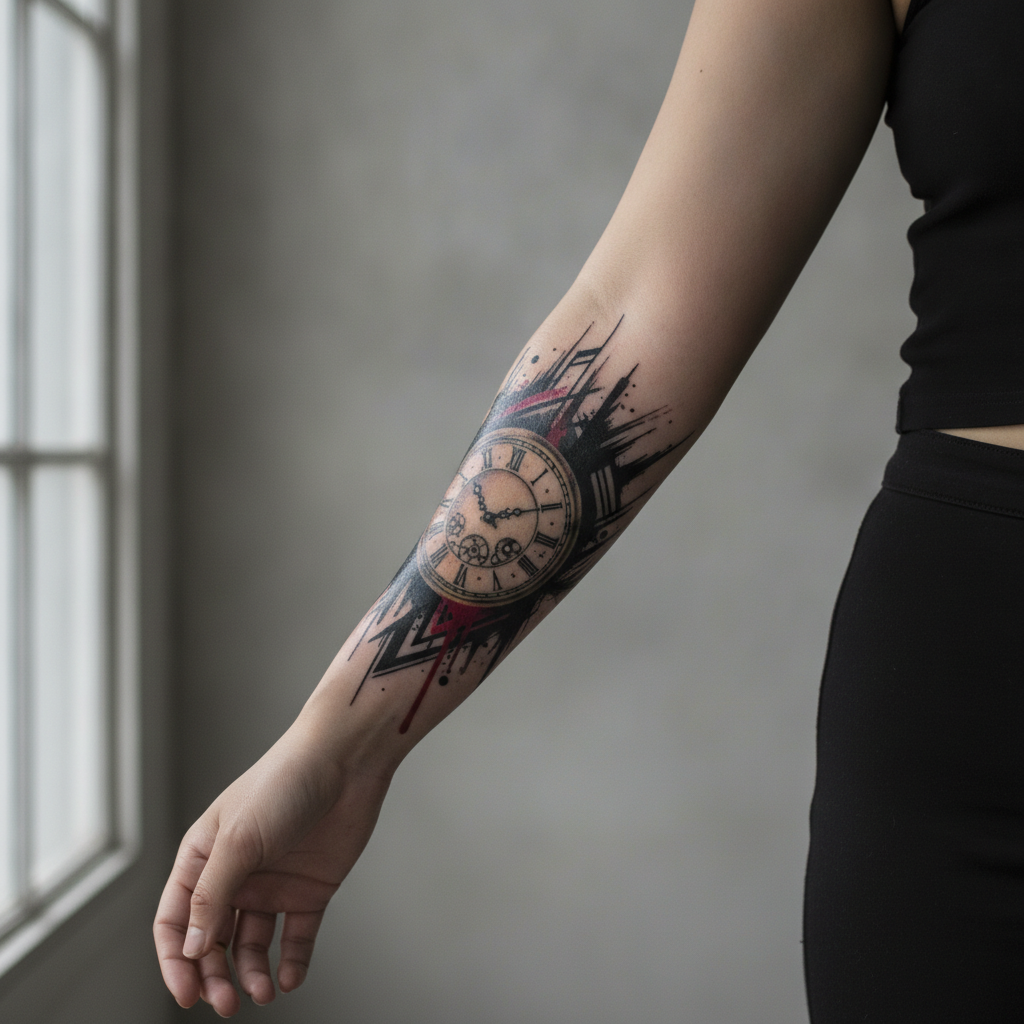
Composition is built in layers. The bottom layer is usually a photorealistic subject: a portrait, a hand, a clock, an animal, a skull. On top of that sit abstract elements like wide ink slashes, drip patterns, geometric blocks, and torn-paper edges. Typography is a signature feature. Latin phrases, single words, dates, and barcode strips are common. The text rarely runs in clean rows. It tilts, overlaps the realism, and breaks across the brushstrokes. A good piece looks deliberately damaged, like a poster someone tore down and re-pasted.
Sizing, placement, and why small trash polka rarely works
Trash polka needs room to breathe. A piece smaller than a postcard usually loses the collage rhythm because there is no space for the abstract layer to sit around the focal realism. Most artists who work in the style refuse anything under a half-sleeve, a chest panel, a thigh, or a back piece. The typical first commission is a half-sleeve at 8 to 12 inches of vertical real estate, or a square chest panel around 10 by 10 inches.
Placements that handle the style well include the upper back, full back, ribcage, outer thigh, full sleeve, and chest. Forearms work if the artist scales the realism down and uses thinner brushstrokes. Hands, necks, and fingers almost never work because the typography and splatter layers shrink into unreadable mush within two years. If you want something small and graphic with a red accent, look at neo-traditional or a stripped-down blackwork tattoo instead.
What a trash polka piece costs
Trash polka pricing sits at the high end of custom work because it combines photorealism with original collage design. A skilled artist is essentially drawing three styles at once. In the United States expect $200 to $350 per hour at a mid-tier studio and $400 to $600 per hour for sought-after specialists. In Western Europe rates land at €150 to €300 per hour. In Berlin and Munich, where the style originated, top trash polka artists charge €250 to €450 per hour with waitlists running 6 to 18 months.
Realistic session counts:
- Half-sleeve: 12 to 20 hours across 2 to 4 sessions, total $2,500 to $6,000
- Full sleeve: 25 to 40 hours across 4 to 7 sessions, total $5,000 to $12,000
- Back piece: 40 to 80 hours across 6 to 12 sessions, total $8,000 to $20,000
- Chest panel: 10 to 18 hours across 2 to 3 sessions, total $2,000 to $5,500
Deposits are usually 20 to 30 percent of the projected total and non-refundable. For a deeper breakdown of pricing logic see our tattoo pricing explained guide.
How it feels in the chair and how it heals
Trash polka sessions are long because the realism layer needs to be laid in first, followed by the heavy black saturation, then the red, then the brushstrokes and typography on top. Average single sessions run 4 to 6 hours. The heavy black packing is the most uncomfortable part. Areas with thin skin like the inner bicep, ribs, and sternum will burn by hour three. Bring snacks, hydrate the day before, and avoid alcohol for 48 hours pre-session because it thins blood and bleeds the red out faster.
Healing follows a standard timeline but with two quirks specific to the style. The red ink takes longer to settle than black and will look duller for the first three weeks before warming back up. The heavy black blocks scab harder than line work, sometimes lifting in thick chunks around day 7 to 10. Do not pick. Follow our tattoo healing timeline day by day for the standard cadence. A touch-up at the three-month mark is normal for the red and any abstract splatter that softened during peeling.
How it ages and who it suits
Long-term aging is the honest weakness of the style. The realism portraits hold up well for 10 to 15 years if the artist used proper layering and the client kept the piece out of direct sun. The wide black brushstrokes age beautifully and often look better at five years than day one because they soften into the skin. The red is the variable. Warm vermillion fades faster than black, especially on darker skin tones, and starts shifting toward orange or pink around the 7 to 10 year mark. Plan for a red refresh every decade if you want the contrast to keep punching.
The style suits people who want a single large statement piece rather than a collection of scattered small tattoos. It does not suit anyone who wants subtle, professional-discreet ink. Trash polka is loud by design. If you work in an environment where visible tattoos are an issue, place it somewhere a long sleeve covers completely. If you are choosing your first ever tattoo, trash polka is a heavy starting point. Most artists will gently steer first-timers toward a smaller realism or American traditional test piece first to confirm you tolerate long sessions and heavy black saturation.
Frequently asked
Is trash polka the same as realism with red?
No. Realism with red splashes is a common imitation but lacks the collage layer that defines trash polka. A real trash polka piece needs at least three competing elements: a photorealistic anchor, abstract brushwork or splatter, and typography or geometric debris. Pieces missing the typography and collage rhythm are usually marketed as trash polka but read as red-accented realism.
Can I get trash polka in colors other than red?
Most artists will refuse. The two-color palette is the foundational rule of the style. A few contemporary artists experiment with deep blue or yellow as a substitute for red, but the result is no longer considered trash polka by purist standards. If you want multi-color collage work, ask for a neo-traditional or watercolor blend instead.
How long is the typical waitlist for a trash polka specialist?
For established names the waitlist is 6 to 18 months. For mid-tier specialists 2 to 4 months is normal. Booking opens in batches, usually announced on Instagram. Be ready with a clear reference brief and deposit on the day booking opens.
Will the red age into a weird color on my skin tone?
Warm vermillion red shifts faster than black on every skin tone but the shift is most visible on deeply pigmented skin, where it can drift toward brown or muted rust within 5 to 7 years. On fair skin the same red usually fades to a softer coral. A skilled artist will adjust the red density at the start to compensate for your skin tone. Ask to see healed examples on skin similar to yours before booking.
Can a trash polka tattoo cover up an existing piece?
Yes, and it is one of the best cover-up styles because the heavy black brushstrokes and abstract layers naturally hide old line work. Cover-ups still need careful planning and usually run 30 to 50 percent more hours than a fresh piece. See our cover-up tattoo cost guide for budgeting.
Do trash polka tattoos require special aftercare?
Standard aftercare applies. The only specific note is to be gentle with the red sections during the first two weeks because heavily saturated red can leach if scrubbed. Use a fragrance-free wash, pat dry, and apply a thin layer of healing balm. Avoid direct sun for at least 30 days and use SPF 50 forever after that to protect the red from premature fading.