aftercare
Sleeping With a New Tattoo: How to Avoid Damaging Fresh Ink
Sleeping on a fresh tattoo is the biggest preventable cause of patchy healing. Here's the position, bedding, and routine that protect your ink in the first three nights.

The first three nights of sleep after a new tattoo do more damage than most aftercare guides admit. You are unconscious for eight hours next to fresh ink that wants to weep plasma, stick to sheets, and roll under your body weight if you shift wrong. The fix is not complicated, but it does take a small amount of planning the night you walk out of the studio. Here is what to set up, what to wear, and how to actually fall asleep when the new piece will not stop reminding you it exists.
Why the first three nights matter most
Day one and day two are when your tattoo behaves more like an open wound than a piece of art. Lymph fluid and plasma seep from the surface for roughly 48 to 72 hours, which means anything pressed against the ink picks up that fluid and then re-glues itself to your skin. Pull a stuck cotton sheet off a healing tattoo at 3 a.m. and you can lift scab material, ink particles, and a thin top layer of skin in one go. That is how light spots and patchy healing get baked in before week one is over.
The pressure side of the problem matters too. Sleeping directly on a fresh tattoo for hours compresses the still-traumatized capillaries underneath and can push ink unevenly through the dermis, especially on bonier placements like the shin, forearm, or collarbone. Most artists will tell you that the first 72 hours set the trajectory for how the piece heals, and the same logic runs through the entire first 24 hours of aftercare. Get sleep right and you remove the single biggest preventable cause of patchy healing.
Position: do not sleep on the tattoo
The rule is simple. If the tattoo is on your forearm, sleep on your back or the opposite side. If it is on your back, sleep on your stomach. If it is on your ribs, sleep on the opposite side propped with a pillow against your spine to stop you from rolling. If it is on your thigh or shin, sleep on your back with the leg slightly elevated on a pillow to reduce swelling.
The hard placements are the ones you naturally sleep on. Side sleepers with a rib tattoo, stomach sleepers with a chest piece, and anyone who shifts at night will struggle with willpower alone. Pillow walls help. Stack two pillows along the side you should not roll toward and your body will hit the obstacle before the tattoo does. People who get full back pieces often sleep half-reclined in a recliner or with a wedge pillow for the first three or four nights.
Bedding setup that actually works
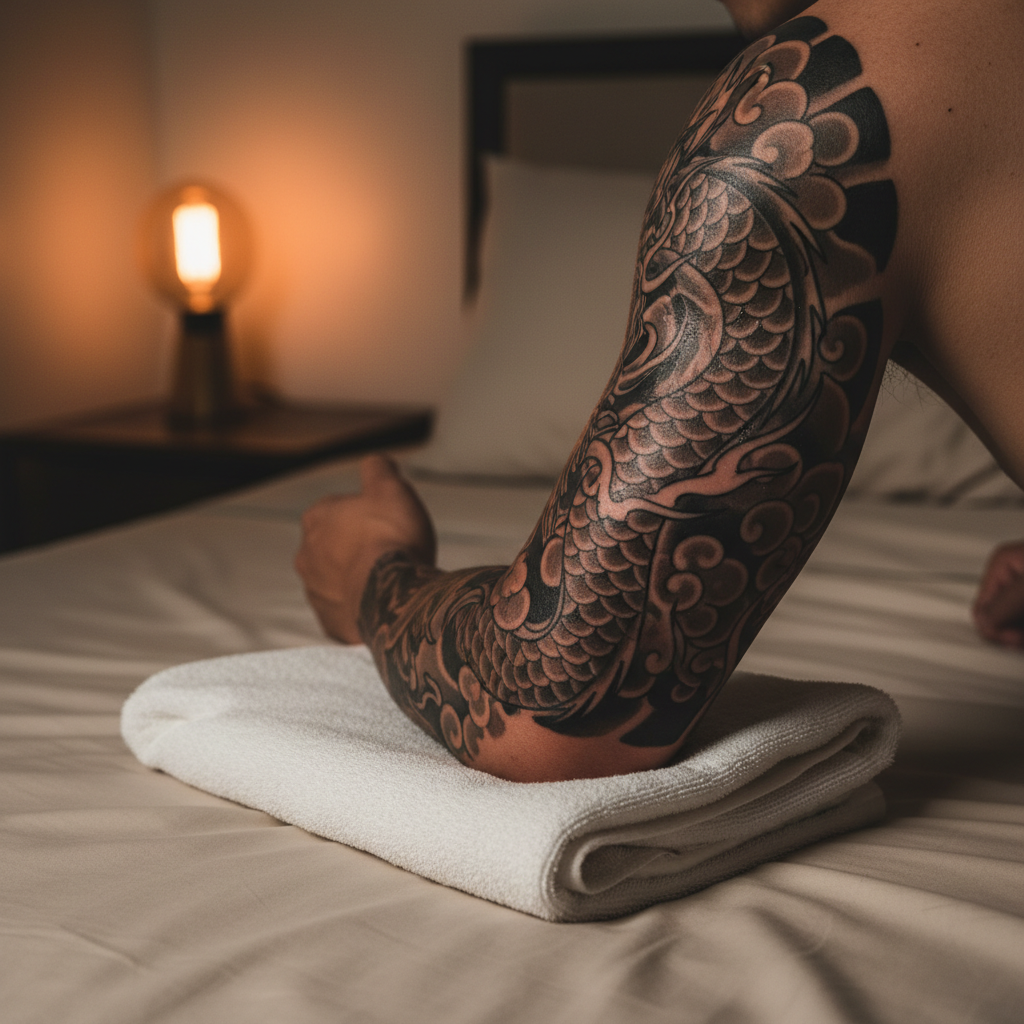
Use clean sheets every single night for the first week. Plasma, ink seepage, and ointment residue compound fast on bedding, and dirty sheets pressed against an open wound for eight hours is exactly how bacterial infections start. White or light-colored sheets are easier to monitor because you can see how much fluid the tattoo released overnight, which tells you whether you are still in the active weep phase.
Keep these on hand before you go to bed on tattoo day:
- A clean dark towel laid over the sheet under the tattoo to catch leakage
- A loose, breathable cotton t-shirt or pajama bottoms that will not bunch
- A bottle of fragrance-free water-based moisturizer or the aftercare your artist recommended
- A fresh pillowcase
- Lukewarm water and unscented soap in the bathroom for a clean morning rinse
Skip the silk and satin sheets. They sound gentle but they are slippery, they shift more during the night, and they cling to ointment residue in patches that make the surface uneven. Cotton percale or jersey is the boring right answer.
What to wear (and what not to)
Sleep in something loose, light, and one hundred percent cotton. Synthetics trap heat and sweat against the wound, and seams that drag across the tattoo while you toss can scrape the surface. For arm and leg placements, an oversized t-shirt and loose cotton shorts work best. For torso, ribcage, and back tattoos, many artists recommend going topless under a loose cotton sheet for the first night so nothing rubs the ink at all.
If your artist wrapped your tattoo in a second-skin film like Saniderm or Tegaderm, you do not need to add clothing as a barrier. The film handles abrasion and fluid containment for you, sometimes for five to seven days at a stretch. If you got a traditional cling wrap, take it off after 4 to 6 hours per your artist's instruction and sleep with the tattoo exposed to air, not re-wrapped. Plastic film left on overnight traps moisture and bacteria, which is the exact opposite of what the healing timeline needs.
Falling asleep when it itches, burns, or aches
A fresh tattoo throbs. The dull burn usually peaks around 6 to 12 hours after the session and again on day two when the skin starts repairing. By day five or six the itching kicks in and that is what wakes most people up. The temptation to scratch in your sleep is real, and a hard scratch can drag ink out of a tattoo that has barely started to set.
A few practical things that help:
- Take ibuprofen or acetaminophen 30 minutes before bed for the first two nights. Avoid aspirin, which thins blood and can prolong the weep phase.
- Apply a thin layer of unscented moisturizer 20 minutes before lying down so it absorbs first.
- Keep the room cool. Sweat aggravates itch and increases plasma leakage, with 65 to 68 degrees Fahrenheit being ideal.
- Trim your fingernails short on day one. Sleep-scratching is unconscious and short nails do less damage when it happens.
- If the itch is severe, a cool damp washcloth held against the area for two minutes resets the nerve response without scratching.
Sleep is when your immune system does most of its repair work on a tattoo. Protecting those first nights is doing more for the final look than any expensive aftercare cream.
Morning routine to undo any overnight damage
Whatever happens in the night, the morning is your reset. Get up, gently rinse the tattoo with lukewarm water and unscented soap, pat dry with a clean paper towel, and apply a thin layer of aftercare. Check for any spots where the tattoo stuck to the sheet overnight. If you see lifted scab edges, do not pick them. Leave them alone, keep them moisturized, and let them release on their own as part of the natural peeling phase in week one.
Wash the previous night's bedding immediately. By night three or four the fluid output drops significantly and you can stop using a barrier towel, but keep changing sheets every two or three days for the first two weeks. If you also went to the gym that week, the same logic about sweat and bacteria applies, and the rules for working out after a new tattoo are worth a quick read.
Frequently asked
Can I sleep on my new tattoo if I am careful? No. Even brief pressure compresses healing tissue and presses bedding into the wound, which is how patches and stuck scabs happen. Use pillows to block rolling and sleep in a position that keeps the tattoo elevated or facing away from the mattress for at least the first three nights.
What if I roll onto it in my sleep accidentally? Once or twice is not catastrophic. If you wake up and find you slept on it, get up and rinse the tattoo with lukewarm water to clear any sheet fibers or dried fluid stuck to the surface, then re-moisturize and reposition. The damage from one short roll is usually cosmetic blur in a small area, not a wholesale ruin.
Is it safe to wrap the tattoo overnight with plastic wrap? No, not after the first few hours your artist specified. Traditional plastic cling wrap left on for hours traps moisture, heat, and bacteria, which raises infection risk. Medical-grade second-skin film is the only exception because it is designed to breathe and stay on for several days at a stretch.
How many nights before I can sleep normally again? Most people can sleep in their preferred position safely by night four or five, once the active weep phase ends and a thin protective layer has formed. By the end of week two you should be back to normal sleep with no special precautions, though you should still avoid sleeping directly on the tattoo until the peeling and itching stages have fully passed around day 14.
Do I need to sleep with the air conditioning on? A cool room is meaningful but not mandatory. The goal is to limit sweating, which prolongs the weep phase and raises the chance of bacterial growth in the bedding. If you cannot run AC, a fan pointed near the bed (not directly on the tattoo) is a reasonable substitute.
Can I take sleep aids for the first few nights? Over-the-counter sleep aids like diphenhydramine (Benadryl) are generally fine and have the small bonus of reducing tattoo itch. Avoid alcohol as a sleep aid because it thins blood, dehydrates skin, and can worsen the weep phase. If you use prescription sleep medication regularly, no change is needed.