style guides
Nordic & Viking Tattoos: Style Guide to Runes & Symbols
Nordic and Viking tattoos pull from runes, Norse myth, and heavy blackwork. Here is how the style actually reads on skin and ages over time.
Nordic and Viking tattoos sit at the intersection of blackwork and symbolism. The style leans on heavy outlines, Elder Futhark runes, knotwork, and figures lifted from the Prose Edda. Done well, it ages into one of the most forgiving long-term styles on skin. Done badly, it turns into a muddy black patch within five years. This guide walks through the visual language, the technical choices that make the ink hold, and the sizing and placement decisions that keep the symbolism legible.
What defines the Nordic Viking style
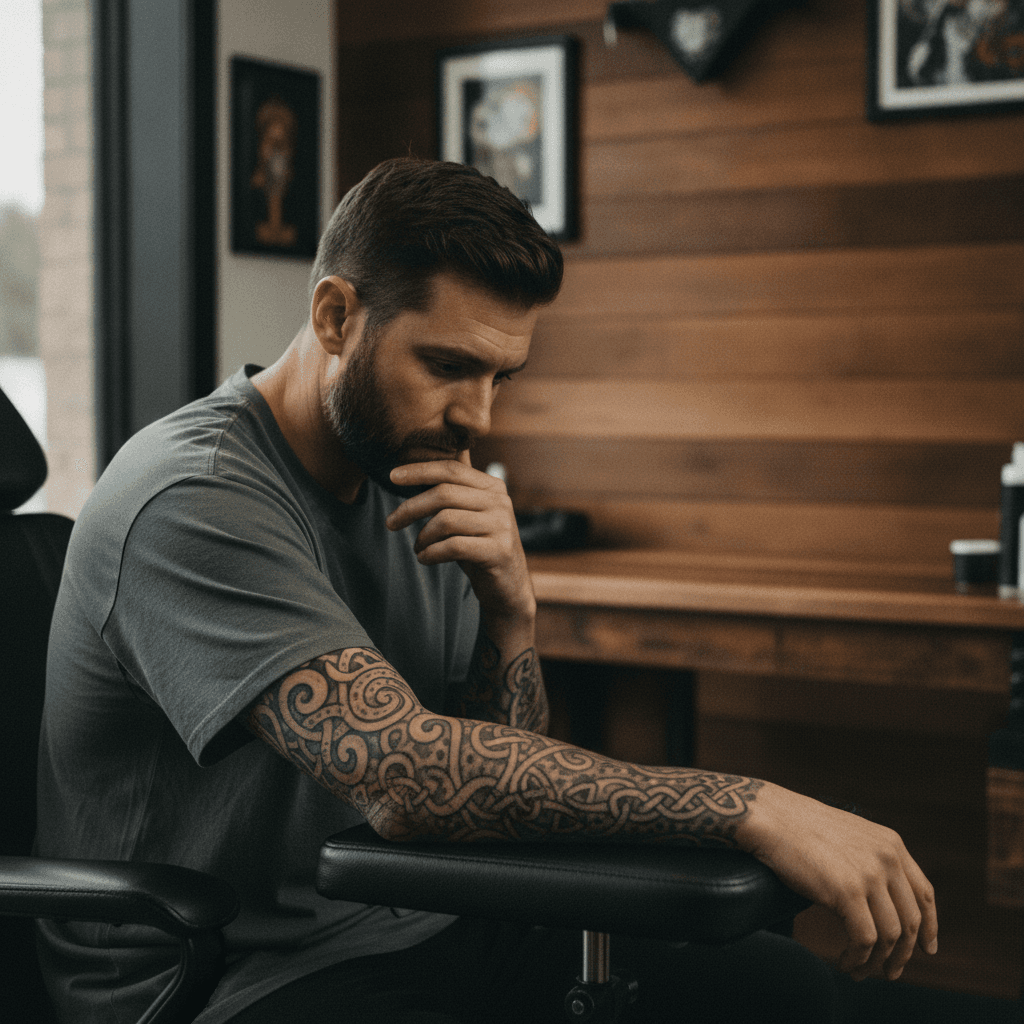
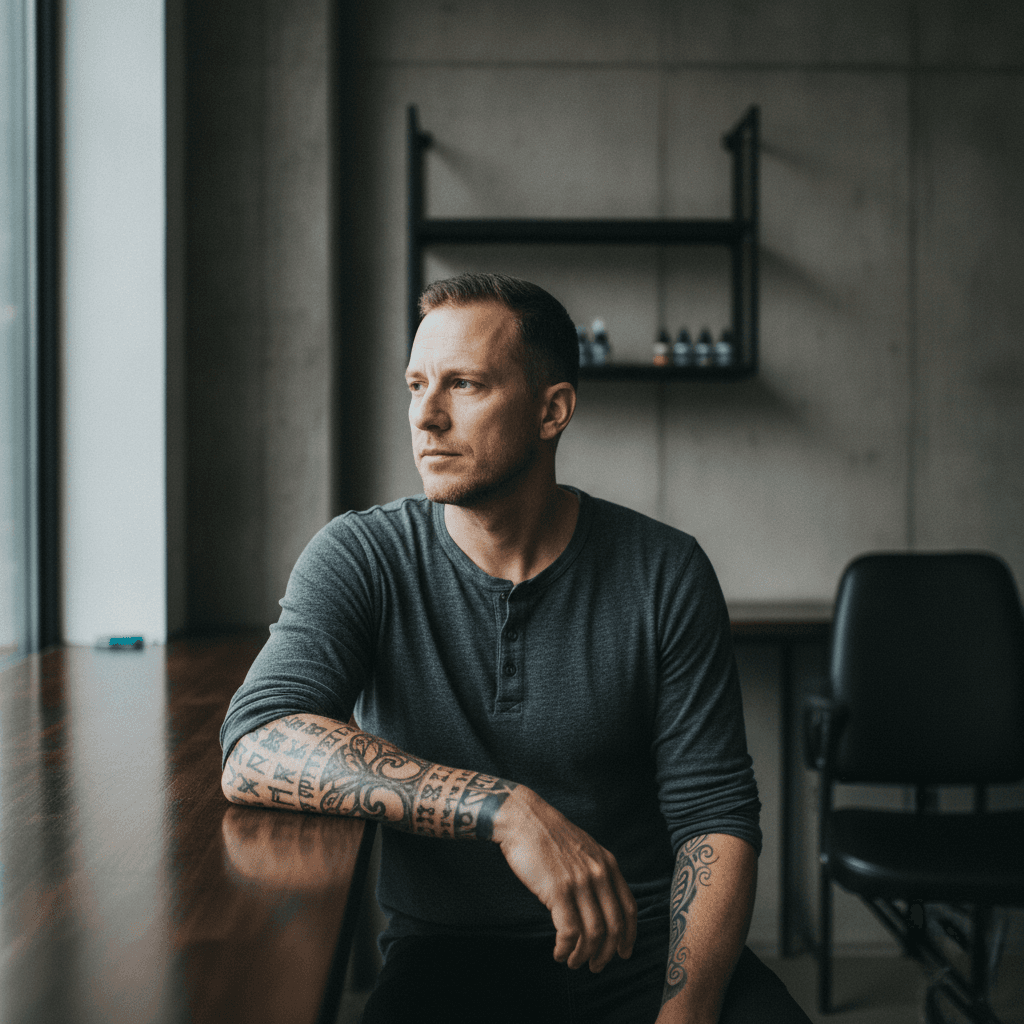
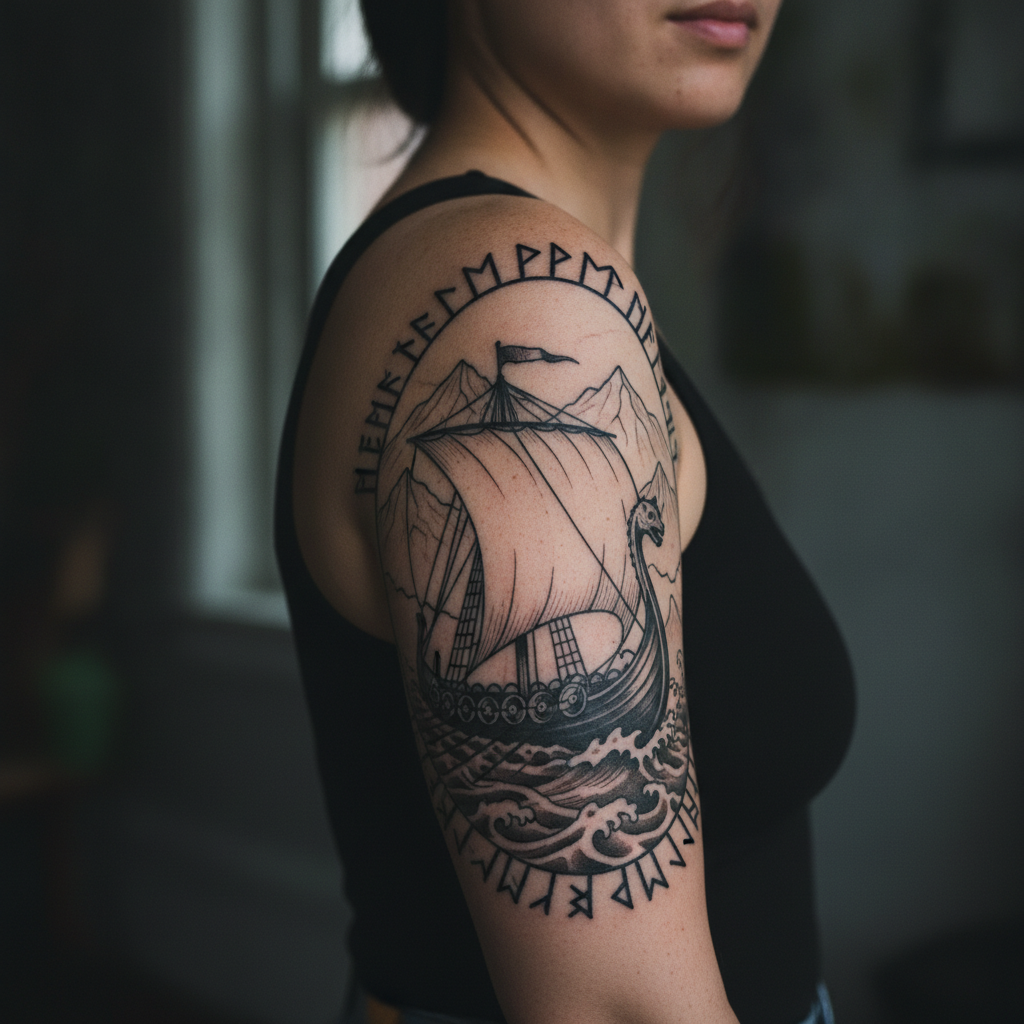
The core look is high-contrast black ink with minimal shading and almost no color. Lines are thick, usually drawn with 7 to 11 round liner needle groupings, and the compositions borrow from Oseberg wood carvings, picture stones from Gotland, and manuscript illumination from the Icelandic sagas. Expect long serpentine knotwork, stylized animal forms (wolves, ravens, serpents, bears), and geometric panels built from runic strokes.
Nordic work rarely uses soft gradients. The shading, when it appears, is almost always dotwork or tight parallel line hatching rather than smooth whip-shading. That technical choice matters because high-contrast black packs down with less fading than mid-tone grey wash, which is why 15-year-old Viking sleeves still read sharp while a watercolor piece from the same era usually looks washed out. If you want the full technical breakdown on how black holds up, our blackwork tattoos style guide covers the saturation and healing details.
The symbols carry weight. A rune is not a letter in the alphabet sense, it is a phonetic marker from Elder Futhark (circa 150 to 800 CE) or Younger Futhark (circa 800 to 1200 CE) that also carried divinatory and talismanic meaning. Pick runes with intent, not aesthetics alone. Common choices include Algiz (protection), Ansuz (communication, Odin), Fehu (wealth, cattle), and Tiwaz (victory, the god Tyr).
Core symbols and what they actually mean
Before you commit a Norse symbol to skin, know its origin. Some are genuinely ancient. Others are 19th or 20th century reconstructions marketed as authentic.
- Yggdrasil: the world tree connecting the nine realms. Attested in both the Poetic Edda and Prose Edda. Reads well as a back piece or full forearm.
- Valknut: three interlocking triangles associated with Odin and the slain in battle. Found on Viking Age picture stones.
- Vegvisir: the "wayfinder" compass. Despite the Viking association, it comes from the 19th century Icelandic Huld manuscript, not the Viking Age itself.
- Aegishjalmur (Helm of Awe): eight-armed radial symbol. Also post-Viking, from the same magical staves tradition as Vegvisir.
- Mjolnir: Thor's hammer, worn as pendants during the Viking Age and well-documented archaeologically.
- Huginn and Muninn: Odin's ravens, "thought" and "memory", a strong matched-pair design for shoulders or clavicles.
A note on tone. The Elder Futhark alphabet has been co-opted by far-right groups for about a century. Specific runes (Odal and Tiwaz in particular configurations, the Sowilo doubled) carry baggage you probably do not want on your body. A reputable artist will flag this during consultation and suggest alternative compositions. If yours does not, that is a signal to find a different artist.
Placement that works for this style
Nordic designs reward long, flowing real estate. The serpentine knotwork and panelled compositions were originally carved onto ship prows, standing stones, and wooden pillars, so they translate best onto body planes that let the design wrap or stretch. The most forgiving placements are the outer forearm (great for runic bands and compass compositions), the full back (ideal for Yggdrasil or a scene from Ragnarok), the upper arm wrapping into a half or full sleeve, and the calf for standalone figures like a wolf or a longship.
Avoid heavily curved placements for text-heavy runic bands unless your artist specifically draws the piece on skin first. Runes read linearly, and a band of Elder Futhark around a bicep that was not carefully stencilled will warp into illegibility within the first month as the skin settles. Shoulder caps, inner wrists, and small chest placements also tend to crowd the knotwork since the style needs breathing room between elements.
Size matters more here than in fine-line work. Minimum viable size for a legible runic band is roughly 4 inches long with each rune at least 0.75 inches tall. Yggdrasil pieces below hand-size lose the branch and root detail entirely. Plan for scale from the start rather than squeezing symbolism into a small slot.
Pricing, sessions, and what to expect
Nordic blackwork sits in the mid-to-upper range of hourly rates because of the ink saturation required and the technical skill in freehand knotwork. Expect $180 to $300 per hour at a reputable shop in the US, UK, or Western Europe, and $120 to $200 per hour in Eastern Europe or Southeast Asia where many of the best blackwork artists currently work. For how hourly billing compares to flat-rate projects on larger pieces, see our breakdown of hourly vs flat-rate tattoo pricing.
Session counts scale with the composition. A simple 4-inch runic forearm band usually finishes in one 2 to 3 hour session, including stencil time. A half-sleeve with Yggdrasil, a raven, and a runic border typically runs 3 to 4 sessions of 4 to 5 hours each, spaced 4 to 6 weeks apart to let each panel heal fully. Full back pieces are 20 to 40 hours of work total across 5 to 8 sessions depending on your pain tolerance and the artist's pace.
Deposit practices mirror the rest of the industry. Expect to put down $100 to $300 to hold your consultation and first appointment slot, and that deposit usually rolls into the final session cost. If your artist asks for the full projected cost upfront, that is unusual and worth questioning.
How Nordic tattoos age
This is where the style earns its reputation. Because the design relies on heavy black and minimal fine linework, it tolerates sun exposure, aging skin, and weight fluctuations better than almost any other style. A properly saturated black pack from a skilled artist will still read as pure black at year ten with only subtle softening at the edges. Compare that to color realism, which typically needs touch-ups by year five and significant restoration by year fifteen.
The weak points are the thinnest linework and any dotwork shading. Fine stippling inside knotwork panels can soften into a grey wash over 8 to 12 years, especially on sun-exposed placements like forearms and calves. SPF 50 applied daily to the tattooed area is not optional if you want the piece to look crisp at the 20-year mark. The specifics on long-term protection are covered in our guide to tattoo sunscreen and long-term care.
Touch-ups for Nordic blackwork are usually simple. Most artists will refresh a 10-year-old sleeve's outlines in a single 2 to 3 hour session, often for a reduced loyalty rate if you are returning to the original artist. Blown-out areas (where ink migrated beneath the dermis during the original session) are harder to fix and sometimes require laser lightening before a cover.
Frequently asked
Can I use runes to spell my name in English? You can, and many people do, but understand that Elder Futhark was built for Old Norse phonetics. Modern English sounds like "th", "sh", and short "a" do not map cleanly to runic characters. A good artist will offer a phonetic transliteration using the closest matching runes and will warn you that linguistic purists will spot the compromises.
Is it cultural appropriation to get Viking tattoos if I am not Scandinavian? Norse symbolism is broadly treated as open cultural material, not closed practice, by modern Scandinavian artists and scholars. The caveat is political. Avoid runes and symbols that have been actively adopted by hate groups, and do your homework on any specific design. Nationality is less the issue than context.
How painful is a Viking blackwork sleeve? Heavy black packing is one of the more intense tattoo experiences because the artist is working the same area repeatedly to saturate color. Expect sessions to feel progressively more raw as hours accumulate. Most people cap pack-work sessions at 4 to 5 hours. Line and outline sessions tolerate longer sits.
Will my runic band blur over time? If the runes are drawn at adequate size (0.75 inches minimum per character) with a 9 or 11 round liner by a skilled artist, blurring at 10 years is minimal. Smaller runes done with lighter needle groupings on fingers, wrists, or necks will blur noticeably within 3 to 5 years because those placements see the most skin movement and sun exposure.
Can I combine Nordic style with other blackwork traditions? Yes, and it is common. Many artists blend Norse elements with Celtic knotwork, Slavic folk motifs, or geometric sacred-geometry panels since all three share the thick-line blackwork vocabulary. The risk is visual overcrowding, so plan the full composition before the first session rather than adding pieces session by session.
What should I bring to my first consultation? Reference images of specific Viking Age artifacts you like (museum photos of picture stones or Oseberg carvings are stronger than Pinterest boards of modern work), a rough placement idea, and any specific runes or symbols you want included with notes on why. Artists value the specificity because it shortens the design-iteration phase and produces a piece that actually means something to you.