style guides
Geometric Tattoos Style Guide: Lines, Mandalas, Dotwork
Geometric tattoos rely on precision linework, mandalas, and dotwork. Here is how the style holds, what it costs, and how to design one that lasts.

Geometric tattooing is the discipline of straight lines, perfect circles, and repeating shapes inked with enough precision that a tiny wobble ruins the whole piece. The style covers everything from a single sacred-geometry triangle to a full sleeve of nested mandalas, hexagonal grids, and dotwork gradients. This guide walks through what defines the style, who it suits, how it heals, what it costs, and how to find an artist who can actually hold a line.
What counts as a geometric tattoo
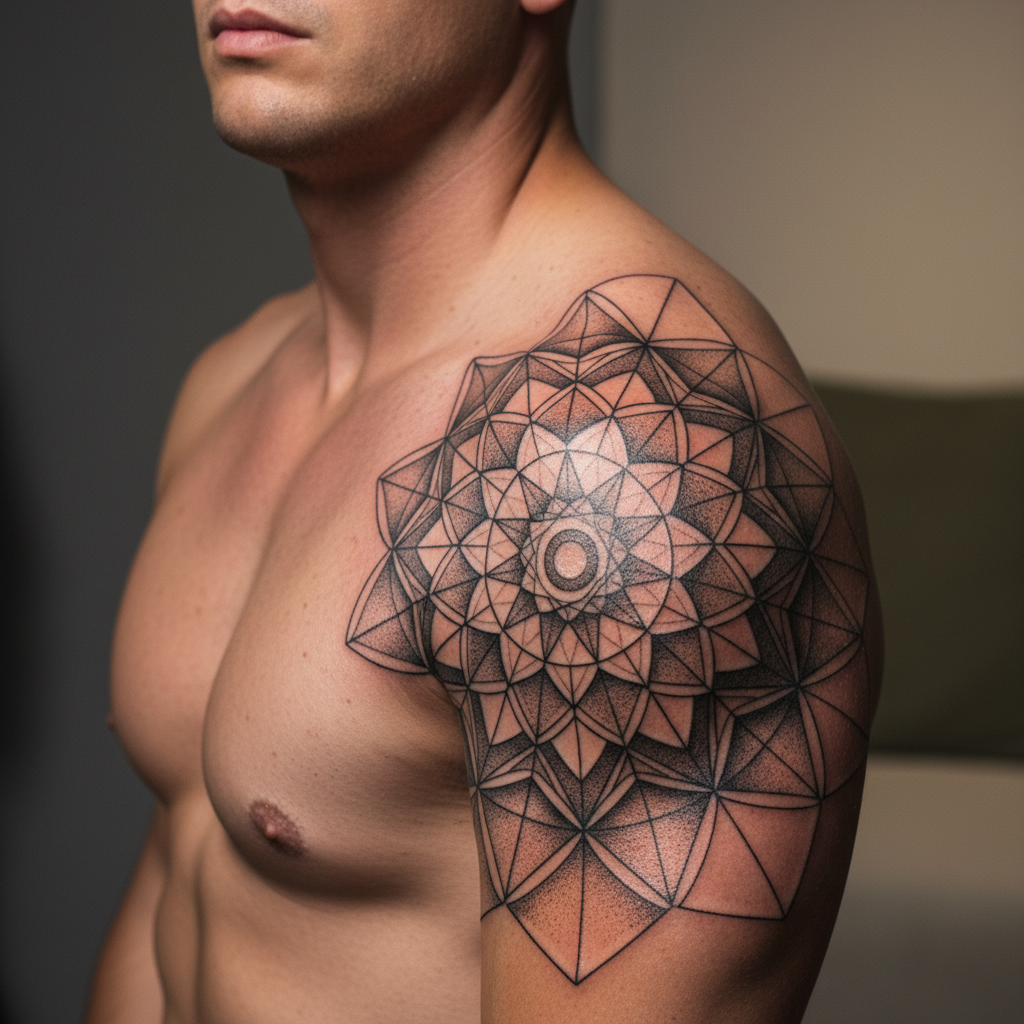
A geometric tattoo is built from primitive shapes. Triangles, hexagons, circles, squares, and the radial symmetry of mandalas form the visual vocabulary. The style descends from sacred geometry traditions found in Hindu and Buddhist mandala art, Islamic tile work, and the dotwork lineage popularized in the West by artists like Xed LeHead and Thomas Hooper in the 2000s. Modern geometric work spans pure linework (bold or fine), blackwork fills, dotwork shading, and hybrid pieces that combine geometric framing with realism or botanical illustration inside the shapes.
The defining technical demand is symmetry. A mandala that is off-axis by two degrees reads as broken. A hexagonal grid where one cell is fractionally wider than its neighbor will draw the eye to the mistake forever. This is why the style attracts a specific kind of artist: patient, mathematical, often using stencils generated in vector software rather than freehand sketching. If you are coming from a fine-line tattoo background, the precision requirement will feel familiar. If you are used to looser styles like watercolor or neo-traditional, the rigidity is the adjustment.
Subcategories you should know
Geometric is an umbrella. Knowing the subgenre you actually want saves both artist-search time and money.
- Linework geometric: pure outlines, no fill. Single-needle or 3RL needle work. Cleanest, fastest to heal, fades fastest.
- Blackwork geometric: solid black fills inside shapes. Heavy saturation, longest healing, most durable over decades.
- Dotwork geometric: shading built from thousands of individual dots (stippling). Soft gradients without smooth shading. Slow to tattoo, ages beautifully.
- Sacred geometry: specific symbolic patterns like the Flower of Life, Metatron's Cube, Sri Yantra, Seed of Life. Often used as centerpieces.
- Ornamental geometric: jewelry-like patterns mimicking lace, chandelier shapes, or Mehndi henna designs. Heavy on negative space.
- Geometric realism hybrid: animals or portraits framed inside geometric windows, or rendered with polygonal facets. Common with wolves, deer, mountains.
Placement and how the body shape interacts with the design
Geometric work lives or dies by the surface it sits on. Flat, stable areas hold pattern best: the outer forearm, the calf, the upper thigh, the back, and the chest plate above the pectoral muscle. Curved or high-movement zones (inner bicep, ribcage, neck, fingers, feet) will distort the symmetry over time and during the actual tattoo session as the skin stretches under the needle.
For a first geometric piece, the outer forearm is the standard recommendation. It is flat, has even skin tension, sits high on the tattoo pain chart tolerability scale, and heals predictably. Mandalas typically work best as centerpieces with negative space around them, sized between 4 and 8 inches in diameter. Sleeves built from geometric panels need an artist who can map the design to the muscle contours of your specific arm, which means at least one in-person consult before the stencil is finalized.
Spine pieces and back centerpieces are the second most common placement. A vertical mandala chain down the spine reads beautifully but requires the client to lie completely still for multi-hour sessions, and the spine is one of the more painful areas to sit through. Foot, hand, and finger geometric work looks striking in photos but fades and blows out faster than any other placement.
How geometric tattoos heal and age
Healing follows the standard tattoo healing timeline, but the visual stakes are higher because line precision is what makes the piece. Days 3 to 7 will involve peeling, and during peel the lines will look thicker and slightly blurred. This is normal and resolves by week 3 once the epidermis fully replaces.
Long-term aging depends on three factors: line weight, ink saturation, and skin tone. Bold blackwork holds for 20 to 30 years with minimal fading. Fine single-needle linework softens noticeably by year 5 and may need a touch-up by year 7 to 10. Dotwork ages gracefully because the human eye is forgiving about dot density shifts. On medium to deep skin tones, blackwork stays strongest because the contrast against melanin remains high; very fine lines on deep skin can fade into the background within a few years, so most experienced artists recommend a slightly heavier line weight (5RL or 7RL instead of 3RL) for darker skin to keep the design visible long term.
Sun exposure is the single biggest factor in geometric fading. UV breaks down ink particles and a season of unprotected sun can age a piece by years. Daily SPF 30 or higher on the tattoo is non-negotiable. The long-term sunscreen guide covers product choice and timing.
Pricing: what geometric work actually costs
Geometric pricing tracks complexity and session length more than square inches. Most reputable artists charge hourly for geometric pieces because stencil prep and freehand corrections eat real time. Expect the following ranges in the United States and Western Europe in 2026:
- Small linework geometric (palm-sized triangle, single sacred geometry symbol): $150 to $400 flat
- Forearm mandala, single session, 4 to 6 inches: $400 to $900
- Half-sleeve geometric panel: $1,500 to $3,500 across 2 to 4 sessions
- Full back piece with nested mandalas and dotwork: $4,000 to $9,000 across 6 to 12 sessions
- Dotwork shading adds 30 to 50 percent to the time of an equivalent linework piece
Hourly rates for geometric specialists run $180 to $350 per hour at mid-tier studios in cities like Los Angeles, London, Berlin, and Tokyo. Top-tier names with year-long waitlists charge $400 to $600 per hour. For the full pricing logic and what changes the bill, see the tattoo pricing explained guide.
A deposit of $100 to $500 is standard to lock the appointment and is usually applied to the final session total.
How to vet a geometric tattoo artist
Portfolio review for geometric work is more diagnostic than for any other style. Look for the following in healed-photo examples (not fresh photos, which hide line wobble):
- Straight lines that stay straight across the full length of the piece, including across body curves
- Circles that close cleanly with no flat spots at the closure point
- Symmetrical mandalas where each arm of the pattern matches its mirror within a millimeter
- Dotwork gradients that transition smoothly without visible bands or gaps
- Healed pieces shown at 6 months and 1 year, not just day-of photos
- Consistent line weight within a single piece (a 1mm line should be 1mm throughout)
Ask to see the artist's stencil process. Most serious geometric artists work in Procreate or Adobe Illustrator and can show you the vector source files. An artist who only does freehand geometric is either a generational talent or about to put a crooked mandala on you. Bet on the former being rare.
Frequently asked
Are geometric tattoos harder to tattoo than other styles?
Yes, in the sense that mistakes are more visible. A wobbly line in a watercolor piece reads as artistic looseness. A wobbly line in a hexagonal grid reads as a broken tattoo. The work itself is not technically more demanding in needle handling, but the tolerance for error is near zero, which is why fewer artists specialize in it.
Will my geometric tattoo look bad if I gain or lose weight?
Moderate weight changes of 10 to 20 pounds will not noticeably distort a geometric piece in flat, stable areas like the outer forearm or upper back. Large weight changes, pregnancy stretch marks, or significant muscle gain in placements like the bicep, thigh, or stomach can warp linework permanently. Plan placement with this in mind.
Can geometric tattoos be done in color?
Yes, but most pieces stay in black or black with single accent colors (red, blue, gold) because the style relies on graphic contrast. Full-color geometric work exists in the dotwork tradition and in mandala pieces inspired by Hindu and Buddhist temple art, where reds, oranges, and blues are traditional. Color geometric fades faster than blackwork and needs touch-ups every 5 to 8 years to stay vibrant.
How long does a typical geometric session last?
Most forearm-sized pieces take 3 to 5 hours in a single sitting. Larger panels are broken into 4 to 6 hour sessions spaced 4 to 8 weeks apart to allow healing. Dotwork-heavy pieces stretch sessions longer because each dot is placed individually, so a similarly sized dotwork mandala can take twice as long as a pure linework version.
Do geometric tattoos hurt more than other styles?
The pain is comparable to any other style at the same placement, but geometric sessions feel longer because you cannot move. Lines in progress require absolute stillness; any flinch during a long straight line will leave a visible jog. Most clients describe the mental focus as harder than the physical sensation.
Is geometric a good choice for a first tattoo?
A small, single-element geometric piece (a triangle, a small mandala under 3 inches, a simple sacred geometry symbol on the forearm or upper arm) is a strong first tattoo because it heals predictably and the design is timeless. A large geometric panel or sleeve as a first tattoo is a heavier commitment because the precision requirement means the artist match has to be exactly right, and finding the right specialist for a first-timer is harder than picking a competent generalist.