cost guides
Dotwork Tattoo Cost Guide: What You'll Pay and Why
Dotwork tattoos are priced by hand-stippled hours, not by inches. Expect $150 to $300 per hour and long sessions for anything geometric or mandala-based.

Dotwork tattoos are priced by the hour, and the hour count is high. Every shaded area is built one dot at a time with single-needle or tight-cluster configurations, so a piece that looks the same size as a bold traditional design can take two or three times longer to finish. If you are budgeting a mandala forearm, a geometric half-sleeve, or a stippled ornamental back piece, the pricing math is different from any other style. This guide covers hourly rates in 2026, realistic session counts by size, why dotwork commands a premium, and where you can save without hurting the work.
What dotwork actually costs per hour
In the United States and Western Europe, most established dotwork specialists charge between $180 and $300 per hour in 2026. Entry-tier artists working out of shared studios sit closer to $120 to $170 per hour, and internationally known dotwork names (Nissaco style tier and above) charge $350 to $500 per hour with waitlists measured in years. Rates in Bangkok, Bali, and Ho Chi Minh City are lower on paper, roughly $80 to $150 per hour at a solid shop, but travel adds real cost that has to be counted in.
Dotwork rarely uses a flat-rate quote for anything above a small palm-sized design. The reason is variance. A single square inch of dense stippled shading might take 40 minutes on one client and 70 minutes on another depending on skin type, hydration, and how the client sits. Artists who quote flat rates for dotwork usually pad the number to protect themselves, which means you pay the worst-case time either way. Hourly billing is almost always the honest deal for this style.
Minimum session charges typically run $150 to $250 even for tiny pieces. For a comparison across geographies, our cost of tattoos around the world breakdown holds up as a sanity check.
Why dotwork is more expensive than solid black
Solid packed black covers ground fast. A traditional artist can black-in a 4-inch shape in 15 to 20 minutes with a magnum needle. The same shape rendered in dotwork gradient takes 90 minutes or more because the artist places thousands of individual points at controlled spacing, adjusting depth so no dot blows out into a smudge. That labor gap is the entire price gap.
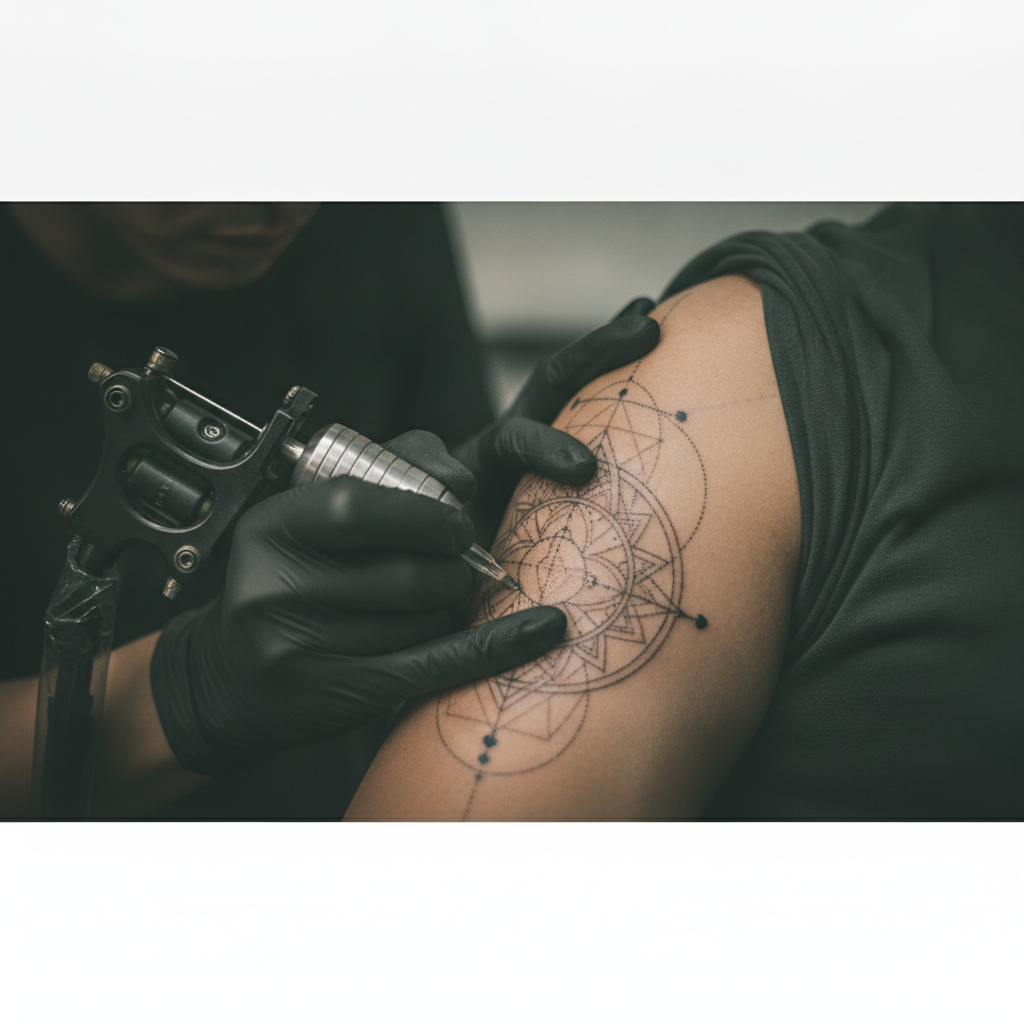
The gear side is also slower. Most dotwork specialists use single-needle liners or tight 3RL groupings at low voltage, which deposits less ink per pass and requires more passes to build tone. Rotary machines are common because they are quieter and give the artist finer stroke control, but they run slower than a coil setup optimized for packing. You are paying for restraint, not speed.
Consistency is the other cost driver. In geometric dotwork, one out-of-place dot is visible from across a room. Artists work with rulers, transfer stencils built in vector software, and constant reference checks. That precision work does not scale, which is why the top dotwork names cap their client days at two or three sessions per week instead of the four or five a traditional artist might handle.
Session counts and realistic totals by size
Here is what most reputable studios quote in 2026 for common dotwork projects:
- Small mandala, palm-sized (3 to 4 inches): 1 session, 3 to 4 hours, $600 to $1,200
- Forearm mandala or ornamental strip (6 to 8 inches): 2 sessions, 8 to 12 total hours, $1,600 to $3,600
- Half-sleeve dotwork geometric: 3 to 4 sessions, 18 to 25 hours, $3,600 to $7,500
- Full-sleeve dotwork (dense stippling throughout): 5 to 7 sessions, 35 to 50 hours, $7,000 to $15,000
- Back piece with ornamental dotwork frame: 6 to 10 sessions, 45 to 70 hours, $9,000 to $21,000
- Chest and pec dotwork panel: 4 to 6 sessions, 22 to 35 hours, $4,400 to $10,500
These ranges assume a mid-tier to upper-tier specialist. Cut about 25 percent off for entry-tier artists and add 40 to 100 percent for a name with a waitlist. For a wider view on multi-session projects, our full-sleeve tattoo cost guide covers the sleeve math in more depth, and half-sleeve tattoo cost breaks down the smaller version.
Deposits for dotwork run higher than average because artists lose real revenue when a client no-shows a 6-hour block. A $150 to $400 deposit is standard and non-refundable inside 48 hours of the appointment. See our tattoo deposit guide for what deposits do and do not cover.
What drives your quote up or down
Placement changes the price meaningfully. Ribs, sternum, and inner bicep add 15 to 25 percent because clients tense, take more breaks, and require slower work to keep the dots even on stretchier skin. Elbows, knees, and hands add 20 to 30 percent for the same reason plus higher touch-up likelihood.
Design complexity matters more in dotwork than in most styles. A single-tone mandala with clean linework prices at the baseline. Add layered geometric overlap, gradient shading between two densities, or ornamental sacred geometry with dot-perfect symmetry, and the hour count grows. Custom design fees of $100 to $500 are normal for anything that requires the artist to build a bespoke stencil, and that fee is usually separate from the sitting rate.
Skin tone plays a small but real role. Dotwork on deeper skin tones needs slightly larger, more spaced dots to read clearly over time. Good artists adjust technique automatically, but a small subset of specialists charge a modest premium for the additional planning time. Anyone charging significantly more for darker skin is not the artist you want.
Where you can save without hurting the work
Book a rising specialist instead of a headliner. Artists two to four years into a dedicated dotwork practice often produce work that reads identically to their mentors at half the price. Follow shop-tagged posts, not personal accounts, and you will find them.
Travel to a strong secondary market. Portugal, Poland, and the Czech Republic have deep dotwork scenes with 2026 rates of 90 to 160 euros per hour at studios that regularly appear in international tattoo magazines. Total trip cost for a half-sleeve, including flights and lodging, often comes out below the same work at a New York or Los Angeles studio.
Do not save by rushing sessions. Dotwork booked in 3-hour blocks heals cleaner than the same total hours booked in 6-hour blocks, because skin trauma stays lower and the artist stays sharper. You will pay the same total but end up with less touch-up work. Our touch-up cost guide has the full math on why prevention beats correction here.
Skip the fake savings of a cheap first estimate. If two artists quote the same design at $2,000 and $3,500, the difference is almost always in stipple density and how long they plan to sit on the shading. The cheaper piece will look thin at year three.
Frequently asked
Why does dotwork cost more than blackwork if it uses less ink? Ink cost is a rounding error in tattoo pricing. Labor is the entire price. Dotwork takes two to three times longer than solid blackwork for the same coverage area because each dot is placed individually with a single needle or a very tight cluster. You pay for hours in the chair, not for ink used.
How much should I tip for a long dotwork session? Tipping expectations do not change by style. Fifteen to twenty percent of the session cost is standard in North America, and 10 percent is common in Europe. For a $2,400 half-sleeve session, that is $360 to $480 on top. Our how much to tip a tattoo artist guide covers regional norms.
Is dotwork more expensive to touch up later? Yes, moderately. Rebuilding stippled gradient without leaving obvious patches takes a careful artist an hour or two even for small areas. Budget touch-ups at 10 to 15 percent of the original piece cost every three to five years for anything on hands, feet, or elbows, and less often for well-placed forearm or back work.
Can I get a dotwork piece done cheaper if I bring my own design? Rarely. Most established dotwork artists refuse pre-drawn designs from clients because the vector geometry has to match their stencil workflow and their placement decisions. A few will honor a strong reference and skip the custom design fee, saving $100 to $300, but they will still redraw the piece in their own system.
How long between dotwork sessions? Four to six weeks is standard, giving the skin time to fully settle before the next round of trauma. Rushing to two-week intervals compromises the final look and often adds a full extra session to correct blowout or unevenness. See our how long between tattoo sessions guide for the healing detail.
Is a fully packed dotwork sleeve worth the extra cost over black-and-grey? It depends on the visual you want. Dotwork ages differently, softening slightly at the edges over 15 to 20 years while holding its tonal structure well. Black-and-grey holds sharper contrast early but often needs more aggressive touch-ups later. Neither is cheaper long-term. Pick the style you actually want to wear.