cost guides
Wrist Tattoo Cost: What You'll Pay in 2026
A clear breakdown of wrist tattoo cost in 2026: minimums, hourly rates, design factors, touch-up timing, and what to budget for fine-line versus bold work.

The wrist sits in an awkward pricing zone. It is small enough to feel like it should be cheap, exposed enough that artists have to be careful, and visible enough that you cannot hide a sloppy job. Most people walk in expecting a $60 piece and leave with a $200 receipt, and the gap between those numbers is almost always shop minimum plus skin-prep time. This guide walks through what you actually pay for a wrist tattoo in 2026, where the money goes, and the design choices that move the number up or down.
Real price ranges in 2026
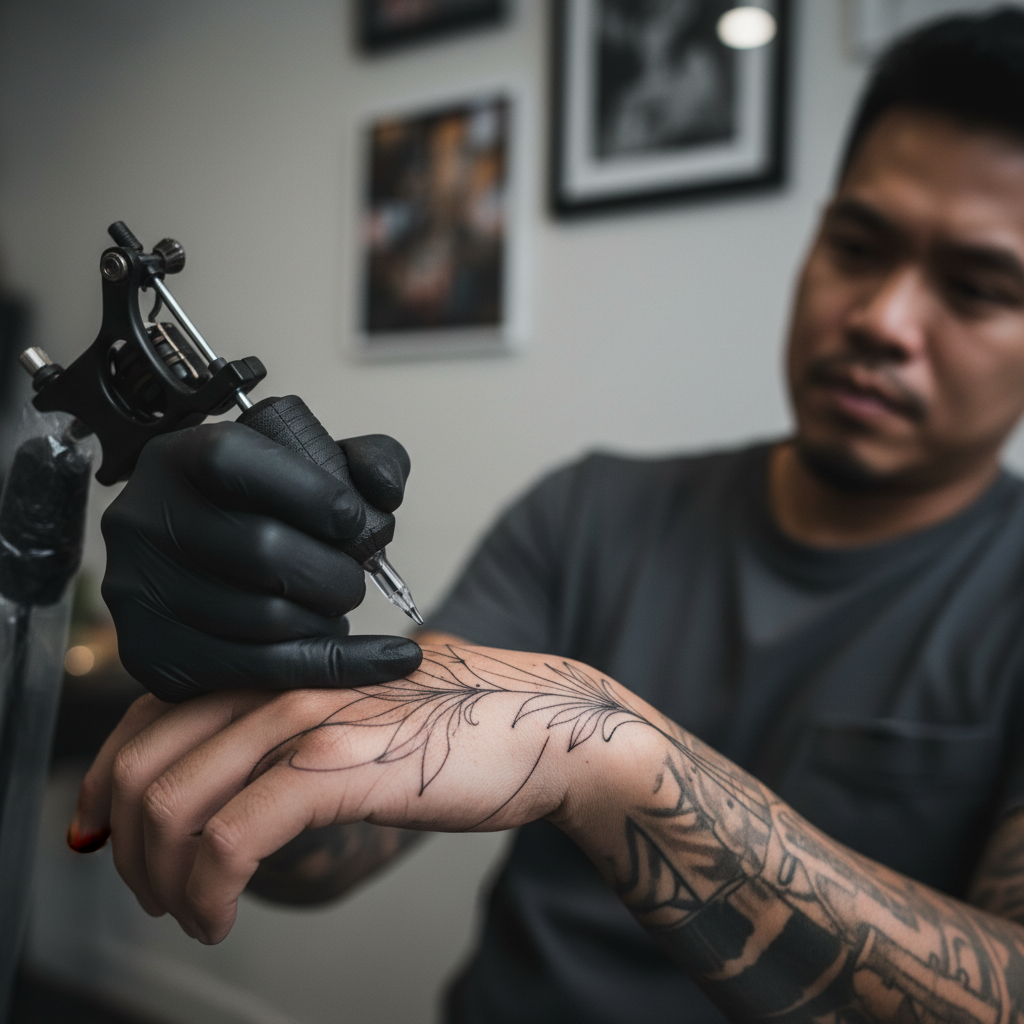
A simple single-line script word or tiny symbol on the wrist runs $80 to $180 at a mid-tier shop in the United States, Western Europe, or Australia. That is almost always a flat shop minimum rather than a measured hourly rate, because the actual tattooing takes ten to twenty minutes but the appointment block, setup, stencil, and aftercare briefing eat closer to an hour. A small fine-line design with two or three elements, like a wave with a sun or a constellation of stars, lands at $150 to $300. A more involved wrist piece, such as a small floral cuff that wraps the side of the wrist or a half-bracelet of geometric linework, costs $300 to $600 and usually takes a single two-hour session.
Bigger statement work pushes higher. A full wrist cuff that wraps the entire circumference, blackwork bands, or a small Japanese motif with shading and color sits in the $500 to $1,200 range across one or two sessions. Geographic differences are significant. Bali, Bangkok, Mexico City, and Lisbon often charge 30% to 50% less than New York, London, or Sydney for the same design at comparable skill levels. For deeper city-by-city comparisons, see our piece on tattoo prices in Bali and the broader tattoo pricing explained breakdown.
Why the shop minimum dominates small wrist work
Almost every reputable shop charges a minimum that covers a single needle's worth of work, regardless of how tiny the design is. In 2026 that minimum runs $80 to $150 in the US, £80 to £150 in the UK, and 80 to 150 EUR across most of Western Europe. The minimum exists because the artist still spends time on consultation, stencil work, sterilizing the station, opening fresh single-use cartridges and ink caps, and walking you through aftercare. The actual ink time on a half-inch wrist symbol can be eight minutes. The cost of being a licensed shop never falls below that minimum, so the price never does either. If you want the structural details on this, the tattoo minimum charge guide covers it in depth.
This is why bundling a wrist tattoo with another small piece on the same visit is often the better economic move. Two single-line wrist designs in one sitting still costs one minimum plus a small hourly add. A second visit for the second piece doubles the minimum. If you are getting a matching wrist tattoo with a friend or partner, ask the shop whether they price two appointments back to back as one minimum each or whether they offer a combined rate.
Hourly versus flat-rate pricing on the wrist
Most wrist work that exceeds the minimum gets quoted as a flat rate because the artist already knows roughly how long it will take. Fine-line script of a five to seven word phrase: 30 to 60 minutes, quoted flat at $200 to $400. A small ornamental design: 60 to 90 minutes, $250 to $500. The flat rate protects you from artist pace variation and protects the artist from undercharging on detailed work that took longer than planned.
For larger or custom wrist work, hourly rates kick in. Standard hourly rates in 2026 sit at $150 to $250 for mid-tier artists, $250 to $400 for established artists at reputable shops, and $400 to $800 for in-demand specialists in major cities. A two-hour wrist cuff at $250 per hour comes in at $500 plus tip. The hourly versus flat-rate breakdown goes through which model favors the client in which situations.
Design factors that move the number
The wrist is small, so the usual size lever has less range than it does on a forearm or thigh. The factors that actually shift wrist pricing:
- Color versus black ink: adding color, even a small accent, usually adds $40 to $100 to a small piece because the artist swaps cartridges, mixes shades, and works in multiple passes.
- Detail density: micro-realism portraits or hyper-detailed mandalas demand a 1-round-liner needle and slow pacing, often doubling the time on the same physical area.
- Placement on the wrist: the inner wrist heals faster and takes ink better than the side or top, but the top of the wrist has more bone proximity and slower work, which can add 15 to 30 minutes.
- Custom design fee: if you want the artist to design from scratch rather than tattoo a stock flash piece, expect a $50 to $200 design fee, sometimes credited toward the final price.
- Numeral or text precision: dates, coordinates, and Roman numerals require near-perfect spacing and almost always run as flat rates at the higher end of the small-piece range.
If you are weighing color against black-and-grey, our piece on color versus black-and-grey tattoo cost walks through the math at multiple sizes.
Longevity and the hidden cost of touch-ups
Wrist tattoos fade faster than tattoos on most other body parts. Hand-washing, sun exposure, wristwatches, sleeves rubbing against the ink, and the thin skin all conspire against crisp lines. Fine-line work on the inner wrist often needs a touch-up within 18 to 36 months. White ink and pastel color on the wrist almost always need a touch-up inside 24 months. Bold black linework holds the longest, often six to ten years before needing a refresh.
A touch-up is usually $60 to $150, sometimes free within the first three months at the artist's discretion if the original ink dropped during healing. Budget for one touch-up per piece across the first three years. Our full tattoo touch-up cost guide covers what is included for free and what gets billed.
Tipping, deposits, and the full out-the-door number
Tipping a tattoo artist in the US is standard at 15% to 25% of the total. A $200 wrist tattoo at 20% tip lands at $240 out the door. Deposits are also standard. Most shops require a $50 to $150 non-refundable deposit at booking, applied to the final price. Skip the appointment and you forfeit the deposit. Reschedule with 48 hours notice and most shops will move the deposit forward once. So a $200 flat-rate wrist tattoo really costs around $240 to $250 once you account for tip, assuming the deposit credits cleanly.
Frequently asked
What is a realistic budget for my first wrist tattoo? Plan for $200 to $300 if you want a small, well-executed piece at a reputable shop, including tip. Going under $150 forces you toward shops with rock-bottom minimums, and quality on visible placements like the wrist is not where you want to economize.
Are wrist tattoos cheaper than forearm tattoos? For comparable designs, yes, but only slightly, because the minimum dominates the small end of both placements. For larger pieces the wrist is cheaper purely because there is less surface area to cover. See our forearm tattoo cost guide for direct comparison.
Why did the artist quote $200 for a one-inch design? That is the shop minimum. It covers chair time, setup, sterilization, and the artist's expertise, not just the ink hitting your skin. Every reputable shop has one and it does not scale down for tiny pieces.
Do wrist tattoos always need touch-ups? Most do within the first three years, especially fine-line and any pieces with color. Bold blackwork can hold a decade. Wearing sunscreen daily on the wrist and not sleeping with the inked side under a tight watchband are the biggest levers on longevity.
Is it cheaper to get matching wrist tattoos with someone in the same appointment? Sometimes. Many shops will charge two minimums but stack the appointments back to back to save setup time, which the artist may pass on as a small discount. Ask before booking.
Should I get the cheapest wrist tattoo I can find? No. Wrist tattoos are visible every time you look at your own arm and every time you shake someone's hand. Pay the mid-tier rate for an artist with a clean fine-line or blackwork portfolio. A $90 tattoo that needs covering up at 24 months costs more than a $250 tattoo that holds for a decade.