cost guides
Trash Polka Tattoo Cost: Prices, Sessions, and What Drives Totals
Trash polka tattoos run $200–$300 per hour and 20–60 hours total. Here's how the red-and-black realism style prices out session by session.

Trash polka is one of the most expensive tattoo styles per square inch, and the reason has almost nothing to do with hype. The style combines photorealistic imagery, dense black graphic elements, red brushstroke work, and hand-drawn typography inside a single composition, which means the artist is executing three or four disciplines at once. Most collectors budget for a multi-session commitment before they even sit down for the consult. This guide breaks the pricing apart so you can walk into a shop knowing exactly what the number on the deposit form is buying.
What trash polka actually costs per hour
Hourly rates for trash polka land between $200 and $300 in the United States for a mid-tier custom artist, and $350 to $500 for the small pool of specialists who trained under or alongside the Buena Vista Tattoo Club in Würzburg. European rates trend a bit lower at €150 to €250 per hour outside the specialist tier, and Southeast Asian shops running trash polka work sit around $100 to $180 per hour with strong portfolios in Bangkok, Bali, and Ho Chi Minh City. The rate is higher than a plain blackwork or fine-line session because the artist is drafting the collage layout on your skin the day of the session, not tracing a stencil straight through.
Flat-rate pricing shows up more often for full compositions than for smaller pieces. A defined-scope forearm panel might be quoted at $1,400 to $2,200 as a flat rate, which typically works out to roughly the artist's hourly figure multiplied by the honest estimate. If you get a flat rate that looks cheaper than the hourly math, ask whether it covers touch-ups and whether it assumes a single sitting.
Deposits for trash polka run higher than the shop average because the design work is heavier. Expect $200 to $500 on the low end and up to $1,000 for a large custom commission with a specialist. The tattoo deposit guide covers how deposits get applied against the final total and when they are forfeited.
Session counts by size
Trash polka pieces are almost always executed across multiple sittings. The reasons are practical: the black saturation layers need to settle before red is glazed on top, and the collage layout evolves as the artist sees how earlier elements read on the healed skin.
- Palm-sized single element (5–7 inches): 1 session, 3–5 hours, $600–$1,500
- Forearm panel (half of the inner or outer forearm): 2 sessions, 8–12 hours total, $1,600–$3,600
- Half sleeve with full trash polka collage: 3–4 sessions, 18–25 hours, $3,600–$7,500
- Full sleeve, shoulder to wrist: 5–7 sessions, 30–45 hours, $6,000–$13,500
- Back piece with realism plus lettering plus red accents: 6–10 sessions, 40–60 hours, $8,000–$18,000
The wide ranges are not padding. Whether a red glaze needs one pass or two, whether the client's skin holds fine typography on the first pass, and whether the composition is portrait-heavy or type-heavy all move the total. Anyone quoting a fixed 20-hour full sleeve without a design draft in hand is guessing.
What drives the total up or down
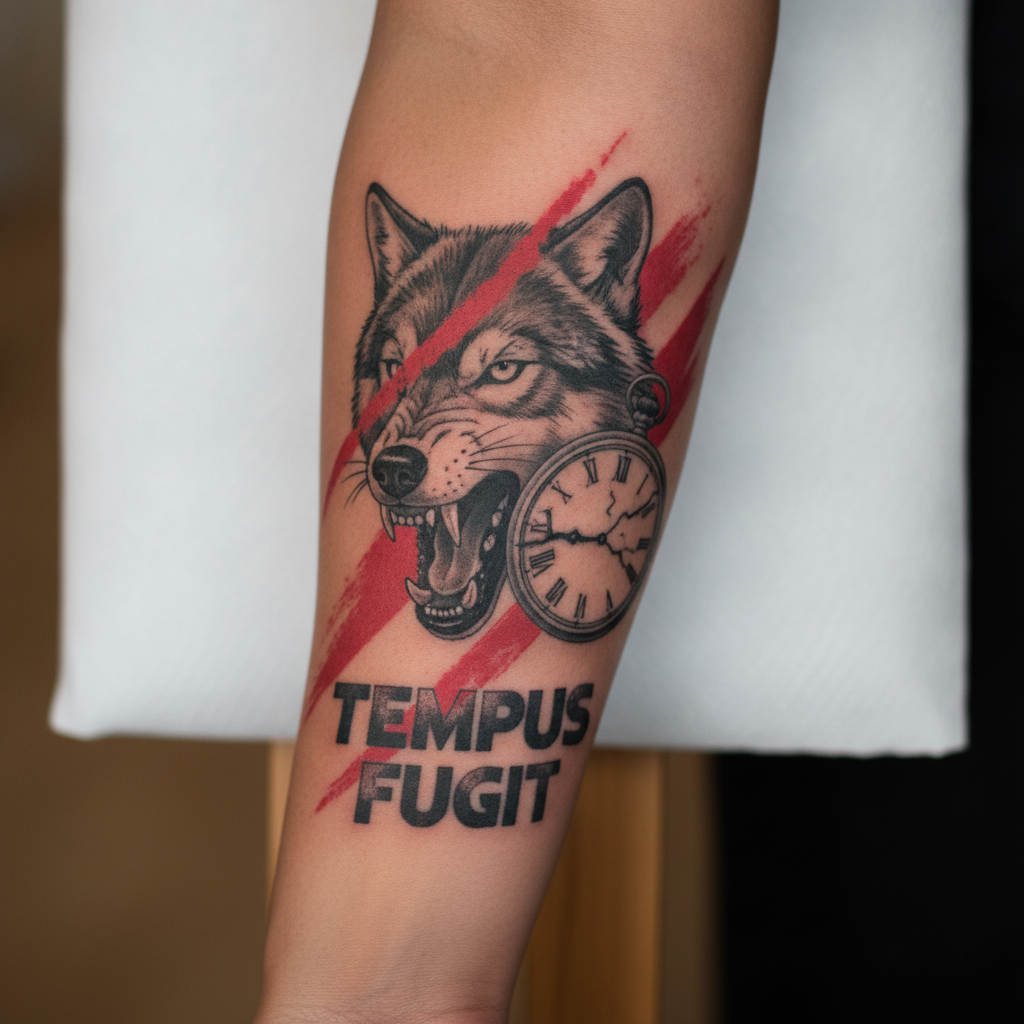
Artist experience is the largest single input. A Buena Vista-adjacent specialist commands a premium because the visual vocabulary is proprietary in a real sense: Simone Pfaff and Volko Merschky trademarked the term in Germany, and the collage grammar is taught inside a lineage rather than reverse-engineered from Instagram. Booking with a lineage-trained artist can push the hourly rate 40 to 80 percent above your city's standard custom rate. Artist experience level is a useful frame here for setting expectations before you email portfolios.
Composition density is the second driver. Trash polka's signature red brushstrokes look loose but require careful ink loading and pass management to avoid muddiness. A piece with heavy realism portraits, small typography, and multiple red overlays takes noticeably longer than a piece built around a single centered subject with sparse red accents. Skin placement matters too: ribs, sternum, and inner bicep add hours because the artist works slower on high-pain, high-movement zones to keep line quality clean.
Body scale is more forgiving than in fine-line work. Because trash polka pieces already lean large, going from a half sleeve to a full sleeve does not double the price. The prep work, the consultation, and the initial layout are already spent. Adding the shoulder cap and wrist wrap usually adds 40 to 60 percent, not 100 percent, to the half-sleeve figure.
Session pacing and cash flow
Trash polka is usually paid in installments across sessions rather than in one lump. Each session at the chair is billed by the hour or against a flat quote for that sitting, and the deposit is applied to the final one. Plan the money the same way. If you are budgeting $8,000 for a back piece, you will likely spend $500 on the deposit up front, then $1,200 to $1,600 per session across five to six visits over four to nine months. Most artists want six to eight weeks of healing between sittings for saturated color-heavy work.
Convention pricing is worth flagging. Trash polka specialists sometimes tour and take guest spots at large conventions, and their per-hour rate at those events can be 20 to 40 percent above their shop rate. If you fly for a guest spot, add flights and lodging to the real cost. On the flip side, a home-shop residency deal for multi-session commitments occasionally comes with a modest rate discount for booking three or more sessions up front. Ask.
Touch-ups on trash polka can be significant because the red brushstrokes are the first element to fade, and clean typography on skin over joints will need refresh within a year or two. Some artists include one free touch-up within 12 months, others charge $150 to $400 depending on complexity. The tattoo touch-up cost breakdown walks through the honest math.
Where the money actually goes
The hourly rate does more than pay the artist's time at the machine. A specialist spends five to fifteen hours of unbilled design work on a mid-sized commission: sourcing reference photos, arranging the collage in Procreate, mocking up two or three variants, and reworking the stencil on the day of the session. High-end trash polka artists also invest in wider ink stocks because the red saturations are proprietary mixes, and quality red pigment is more expensive per bottle than standard black.
Studio overhead in cities like New York, London, and Berlin is meaningful. A specialist working out of a boutique studio pays $2,000 to $6,000 per month in booth rent, which gets built into the hourly rate before the artist takes home a wage. This is one reason trash polka in a small European city or a specialist visiting Bangkok can undercut the same skill set in Manhattan by 30 to 50 percent without any drop in portfolio quality. Travel becomes part of the pricing model if you are willing to plan around it.
Frequently asked
Is trash polka more expensive than realism? Slightly, yes. Pure black-and-grey realism from an equivalent artist runs $150 to $250 per hour in the same city. Trash polka adds the red pigment layer, the typography discipline, and the collage layout work, which typically pushes the rate up $50 to $100 per hour and adds one to two total sessions for a comparable size.
Do I need to see a stencil before the first session? Trash polka is almost never fully stenciled. The artist places anchor elements with a light stencil, then draws freehand for the brushstrokes, splatters, and secondary type. If a shop insists on a fully locked stencil for a trash polka commission, that is a signal the artist is doing trash polka aesthetics rather than the actual freehand method.
Can I get a small trash polka piece under $500? Rarely. The style depends on collage layering, which needs surface area to breathe. Anything under 4 inches usually reads as generic red-and-black graphic work rather than trash polka. If your budget is $500, consider a small blackwork piece with a single red accent, or save toward a $1,500 forearm start.
How long between sessions? Six to eight weeks is standard for trash polka because of the red glaze layers. Some artists push to ten weeks for back pieces to let deep saturation settle. Booking your next sitting at the end of the current session is smart because specialists book out three to six months.
Does tipping still apply on multi-session work? Yes. Tip 15 to 20 percent per session, calculated on the amount paid at that sitting, not on the total commission. Cash is preferred. The tipping guide covers etiquette across price bands.
Will a cheaper local artist copy the style well? Some can, most cannot. Ask for at least three healed trash polka pieces in the portfolio, not fresh-off-the-machine photos. If the red brushstrokes look flat or the typography looks stiff, the artist is still learning the vocabulary. Cheaper is only a bargain when the skill matches.