style guides
New School Tattoos Style Guide: Bold Color, Cartoon Energy
New school tattoos push exaggerated cartoon subjects, heavy outlines, and saturated color into a distinct style. Here is what defines it, how it ages, and what it costs.

New school is the tattoo style that looks like a Saturday-morning cartoon crashed into a graffiti wall. It grew out of American traditional in the late 1980s and early 1990s, pulled in comic book panels, hip-hop graphics, and skate deck art, and settled into its own language of exaggerated proportions, thick black outlines, and colors that punch you in the eye from across the room. If you want a tattoo that reads clearly from six feet away and stays legible for twenty years, this is the family of designs worth understanding before you book a chair.
This guide covers what actually makes a tattoo "new school," which subjects work and which ones fight the style, session counts for small through full-sleeve pieces, longevity on different skin tones, and what you should expect to pay in 2026 across a range of artist tiers.
What defines the new school style
New school runs on four hard rules that separate it from every other color style. Outlines are thick, usually a 9 or 11 round liner at minimum, and they are never broken or fine. Colors are fully saturated flats with sharp gradient bombs of complementary color pushed into shadow areas, so a green subject will carry purple shadows and a red subject will carry teal. Compositions exaggerate scale and perspective, pulling one feature of the subject forward until it dominates the design, and the whole piece usually sits on a background of drips, drop shadows, halftone dots, or bold graphic elements that ground the subject to the skin.
The style borrows technique from American traditional but rejects its restraint. Where a traditional rose is a stylized diagram of a rose, a new school rose has a face, six-inch thorns, and a speech bubble. Where Japanese irezumi uses wind bars and cloud patterns as connective tissue, new school uses drip effects, spray-can textures, and cartoon smoke. Both styles pack a full sleeve edge to edge, but new school reads as one continuous illustration rather than a sequence of iconic subjects.
Line weight variation inside the outline is the tell that separates a real new school piece from a beginner's color cartoon. A skilled new school artist will thicken the outline on the shadow side of every form and thin it on the light side, giving the whole tattoo a chiseled, three-dimensional read even before the color goes down. Ask to see healed photos of that specific line technique before you commit to a large piece.
Subjects that work and subjects that fight the style
New school lives on characters, objects with personality, and scenes that already feel like a cartoon. Anthropomorphic animals, video game characters, food with faces, hip-hop icons, sneakers, boomboxes, graffiti letters, monsters, and pop culture mashups all land naturally. Anything that benefits from exaggerated features and bright color reads well.
Subjects that fight the style are the ones that lose their meaning when you cartoon them. Realistic portraits of family members, memorial pieces, script-heavy tributes, and delicate botanical work all belong in other styles. If you want a portrait of your grandmother, book a realism artist. If you want your grandmother reimagined as a cartoon character riding a skateboard, new school is exactly right.
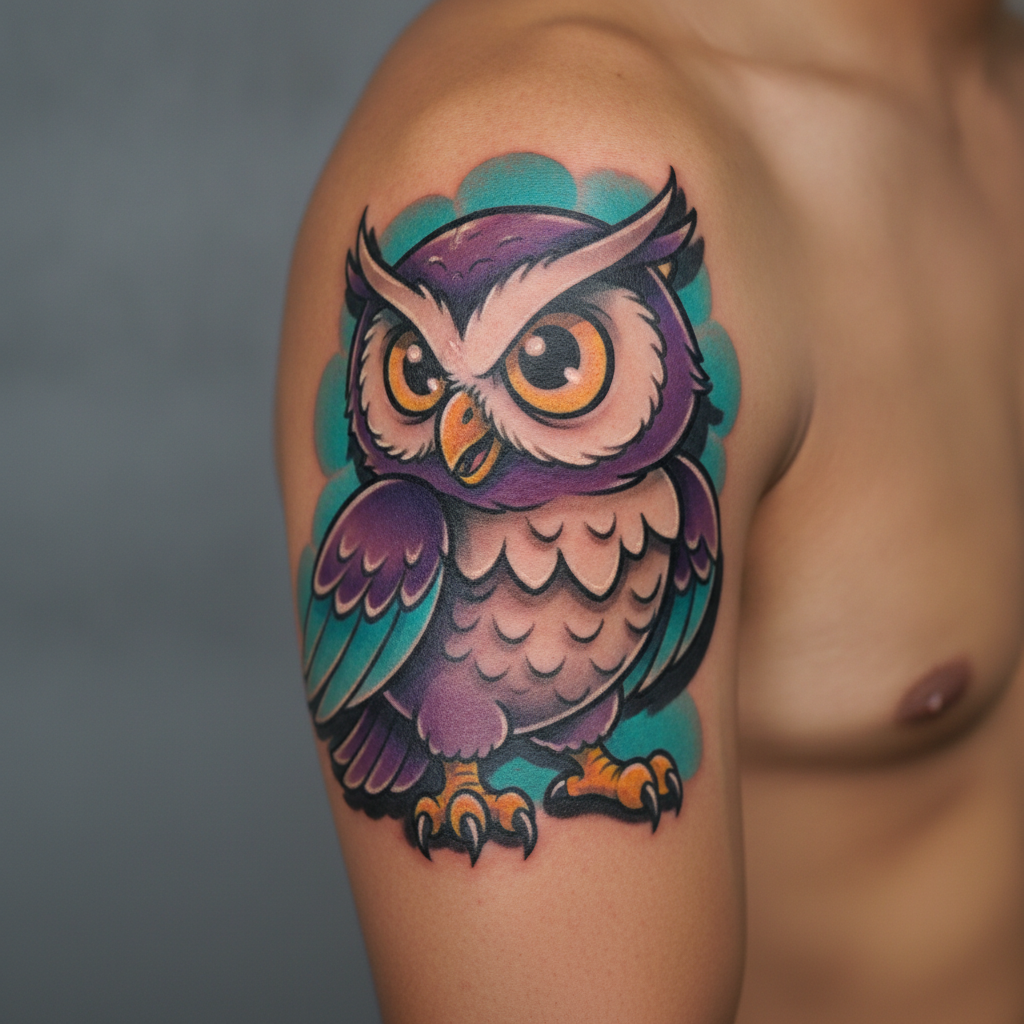
The best new school pieces commit fully to the style. Half-cartoon and half-realistic hybrids almost always look confused six months into healing, because the softer realistic elements fade at a different rate than the hard-outlined cartoon elements next to them. Pick a side.
Session counts, sizes, and how long each piece takes
A palm-sized single character with a simple background runs three to five hours in one sitting. Add a second character, a full graphic background, or a wraparound element and you are looking at two sessions of four to six hours each. This is because color packing at new school saturation levels is slow work. The artist has to lay down flats, blend gradient bombs, add highlights, and re-outline any areas the color pushed into.
Half-sleeve pieces average three to four sessions of four to five hours. Full sleeves average six to eight sessions across four to eight months, spaced two to four weeks apart to let each section heal before the next block. Back pieces and full chest panels can push into ten or twelve sessions. Rushing a color-heavy style is where blowouts and patchy saturation happen, so a good new school artist will actively slow you down if you try to book back-to-back sessions.
- Small standalone character (3–4 inches): 3–5 hours, one session
- Forearm half-sleeve with background: 12–20 hours across 3–4 sessions
- Full sleeve: 25–45 hours across 6–8 sessions
- Back piece: 40–70 hours across 8–12 sessions
How new school ages on different skin tones
Saturated color is the hardest ink family to keep looking sharp over a decade, and new school pushes color harder than any other mainstream style. Reds, yellows, and light greens fade fastest, especially on skin that gets regular sun exposure. Blues, purples, and blacks hold longest. On lighter skin, expect a good new school piece to need a color touch-up around year seven to ten. On medium and darker skin tones, the underlying warmth of the skin shifts how bright yellows and oranges read from day one, and touch-ups may be needed earlier at year five to seven to keep contrast crisp.
Sun protection matters more here than in any other style. Once your tattoo is fully healed, a broad-spectrum mineral sunscreen at SPF 30 or higher applied to the tattooed area every time you are outdoors will extend the sharp color read by years. Skipping this step is the single fastest way to turn a $3,000 sleeve into a washed-out blur. Read the full long-term sunscreen and care guide for specific product picks and application frequency.
Black outlines are the skeleton of a new school tattoo, and they will always survive longer than the color inside them. This means an aged new school piece can be touched up cheaply because the artist is only refreshing the color inside existing lines, not rebuilding the design.
What new school costs in 2026
Artist tier drives new school pricing more than size, because the color technique separates strong artists from weak ones so visibly. Expect three tiers in most major cities.
- Junior artists (0–3 years, guest spots, apprenticeships wrapping up): $120–$180 per hour
- Established artists (4–10 years, resident at a reputable shop): $180–$280 per hour
- Named artists (guest circuit, published in tattoo magazines, waiting list of 4+ months): $300–$600 per hour or flat rates starting at $2,500 for a session
A well-executed new school half-sleeve from an established artist lands between $2,500 and $4,500 all in. A full sleeve from the same tier runs $6,000 to $12,000. If the artist charges flat per session rather than hourly, expect $1,200 to $2,500 per full-day sitting. Deposits usually run 20 to 30 percent of the estimated total and roll into the final session cost. See the full pricing breakdown if you are trying to budget a larger piece.
Cheap new school is almost always a mistake. The style has no hiding places, and a $500 sleeve panel from a weekend artist will look muddy inside two years. Save until you can book the tier of artist whose color work you have seen healed and photographed at the one-year mark.
Frequently asked
Is new school the same as neo-traditional? No. Neo-traditional keeps American traditional's iconography and reading order but expands the color palette and adds shading depth. New school throws the iconography out entirely and replaces it with cartoon-scale exaggeration, graffiti and comic book influences, and much heavier gradient work. A neo-traditional rose still looks like a tattoo of a rose. A new school rose looks like a cartoon character that happens to be shaped like a rose.
Does new school hurt more than other color styles? Duration hurts more than technique. Because saturation levels are high, sessions run long, and the second and third passes over the same skin during color packing are where most clients start to feel the burn. Ribs, sternum, inner biceps, and the back of the knee are the hardest placements for a color-heavy style because you cannot easily break long sessions on these spots.
How often do new school tattoos need touch-ups? Plan for a first color refresh at year seven to ten on lighter skin, or year five to seven on medium and darker skin. Outlines usually hold cleanly for fifteen-plus years without intervention. A touch-up on an existing piece runs 30 to 50 percent of the original hourly rate for a fraction of the time, so a $3,000 sleeve might touch up for $400 to $700.
Can new school be done in black and grey? It can, and the results are striking, but you lose most of what makes the style distinct. Without saturated color, new school compositions read as heavily outlined cartoons, which puts them closer to illustrative or blackwork territory. Most artists who specialize in new school will steer you toward at least a limited color palette rather than pure black and grey.
Is new school still a current style or is it dated? The style peaked commercially in the late 1990s and early 2000s, softened for about a decade, and has come back strong since 2022 as younger artists have blended it with graffiti and street-art influences. A well-executed new school piece from a modern artist does not read as dated. It reads as a specific, deliberate aesthetic choice. A poorly executed piece from any era reads as dated regardless of style.
Should new school be my first tattoo? It can be, if you commit to the size and budget the style needs. The most common first-tattoo mistake in this category is booking a tiny 2-inch cartoon character that will not carry the heavy outline weight or color saturation the style demands. If your first tattoo budget is under $500, pick a different style or wait until you can afford a piece large enough to hold the technique.