style guides
Biomechanical Tattoos Style Guide: Cost, Healing, Artists
Biomechanical tattoos fuse flesh and machinery into hyperreal sleeves. Here is what they cost, how they heal, and how to find an artist who can actually render chrome on skin.
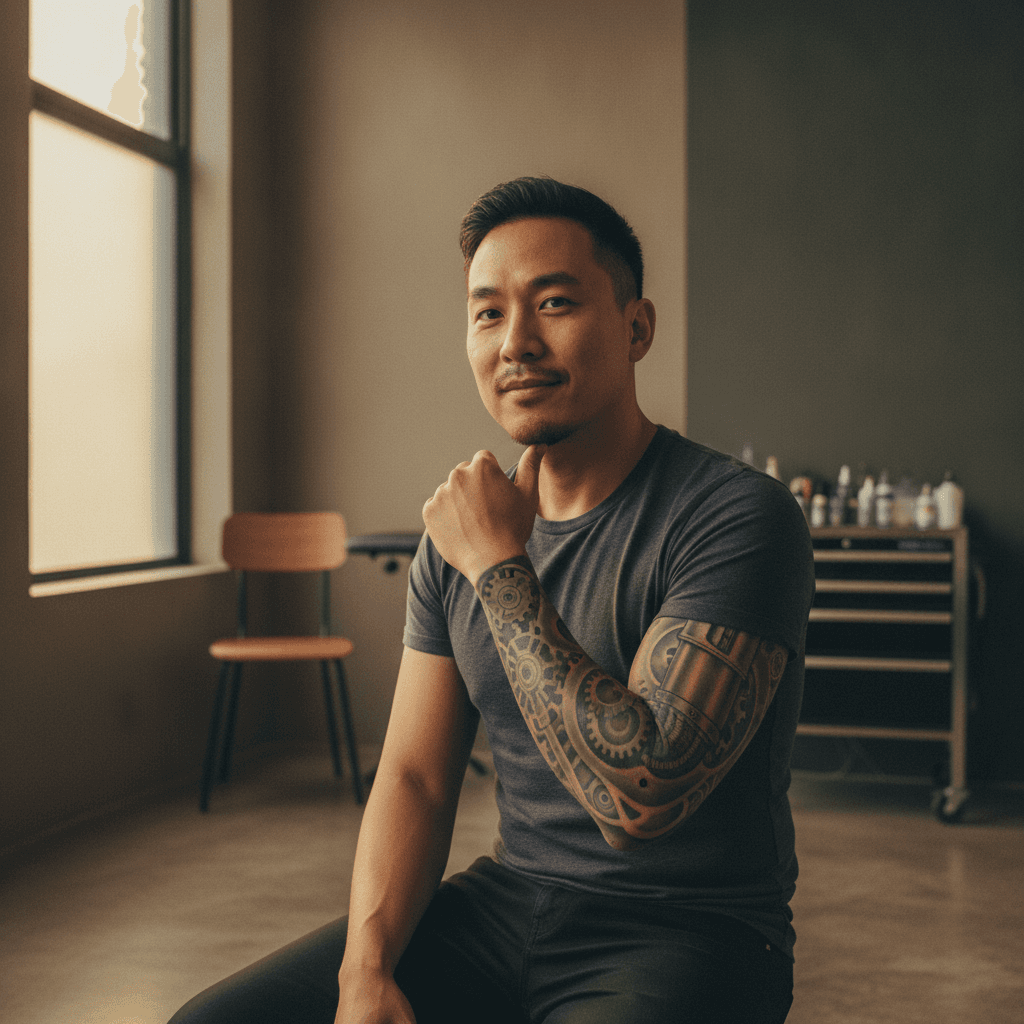
Biomechanical tattoos are the most technically demanding work in the realism family, and they punish anything less than a specialist. The style fuses anatomical structures with machinery, gears, hydraulic pistons, fiber-optic cables, exposed pistons, and chrome plating, all rendered to look like they live under the skin. Done well, the tattoo reads as an X-ray of a cyborg. Done poorly, it reads as a flat sticker. This guide covers where the style came from, what it actually costs in 2026, how the healing behaves on dense black-and-grey work, and how to vet an artist before you book a deposit.
Where biomechanical tattoos came from
The style traces directly to H.R. Giger, the Swiss painter behind the Alien franchise creature design, whose 1970s biomechanical paintings turned organic and mechanical forms into a single integrated surface. Tattoo artists Aaron Cain, Guy Aitchison, and Roman Abrego carried that visual language onto skin through the 1990s and codified the conventions still used today. The early work was almost exclusively black-and-grey, because Giger's source material was monochrome and because the illusion of metal sitting under torn flesh depends on smooth tonal gradients that color tattooing cannot fake.
A second wave through the 2010s added biomechanical hybrids with steampunk brass, organic biomech (more bone, tendon, and muscle than machinery), and full color biomech leaning into cyberpunk neon. The black-and-grey core remains the dominant variant because it ages the best and because the trompe-l'oeil effect of "machinery under the skin" only works convincingly in greyscale. If you see a biomech piece that looks photographic, it is almost always realism work built from a custom reference collage, not a flash design pulled off a wall.
What biomechanical work actually requires from an artist
This is not a style you book with a generalist. Biomech depends on three skills layered on top of each other: anatomical drawing (so the machinery follows the actual muscle and bone underneath), photorealism technique (smooth black-and-grey gradients with no banding), and compositional sense for flow on a curved body part. An artist who is excellent at fine-line script will not produce a clean biomech sleeve. You want someone whose portfolio shows at least 15 to 20 completed biomechanical pieces, not just realism in general.
The needle work is also specific. Most biomech specialists use a combination of magnum shaders for the wide tonal fields and tight liners (typically 3RL or 5RL) for cable and bolt detail. Sessions tend to run long, four to six hours, because stopping mid-gradient creates visible seams that show up months later when the ink settles.
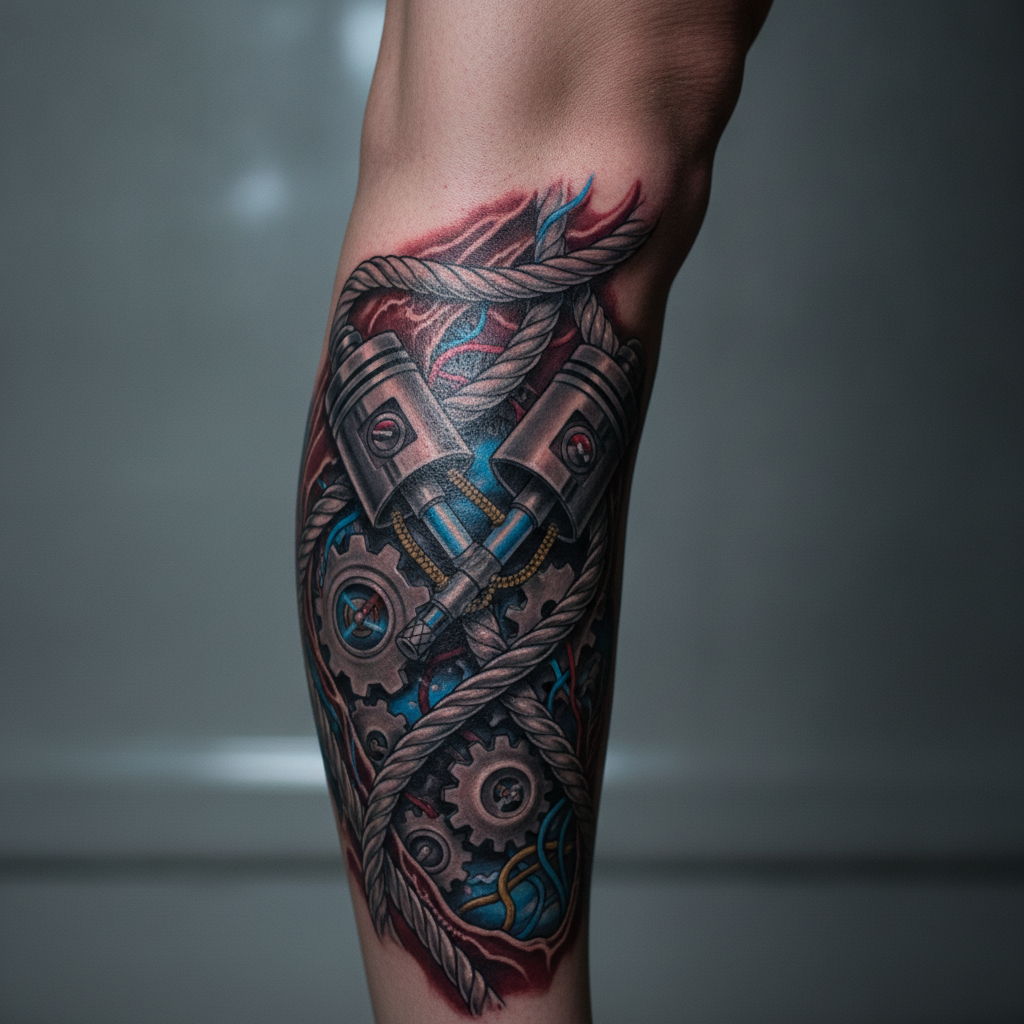
Cost and session counts
Biomechanical work prices at the top of the realism market because of the artist skill required and the size of the pieces. A small standalone biomech panel, roughly the size of a deck of cards, runs $400 to $800 in most US cities. A half sleeve typically lands between $2,500 and $5,000 across three to five sessions. A full sleeve in this style is rarely under $6,000 and frequently lands at $8,000 to $12,000 across six to ten sessions over six to twelve months. For deeper city-by-city numbers see our tattoo sleeve cost breakdown.
Hourly rates from recognized biomech specialists sit at $200 to $400 per hour in the US, $180 to $300 in Western Europe, and $100 to $200 in Bangkok, Bali, and Manila for international-tier artists. Most specialists charge a flat per-session rate (commonly $1,200 to $2,500 for a six-hour session) rather than strict hourly billing, because the work cannot be rushed and they prefer to scope by panel rather than by clock. Deposits are typically $300 to $600 and are deducted from the final session. Pricing mechanics in general are covered in our hourly vs flat-rate tattoo pricing guide.
Common cost levers:
- Body part: ribs, sternum, and back of the knee cost more per square inch than forearm or calf, because the artist works slower on painful and curved areas
- Detail density: a clean panel of three gears costs less than a packed cyborg scene with twenty interlocking components
- Cover-up status: biomech is one of the best cover-up styles because dense black-and-grey hides old ink, but cover-ups add 30 to 50% to the price
How biomechanical tattoos heal
Biomech is dense, saturated, large-format work, which means the healing is heavier than fine-line or American traditional. Expect the first 24 hours to weep plasma and ink more than a smaller piece, sometimes for 36 to 48 hours on a full panel. The full healing window runs 4 to 6 weeks for the surface and up to 4 months for the deeper dermis to fully settle. The smooth gradient work shows healing artifacts more obviously than line work, which is why touch-ups at the 8 to 12 week mark are common and usually free with reputable artists.
A few specifics that come up with this style:
- Black-and-grey saturation can look patchy at week two as scabs lift, then return to full smoothness by week four. Do not panic.
- Large panels on the inner arm and ribs are more prone to blowout because the skin is thinner. Pick an artist with documented experience there.
- Sun exposure dulls the chrome illusion faster than it dulls solid black work, because the optical effect depends on tonal contrast. Daily SPF 50 is non-negotiable.
Full session aftercare follows the same protocol as any large realism piece. Detailed week-by-week guidance is in our tattoo healing timeline.
Longevity, skin tone, and aging
Biomech work ages well on lighter skin tones in the cool grey range because the contrast does not depend on color saturation. On medium and darker Fitzpatrick IV to VI skin, the artist needs to push contrast harder during the initial pass, because finished black-and-grey reads softer through warmer skin undertones. A specialist will adapt by using denser black anchors and skipping the lightest grey washes, which would otherwise disappear within two years.
Across all skin tones, the chrome and metallic illusion stays convincing for roughly 8 to 12 years before the lightest greys start to soften enough that a touch-up becomes worth scheduling. Compared to fine-line, which often needs touch-ups at the 3 to 5 year mark, biomech is one of the longest-lived styles in the realism family.
How to pick the right artist
The shortlist process is the same regardless of city. Look at 30 to 50 completed pieces on Instagram, ignore in-progress photos and focus on healed work shot at least 3 months after the final session. Healed photos are the only honest portfolio. Ask the artist for two healed references when you book a consultation. If they cannot produce any, that is the signal to walk.
A few practical filters:
- Specialist studios will have a 6 to 12 month booking wait. That is normal, not a red flag.
- Custom design is mandatory. Anyone offering flash biomech is not doing the style correctly.
- The artist should ask for reference photos of your own body part before drawing, so the composition follows your actual anatomy.
Frequently asked
Does biomechanical work translate to color? Yes but rarely well. Color biomech tends to look like science fiction concept art rather than skin-embedded machinery, because color flattens the trompe-l'oeil effect. Most specialists will gently steer you back to black-and-grey or suggest a single accent color (red hydraulic fluid is the most common) instead of a fully colored piece.
Is biomech more painful than other styles? Yes, somewhat. Long sessions of dense shading on curved body parts mean more total cumulative pain than a shorter line-work piece of the same size. Pieces on the ribs, sternum, and back of the knee are notably harder to sit through. Expect to break a six-hour session into two three-hour blocks with a meal in between.
Can biomechanical work cover an old tattoo? It is one of the best cover-up styles because the dense black-and-grey saturation hides old ink effectively. A skilled artist can integrate an old piece into the machinery composition rather than fully obscuring it, which usually produces a cleaner result. Cover-up biomech typically requires one extra session compared to a fresh piece of the same size.
How do I prepare for a long biomechanical session? Eat a real meal within two hours of the start time, hydrate aggressively the day before, sleep eight hours the night before, and skip alcohol for 48 hours pre-session. Bring snacks, headphones, and something with a screen for the parts of the session where you cannot move. Most specialists provide regular 10 minute breaks every 90 minutes.
Will the artist let me see the design before the session? Reputable biomech specialists send the design 24 to 48 hours before the session for one round of feedback. Major changes after that point are charged separately because the design time is significant. Some artists prefer to design the day of the session in front of you, which is also legitimate and how Aaron Cain has worked for decades.
Is biomech a good first tattoo? No. A first tattoo should be smaller and shorter to build a sense of how your body handles the work. A small biomech panel as a second or third tattoo is reasonable. Going straight into a full sleeve as a first tattoo is a real way to end up regretting either the placement or the artist choice.