cost guides
Custom vs Flash Tattoo Cost: What You Actually Pay
Custom tattoos usually cost 40 to 100 percent more than flash. Here is the real breakdown of what you pay for and why.
The gap between a custom tattoo and a flash piece is not a small line item. On the same body part, with the same artist, at the same shop, a custom design will usually run 40 to 100 percent more than a flash pull from the artist's sheet. That difference is not markup for the sake of it. It pays for hours of drawing, revision, and design ownership that never touch the machine.
This guide breaks down the real pricing math on both sides, what the design fee actually covers, and when flash is the smarter buy. Prices below are USD, drawn from mid-tier US and Western European shops in 2026. Adjust down 30 to 50 percent for Southeast Asia and Latin America, and up 40 to 80 percent for New York, LA, London, or resident artists at destination shops.
What flash tattoos actually cost
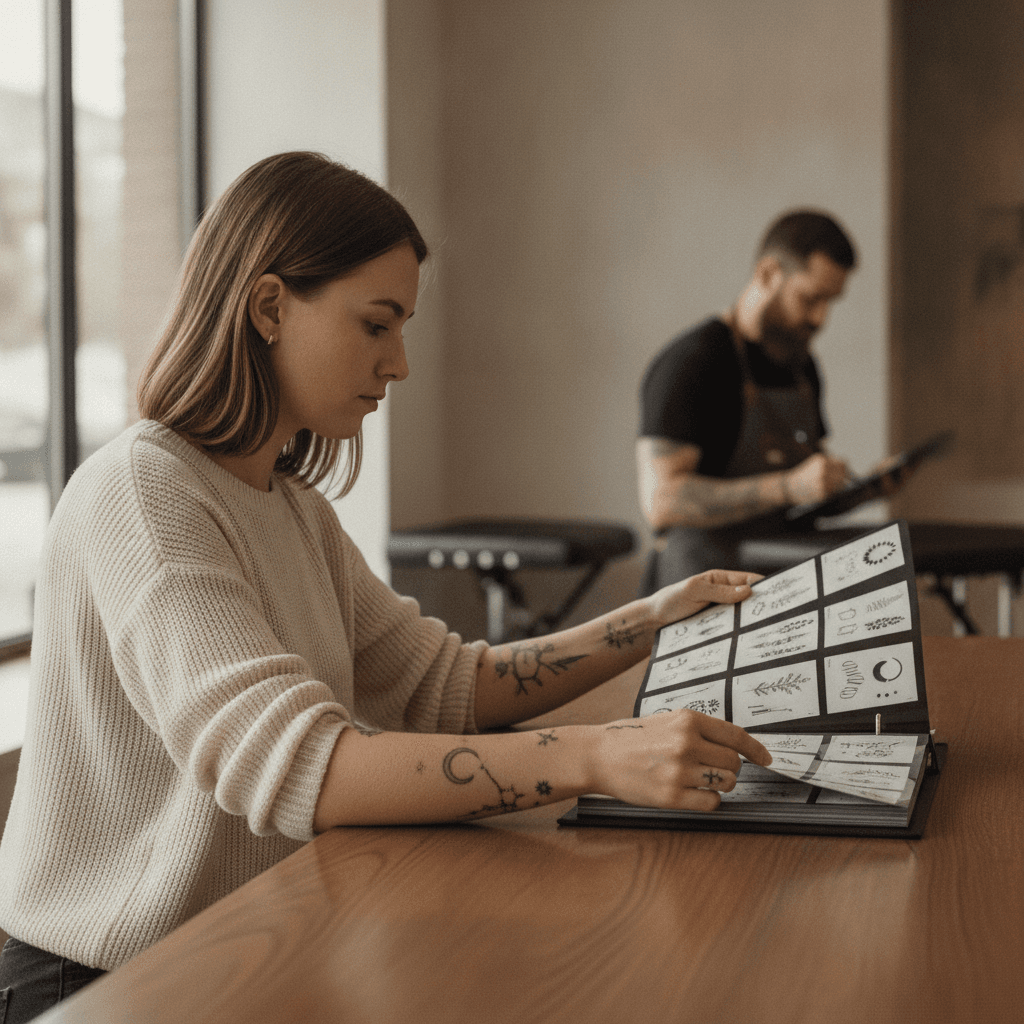
Flash refers to pre-drawn designs an artist has already created and is willing to tattoo, often multiple times. Old-school flash lived on wall sheets in street shops. Modern flash lives on Instagram grids, private client apps, and shop binders. The design work is done. You pick, you book, you sit.
Small flash pieces (under 3 inches, single color or black) usually land in a flat $80 to $200 range at street shops and $150 to $350 at higher-tier private studios. Medium flash (3 to 6 inches, more detail) runs $200 to $500 flat, or the shop's minimum plus one hour of work. Because the artist is not designing anything new, they price for chair time and consumables only. This is why flash days, where a shop clears its calendar to tattoo a curated sheet at fixed prices, have become the go-to for anyone with a $150 budget who wants a good piece from a good artist.
Flash also removes deposit friction. Many artists take flash bookings with a smaller deposit ($50 to $100) or none at all, since there is no design labor to recover if you cancel. Read the tattoo deposit guide for how deposits work across shop types.
What custom tattoos actually cost
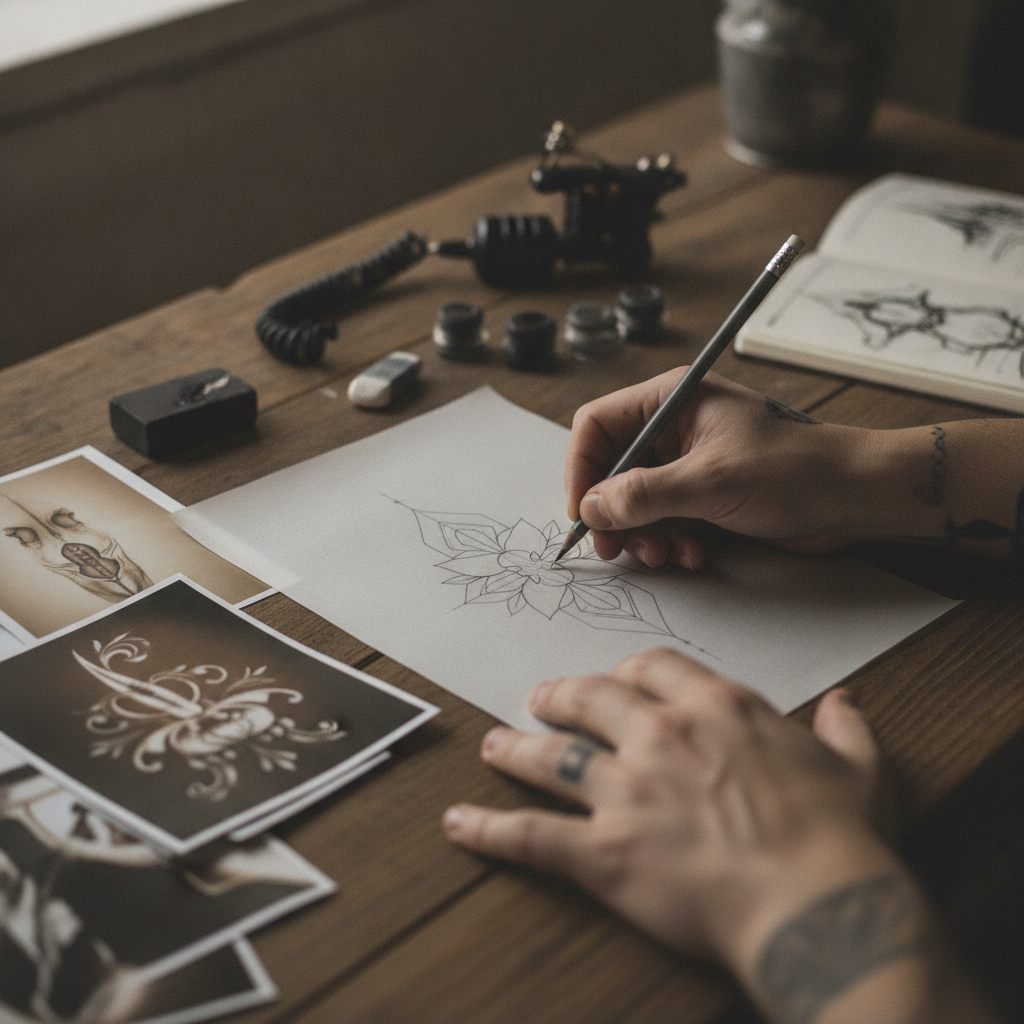
Custom means the artist draws the piece for you, based on your reference, brief, or conversation. That labor is the price driver, and it shows up in three places.
First, the design fee itself. Some artists roll it into the tattoo price. Others charge $50 to $250 separately, non-refundable, applied against your final total if you show up. Second, the hourly rate for the tattoo session, which typically runs $150 to $300 in the US mid-market and $250 to $500 at senior artists in major cities. Third, the revision cycles. A serious custom process includes one to three rounds of edits before your appointment, which the artist bakes into either the design fee or the first hour of the sit.
A 4-hour custom forearm piece from a $200 per hour artist with a $150 design fee lands at $950 before tip. The same forearm as a flash pull from the same artist would run closer to $500 to $650 flat, because the drawing is already done and reused. That is the practical price of "make it mine." For placement-specific benchmarks, cross-reference the forearm tattoo cost breakdown and the general tattoo pricing explained guide.
Why the gap is bigger than people expect
The visible cost of a custom is the design fee. The hidden cost is time you never see. A senior artist will spend 3 to 8 hours on a custom sleeve concept before the first needle drop, including reference gathering, thumbnails, stencil-ready line art, and client revisions. At their $200 per hour rate, that is $600 to $1,600 of unbilled labor if the design fee is only $150. Studios recoup the rest by pricing custom sessions on the higher end of the hourly range or setting a higher session minimum.
Flash sidesteps all of that. The artist drew the piece once, on their schedule, and can tattoo it 5 or 50 times. Every subsequent client subsidizes the original drawing time. That is why flash pricing feels cheap next to custom, and why artists with a strong flash catalogue can run days that would be financially painful if every piece were bespoke.
There is one more line item worth naming. Custom work usually requires a longer consultation, sometimes an in-person one, sometimes a scheduled video call. That time is billable in the sense that it displaces a paid appointment. Some artists charge a consultation fee. Most fold it into the design fee.
When flash is the right call
Flash is the right buy in four scenarios. If your budget cap is under $400, flash gets you a better artist for the money than a custom would. If you want a specific artist's style but do not have a specific idea, their flash sheet is literally a curated list of their best-executing motifs. If you are getting your first or second tattoo and want to reduce decision fatigue, flash removes the design-approval loop that trips up new clients. If you want to book fast, flash days sometimes have same-week availability that custom queues cannot match.
Flash also protects you from a common custom trap: paying for a design that does not match what you pictured in your head. The artist drew what they were briefed to draw. If your brief was fuzzy, the result will be too, and the deposit is gone. Flash is what you see is what you get.
- Under $400 budget on a small to medium piece
- You love an artist's style but have no specific concept
- First or second tattoo, want to minimize revision anxiety
- Tight timeline, need a booking in the next 2 to 4 weeks
- The flash design already fits the placement you had in mind
When custom is worth the extra money
Custom earns its price tag on three types of pieces. Placement-driven work that has to flow with your anatomy: chest, ribcage, back piece, full sleeve. A flash design drawn as a rectangle rarely wraps well around a shoulder or ribcage without a custom redraw, at which point you are paying custom rates anyway. Meaning-driven work: portraits, memorials, symbolic pieces tied to your story. Flash cannot carry that weight because it was not built for you. And technically ambitious work: large-scale realism, Japanese sleeves, biomechanical compositions, cover-ups. These need bespoke composition or they will not read correctly on the body.
The other honest case for custom is that you want a piece that is yours. Flash pieces get repeated. If seeing someone else on Instagram with your exact tattoo would bother you, custom is the only path. Some artists mark flash as "one-off" and will not repeat it, which is a middle option: flash pricing, custom uniqueness. Ask before you assume.
For heavier pieces where custom is basically mandatory, see the back piece tattoo cost guide and the half-sleeve tattoo cost breakdown.
How to negotiate without insulting the artist
Do not negotiate the hourly rate. That is the artist's income and it is set by their skill and demand. What you can adjust is scope. Ask if the design can be simplified to fit a smaller session. Ask if a color piece can be executed in black and grey to save time. Ask if the piece can be split across two sessions instead of one long marathon, which sometimes reduces the total because a fresh artist works faster than a fatigued one. All of these are legitimate conversations. Asking for a discount because you saw a cheaper artist online is not.
If the design fee feels high, ask what it includes and how many revision rounds are covered. A $250 design fee that includes three revisions and a final line-art stencil is fair. A $250 fee with one round and no stencil is worth pushing back on.
Frequently asked
Is a design fee the same as a deposit? No. A deposit holds your appointment slot and is usually refundable or transferable if you cancel with enough notice. A design fee pays for drawing labor and is almost always non-refundable, since the artist has already done the work. Some shops combine them into one payment, which is fine as long as the terms are written down.
Can I bring my own design to save money? Only if you drew it yourself or own the rights. Bringing a Pinterest screenshot does not remove the custom drawing step, because the artist still has to redraw it as a tattoo-ready stencil, adjust proportions for your body, and often clean up the linework. You will still pay something close to a full design fee. What does save money is bringing a clear, single reference with a specific placement, which shortens the consultation and reduces revision rounds.
Do artists ever refuse to tattoo flash on certain body parts? Yes. Rectangular flash rarely works on ribs, spine, chest, or hips without a redraw, and many artists will decline rather than force it. That redraw becomes a custom job with custom pricing. If you love a flash design but want it in one of those spots, expect to pay closer to custom rates.
How much does a flash day tattoo usually cost? Flash day pricing is usually flat and pre-published, typically $100 to $300 per piece for small to medium designs. The artist sets the sheet and the price and does not negotiate on the day. Deposits are smaller or waived. Turnaround is fast, often same-day for walk-ins or a single booked slot.
Is custom always higher quality than flash? No. A well-executed flash piece from a senior artist beats a rushed custom from a mid-career one every time. Quality is about the artist's hand, not whether the design was bespoke. Choose the artist first, then decide custom or flash based on budget and concept.
Can I convert a flash design into a custom piece? Sometimes. If the artist owns the flash and is open to modifying it, you can pay a partial design fee to have it resized, recomposed, or adjusted for your placement. This is usually cheaper than a full custom job and gives you something closer to unique. Ask upfront so the artist can price it fairly.